Saturday, February 26, 2022

The Tree-mendous Benefits to Trees

One of the things I personally like about Facebook is that I follow a number of environmental and edtech sites. Given that, I am exposed to a lot of ideas from a lot of sources. Footpath Foundation shared this infographic created by Greenpeace. Definitely makes you understand why we have treehuggers out there--trees give us a wealth of benefits. 

Image from https://www.facebook.com/FootpathFoundation/posts/5082349455157205 created by Greenpeace.

Wednesday, February 23, 2022

Google Arts & Culture Experiments

I've been doing some investigating around Google Arts & Culture. Not surprising given it's connection to Google, there is definitely a wealth there!!

One of the really interesting parts of the Google Arts & Culture world is their Experiments, which is self-labeled as "the crossroads of art and technology, created by Artists and Creative Coders." 

Currently, there are 80 Arts & Culture experiments [though, at this writing, there are 1605 Google Experiments total on a wider scope than just the Arts & Culture Collection]. Of these, here are a few that have environmental tie-ins. You definitely could get lost here, spending a lot of time exploring each one!

🎨 Voices for Change--A Global Goals World -- A 3D virtual experience to learn about the 17 United Nations Sustainable Goals. Mixed in are 1500 voices and comments from people from 60 countries.


🎨  Pollinator Pathmaker -- Design a garden that's a pollinator's dream. When you finish, you get a certificate of authenticity along with planting instruction to bring to you own backyard.


🎨 Cold-Flux -- Discover what can happen to our polar icecaps as global temperatures rise.

🎨 Medusae -- Data visualization that shows what happens to jellyfish populations when water temperatures rise and acidify, and those waters are overfished.

🎨 The Lagoon -- A visual collage to show you what can happen to a coastal city as water rises.

🎨 Climate Change Impact Filter -- Hundreds of pictures and a sliding scale to raise or lower temperature show you what can happen to 62 species (plus human-created items) if our global temperature rises.

🎨 Plastic Air -- With microplastics in the air, unseen, this gives you an opportunity to see what you can't see but are breathing in.

🎨 Coastline Parodox Filter -- Take a look at actual and predicted global sea level rising due to the effects of climate change.

🎨 Diving into an Acidifying Ocean -- Interactive data visualization that shows the effect of warming oceans on marine life.

🎨 Timelines -- With the help of drone footage over two glaciers in Switzerlandand Google Earth, take a look at the glacial retreat over the last 140 years.

🎨 What We Eat -- Data visualizations of what you eat and the carbon footprint it holds.

Saturday, February 19, 2022

The Power of Music & Nature

This is one of the many beautiful stories that came out of the pandemic. I didn't hear about it at the time, but read about it in Jane Goodall's latest book written with Douglas Abrams: The Book of Hope: A Survival Guide for Trying Times (part of the Global Icons Series). [More on that book in a future post.] It showcases the power of music and nature.

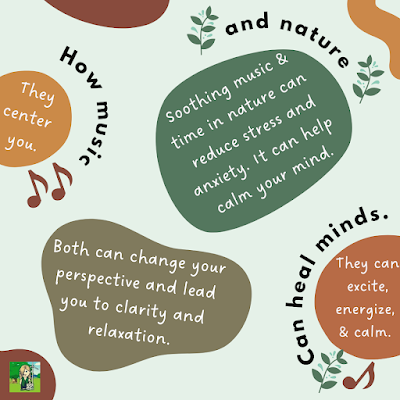
In June of 2020, at Barcelona's El Liceu Opera House, the string quartet live-streamed a concert. Performing Puccini's Crisantemi (Italian for "chrysanthemums"), the quartet In the thick of the pandemic, no people were allowed in, however there was only standing room available as every seat was filled with plants donated from a local nursery. 2,292 to be exact. The video is beautiful, hearing the music wrap around its colorful, cholorphyl-filled audience. Then what a gift for these musically infused plants to be given to Spanish healthcare workers who were enmeshed with patients struck with Covid-19.  Visionary Artistic visionary Eugenio Ampudia created this idea to bring music to the online world of folks in lockdown while also gearing at the importance of both music to support plant growth and how both nature and music can positively influence our mental health.

Bravo and standing ovations to all.


Video from https://youtu.be/HWMn0680cbo; image created at Canva.com 

Wednesday, February 16, 2022

The Six Americas

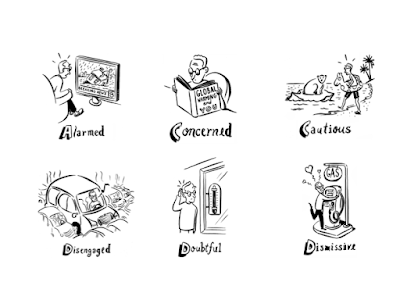
When I was reading Katherine Hayhoe's book Saving Us: A Climate Scientist's Case for Hope and Healing in a Divided World, I was struck by her chapter on the "Six Americas of Global Warming." This comes from the Yale Program of Climate Change Communication. Rather than Americans being merely binary as climate believers or climate deniers, there are really six different vantage points. They are pictured here:

The delineation is as such:
  • Alarmed--Climate change believers who feel it is here now as an urgent, human--created threat and are taking action as they can.
  • Concerned--People see it as a serious threat, but not immediate, therefor they give it less priority.
  • Cautious--Folks who are on the fence and haven't made up their mind about if it is happening, human-created, or a serious concern.
  • Disengaged--People who don't care, know little (if anything) about it, and are not interested in learning about it.
  • Doubtful--They do not consider it serious or even happening, or they may feel it is all part of t he natural planetary cycle.
  • Dismissive--People who do not believe climate change is "a thing," and they see it as a hoax or a conspiracy theory.
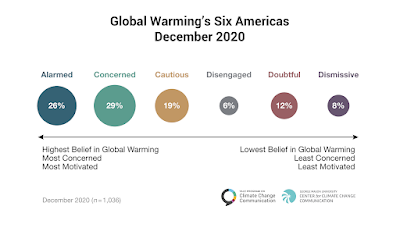
Yale's website has some impressive data visualizations as well as a video detailing each of the six perspectives and how they have changed over time. This infographic from their website shows where the numbers are per category.


Katherine Hayhoe referenced this information in her conversation about finding common ground to talk with others about climate change. (See my A Trio of Hope Messengers post for more about that.) She said that if you share why climate change is important to you based on what you know about your discussion-mate, you can help them to see why they might want to care. In relation to the Six Americas, you actually have the ability to reach others as long as they are in any of the categories except Dismissive. Dismissives are die hard in their disbelief of climate change. Your stories or experiences, no matter how compelling they are, won't reach them.

I found comfort in this, seeing it as far more promising than I had imagined by news stories of climate deniers. I also see it as encompassing the vantage points in perceived science deniers or even Covid deniers. The principles apply in both of those sets of views too. It's comforting because there are only 8% of the population that is so dogmatic with this issue, viewing climate change in the "hoax" department--meaning, that there's potential to reach the other 92%! 

Additionally, it shows a radical shift to the collective concern about climate change. That is what it takes to shift the balance in conversations, legislation, and activism!!

To learn more, check out Yale's "Global Warming's Six America's" video.

Images from https://climatecommunication.yale.edu/about/projects/global-warmings-six-americas/

Saturday, February 12, 2022

Nature-Inspired Valentine's Day

"Love, exciting and new....Come aboard, we're expecting you...." 

The theme song that fills my brain every Valentine's Day. The song is indeed a theme song--from the 1977-1986 hit TV show "The Love Boat" (an hour-long rom-com television show for those of you for whom this may have been a bit before your time).

As cupids and images of pink and red float about this "happy heart" holiday, maybe you can get some inspiration from nature this week. Here are a handful of sites with all sorts of Valentine's crafts and card ideas, all stemming from nature or natural items you can find outdoors. Fill you own heart with love of all the planet has to offer while you share forward your love for others.

Have a wonderful Valentine's Week filled with love!

Image created at canva.com


Wednesday, February 9, 2022

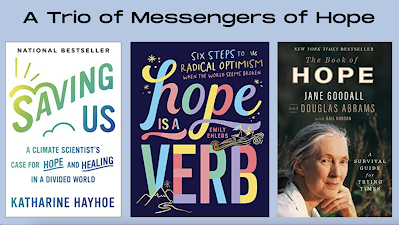
A Trio of Messengers of Hope

This fall and winter among the slew of books I've been reading, I read the three of these books--all of which made a powerful impact on me:
It doesn't take a rocket scientist to see the similarities by titles alone to know that they all are tied to hope in the time of climate change. On top of a pandemic (as well as deeply partisan politics and racial injustice), it is indeed is a difficult time to find hope. As authors and environmentalists, these three women (along with Douglas Abrams) had a daunting task as their main thesis. 

For me, the three books acted as different pieces of a puzzle, working together to build a larger picture. All three had ties to the pandemic and Covid--sometimes explicitly, and sometimes in more subtle ways. Additionally, I see parallels in the work to eradicate Covid as well as turning around the trajectory of climate change. Collectively, I needed all three, and I saw them as companion pieces. 

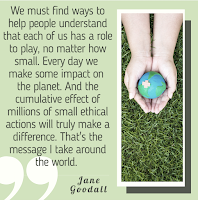
Within each of these books, the general sentiment that signs loudly is that hope comes from taking action. If we all do what we can, it is through all of our collective, individual acts that we make a difference. Even if our own small actions "feel like a drop in the ocean," (as Douglas Abrams said to Jane Goodall in their interview/conversational style book). However, Jane Goodall countered it with this quote: "But millions of drops actually make the ocean," [Book of Hope, p. 134]. Jane Goodall referenced multiple hope studies along with these four reasons for hope: "the amazing human intellect, the resilience of nature, the power of youth, and the indomitable human spirit," [Book of Hope, p. 35].

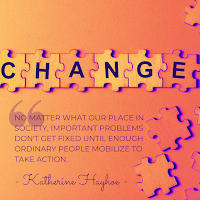
Katherine Hayhoe is both a climate scientist and a Christian from Texas--sometimes a dichotomous combination in our polarized world these days. She also speaks of the importance in taking action. Thought individual acts and working with others in the community, it perpetuates a cycle of action and support. "It's like knocking over the first domino: action eventually changes us all," [Saving Us, p. 205]. 

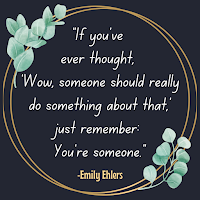
Given the title of Emily Ehlers book, hope is a verb. It's active--not wishful thinking not "just something you have; its something you do," [Hope is a Verb, p. 10]. Her book, full of art and a font that feels like you've stepped into her handwritten journal, makes it almost like a graphic novel. Perhaps some of the power comes from these visuals, one of which included this quote that also speaks to action: "We change and innovate when we have no other choice. What if we are about to step into a golden era where everything changes?" [Hope is a Verb, p. 51]. She goes on to say "Hope is not about closing your eyes to the world's problems and wishing they would disappear. It's about imaging a brighter future and then taking steps, no matter how small, to make that vision a reality," [Hope is a Verb, p. 146].

One of the pieces that I feel was powerfully similar in all three books was the concept of stories. Jane Goodall's book was a collection of stories about people she has met in her 8 decades and how their experiences have shaped all she knows and believes in as an environmentalist. She talks about how stories serve to move people more than data-driven statistics (which can often serve to be isolating or overwhelming). One of Katherine Hayhoe's biggest premises in her book is in the power of stories to connect with someone with opposing views. In doing so, then you can find common ground and can really begin to not only hear but also understand and appreciate each other. "Study after study has shown that sharing our personal and lived experiences is far more compelling that reeling off distant facts....Tell them why you care about climate change and others might too," [Saving Us, p. 19]. Emily Ehlers also shares the importance of storytelling by elaborating about Chimamanda Ngozi Adichie's TED Talk "The Danger of the Single Story." It is through the stories that we can see different perspectives and work to connect across the divides.

After reading all 3 books, I still struggle with hope sometimes when I watch the news--whether its about climate change, Covid, the angry world of toxic politics, or systemic injustice. But, as all 3 books explain, "hope" is an active job. At our most recent Baltimore Speaker Series event, political journalist Mara Liasson said "vote for everything and run for something"--meaning get involved in being part of the solution and part of the change. 

It can become easy to get overwhelmed by it all and want to run and put our head under the cover, but nothing will happen from there for sure. Even Jane Goodall admitted to having hard moments--but she still has hope. Seeing that, is what causes me to breathe more deeply. I find it comforting that Jane Goodall (just like Katherine Hayhoe and Emily Ehlers) still takes pause in the fighting spirit and determination of others who are taking a stand. Jane Goodall takes comfort and delights in seeing young activists step up as future leaders--she sees the power in active hope and engagement. "Without hope, all is lost. It is a crucial survival trait that has sustained our species from the time of our Stone Age ancestors....Hope is contagious. Your actions will inspire others," [Book of Hope, p. xiv].

What can you do today that will inspire others and cultivate hope?

Image created at www.canva.com using book art from www.amazon.com. Video from https://youtu.be/D9Ihs241zeg, Quote arts created using www.canva.com and book quotes from the 3 authors.

Saturday, February 5, 2022

Women in Innovation

The Smithsonian is known for its exceptional level of education--whether the museums in Washington, DC or their online counterparts. They know how to take learning to the next level.

One of the many ways it is doing that is by bringing the education to you in your homes and schools through their Poster Exhibitions. By going to their SITES Community website, you can order free print or digital content in their Poster Exhibitions to use as educational resources. They currently have an array of 13 different Poster Exhibitions to investigate.

The one I just ordered is their Picturing Women Inventors Poster Exhibition. It comes with 8 printed posters and educational material to go with it. Additionally, they have the posters available immediately with their digital download. I love that the inventors cross a variety of fields and showcase some amazing women. Women's History Month may be March, but these women are worth celebrating all year round!


Image acquired from https://www.sites.si.edu/s/topic/0TO1Q000000wz9hWAA/picturing-women-inventors-poster-exhibition 

It's Olympics Season

Olympic frenzy has hit the world! It is Olympics Season!

This year's Winter Olympics are in Beijing and underway, running from February 4th to the 20th.

Here are some ways to bring the Olympics into your classroom to capitalize on the excitement!

Image screenshot from Miss Hecht's Olympics Bitmoji Board https://linktr.ee/MissHecht?fbclid=IwAR2XjFRMe9tVrC97W3oZ4PQJJAp3xEjaDd45axQFddlArUvDj2AFfU31Dec; Video from https://youtu.be/FPdKq-MXQlk

Wednesday, February 2, 2022

An Evening With Walter Isaacson

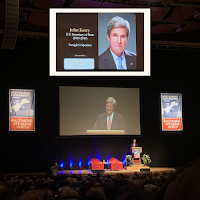
When you are a bit of an info-junkie, love at first sight comes in funny ways. It struck me in the pre-pandemic days when I was gifted a ticket to the Baltimore Speaker Series from a colleague to go see John Kerry. Her plans changed for the evening, opening up their ticket, making for a delightful evening for my husband and I to go to a beautiful venue and spend an hour or more listening to John Kerry talk on a multitude of topics. He is a fascinatingly brilliant man with a vast array of stories and experiences as well as an abundance of knowledge. Now, of course, he is ou first United States Special Presidential Envoy for the Climate.

The pandemic turned us all into homebodies for a good year and a half, but the Speaker series was always calling our names in the background...and now, mid-season tickets are ours for this year.

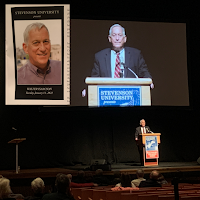
The first session we had tickets to this year was on January 11th. The speaker that night was historian, professor, and author Walter Isaacson. His curriculum vitae was extensive, being a former editor of Time Magazine, former CEO of CNN, and Fellow at the Aspen Institute (among other things).

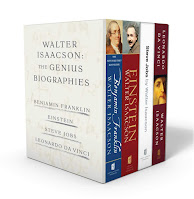
As the author of what's come to be known as "The Genius Biographies," Isaacson knows a little bit about "genius," and the focus of his evening was the distillation of lessons learned from the many geniuses he has researched or interviewed and written about. And he should know since he's written books on Leonardo Da Vinci, Benjamin Franklin, Albert Einstein, Steve Jobs, Henry Kissinger, Jennifer Doudna (co-inventor of CRISPR and gene editing) and more.

As Walter Isaacson spoke throughout the evening, you came to see that "being smart" isn't enough. There are boatloads smart people out there.  But there's an extra "something" that makes "the greats" great. 

They have a sense of higher purpose and they push to see what they can do to push humanity forward. Additionally, what's key to inspiring creative and innovative, genius-level thinking are elements that innovators (and often entrepreneurs) have...YET, we all have it in us to do these exact things! Many of the these traits we nurture in our children; however, the true gift of genius is to never lose these gifts. We should spend our lifetime cultivating and curating the following to grow and enrich our lives:
  • Be passionately, playfully, obsessively curious--for his own sake.
  • Think outside of the box.
  • Be more observant.
  • Have a passion for your perfection, bringing beauty to what is important.
  • Simplicity is the ultimate sophistication
  • Have some humility.
  • Creativity is a team sport and innovation is a collaborative act.
  • Focus on the shared values, for they are greater than the ones that polarize us.
  • Celebrate the diversity that makes collaboration work
  • Gratitude is vital.
It reminded me of one of the ideals I hold most true: it will take innovation to solve our environmental issues. The same is true when it comes to social and environmental justice. It will take those with genius to "think different" (as Steve Jobs was known to say) to create the solutions necessary. 

Yet genius can be within all of our grasps. Continuing the love of learning and being open to possibilities are all part of the process. I love how we all have the power and potential inside us to do this exact thing!

Information junkies, for the win!

Book images from Amazon.com, other pictures from my camera.


Saturday, January 29, 2022

Urban Forests

What's a way to improve biodiversity and stockpile some carbon?

Create compact mini-forests in urban areas by planting native species close together in a dense area. These  mega, mini forests can have a way of packing a punch and taking a solid impact on climate change.

Video from https://www.facebook.com/UTWnow/posts/5831673740192193, Image created at Canva.com

Wednesday, January 26, 2022

Ken Burns In the Classroom


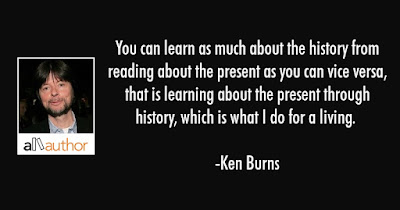
Ken Burns has become synonymous with historical documentaries. No wonder, given he's been writing, directing, producing, and filming them for over 40 years. During his tenure and along with his collaborators, he has produced 36 films, most of which have aired on PBS, where you can also access them to stream online.

For teachers, this is a goldmine given he is the master of weaving together primary sources and archival footage.

PBS has set up a whole website dedicated to Ken Burns in the Classroom. There, you can search by film, era, topic, grade level, subject, and keyword to build your lesson plans.  Filtered searches can then lead you to videos, interactive, interactive lessons, lesson plans, audio, images, documents, webpages, and resource galleries that integrate with all of PBS's resources. 

The Ken Burns in the Classroom website also links you to the Ken Burns UNUM website, an extension digital world curated by Ken Burns in 2018 to build further connections. "Unum" comes from the United States motto: "E Pluribus Unum" which means "out of many One." His reasoning for both the name and the website--to create a visual history of a united shared history, even in divisive times. 
The goal is to remain impartial while layering together clips from past histories with the present day conceptual stories to see the greater meaning. Likewise, the intent is to help us return to civics education and civility.

UNUM is arranged by Featured content*, UNUM Shorts, Themes, Events, UNUM Voices, People, AP US History Themes, War, Places, Times, Conversations, and Opportunities from their Partners. Likewise there is a section for educators.

If ever you are looking for historical online resources, you may want to tuck this bookmarked page where you can find it!

*At time of writing, the Featured content includes his Facebook Live conversations in December 2021 with political historian, author, and professor Heather Cox Richardson.

Saturday, January 22, 2022

Ryan Reynolds: The Environmentalist

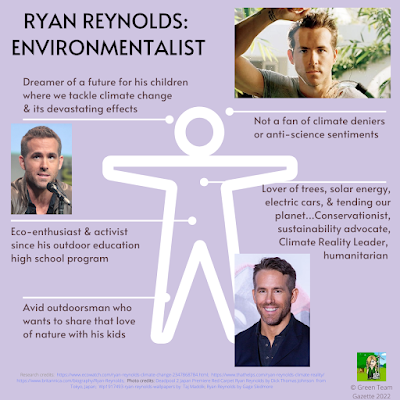
My mom loves Ryan Reynolds. Not in a weird way, but in a cute, her-grandkids-like-to-tease-her way, where she could possibly watch "The Proposal" every day. Especially with Betty White, it's a complete classic. Not to mention, he IS pretty darn cute.

More importantly, he was green long before 2011 when he appeared in Green Lantern (long before his Deadpool & Red Notice days). Being an environmental lover and activist has been part of his core for well over half of his lifetime.


He also is the voice of Canadian's January 2022 The Nature of Things "Curb Your Carbon" series (where curses! as an American, I can not view this! Argh!). [You can learn more about that series here.] Here's a trailer (and you'll get why I'm upset to miss it, as it brings that iconic, engaging Ryan Reynolds humor to the screen):


It sort of makes sense why Canada (and fellow Canadian Steven Page of Barenaked Ladies) wrote a love song to him, especially after he won the Governor General's Art Award for his work, entrepreneurship, and activism. May we all follow in his environmental endeavors and carbon footprints!


Infographic created at Canva.com--image credits on infographic, video from https://www.youtube.com/watch?v=8q4ph2XVelA and https://www.youtube.com/watch?v=nXulsCU1geg

Wednesday, January 19, 2022

TED's Think Like A Coder Series

I've been working on some coding activities with my younger elementary students at school. For my very youngest students, we use Bee-bots as a way to introduce the concept of programming. Then Code.org and their CS Fundamentals courses are the perfect introduction to block coding for young students. From there I always like to bounce into Scratch Jr on the iPad.

The students love it and always beg for more.

Coding and computational thinking are definitely key literacy skills for today's students.

That's why, TED-Ed's "Think Like a Coder" Series is brilliant! Partnering with YouTube Learning Playlist, TED-Ed has created these ten short animated adventures teach the principles of coding through videos challenging you to think them through. To learn more about the series, go here. With names like Prison Break, The Resistance, and more, they will capture the interest of students of all ages!

Here's the trailer:

Episode 1: Prison Break

Episode 2: The Resistance

Episode 3: The Furnace Bots

Episode 4: The Train Heist

Episode 5: The Artists

Episode 6: The Chasm

Episode 7: The Tower of Epiphany

Episode 8: The Gauntlet

Episode 9: The Factory

Episode 10: The Finale: The World Machine

Video from :https://youtu.be/qhAAmyGnA-M, Image from https://blog.endlessnetwork.com/blog-1/how-one-ted-ed-producer-thinks-like-an-artist-to-inspire-others-to-think-like-a-coder


Saturday, January 15, 2022

If Trash Could Talk

We all want a voice, because in having one, then we can be heard.

Archaeologists have long since been the historical voice through their archaeologist digs. You can learn a lot through the remains, and that remains true for both ancient and modern day trash. In that way, archaeologists are trashologists or garbologists!

Just like the Lorax spoke for the trees, these resources below speak for the trash. The video (🎥) may bring a smile, the book (📙) of poems might bring some enjoyment, and the experiments (🧪) might bring some hands on science... but more than that, hopefully they cause you to pause and rethink what you are using in order to go forward making different choices.

📙 If Trash Could Talk: Poems, Stories, and Musings (2018) by Jacquelyn A. Ottman

🧪 If Trash Could Talk experiment from the American Museum of Natural History 

🧪 Trash Talks from AIA Education Department

🧪 Trash Experiments from KonnectHQ

🎥  If Trash Could Talk from Buzzfeed Videos:  


Wednesday, January 12, 2022

Phenology & The 4 Seasons

As we are hitting the "wintery mix" days of weather here in early January where I live, I'm looking outside at "the muck and stuff" that's coming down on the snow that gave us a beloved snow day last week. Not being a winter girl, it has me longing for the signs of spring.

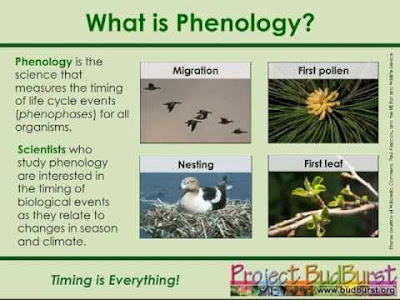
When we pay attention to those seasonal signs, we are following phenology.


To learn a little bit more about phenology and how it is tied to what is happening with climate change, check out this TED-Ed video:


If you can't get enough about Phenology, check out The Roving Naturalist's video on it!

It all reminded me of this video by Charles Germaine. I had the honor of sitting on a maritime foundation board with Charles over the past few years prior to the dissolving of the organization. Even prior to that, I'd been a fan of his videos and YouTube Channel. The video below is a phenology video of the "4 Seasons of Magothy River." The Magothy used to be the view outside my window at a school I taught at for 7 years (years ago). 

Here as we are making our way into January, if you are needing a little visual meditation to carry you through your current weather through the other seasons, take a phenology trip to visit them through Charles Germaine's 3:41 minute movie.


Saturday, January 8, 2022

Cheering on the Changemakers

As I was catching up on TED Countdown and the many environmental talks from the end of October 2021, I ran across this talk from Melati Wijsen. That name sounded familiar. Of course it did! I'd written about her and her sister Isabel in 2018 and their TED talk about their push to make Bali plastic free. They were changemakers then, and as Melati describes in this TED Talk, making change doesn't happen over night, but it does happen!

Looking for a little inspiration here at the beginning of 2022? 

Start here: 10 years after Melati and Isabel Wijsen have been working hard to make a difference in their community. Then see where it is you can begin to make a difference as a changemaker in your own ways.

Looking for more about Changemakers? Check out the Changemaker podcast by Jackie Biederman.

A Treasure Trove of Wisdom & Wonderment with SciShow & More

I've talked before of my love of Crash Course videos. Brothers Hank and John Green (yes, "Fault in Our Stars" and other young adult books, author John Green) do a sharp-witted, quick pace deep dive into all sorts of topics of such as history, science, technology, engineering, psychology, business, sociology, film study, ecology, and more. They've revamped their website and have 32 themed courses and the knowledge base in there is exponential.

Hank Green is at it again--and has been since 2212. Hank, along with the help of a team of others including Michael Aranda, Olivia Gordon, Stefan Chin, Caitlin Hofmeister, Reid Reimers, Brit Garner, and Anthony Brown have created SciShow, which has now branched into the following 4 YouTube channels of wonderment and answers: 

  • SciShow -- tackling science discoveries and more to tweak your curiosities.
    • Spinoff: SciShow Tangents, which began in 2018, and gives you loads of random tangents and tidbits.
  • SciShow Psych -- sharing brain-based research and diving into what makes you "you!"
  • SciShow Kids -- bringing it down a notch to be right and ready to share information with the elementary set.
This post from edtech guru Richard Byrne on his Free Technology For Teachers details 3 elementary aged SciShow Kids' engineering--great if you are doing a digging into the design process. At 4-6 minutes long, these animated shorts are the perfect bite sized bits to energize your students.
You'll find other great engineering topics at a slightly higher level for students on the SciShow channel too. And the environment.... And math... And music..... the list goes on!!!

Wednesday, January 5, 2022

52 Weeks Ahead

Last year, in February, I wrote about "52 Weeks Challenges." In it, I described my own personal pursuit to reading 52 books to correlate with the 52 weeks of the year. I kept a running list in my Artful Agenda digital calendar, and I did indeed hit 52 books... by August 11th. I also hit my stretch goal of 75 books, hitting 76 by the year's end. With a mix of fiction and non-fiction, sometimes it was a campy light read, and sometimes it was a book with deeper meaning. But it definitely was a year of a lot of reading... and escape... and new ideas.  

My book list for 2021 is below. Stars indicate my favorites. I'm going to go for another 52 books for 2022.

My hiking friend also met her goal on her #52HikeChallenge, hitting a grand total of 58 hikes during the year. Impressive!

What's your plan for the next 52 weeks? Where will you be a year from now? What changes do you hope to conquer, and what will it take to get you there. Whatever your plan is, take note of it, keep track and go for it!

*  *  *  *

MY GOAL: Read 52 books this year!

Achieved August 11th, 2021

Stretch Goal 75--Super Stretch goal 80


Stretch goal met December 26th, 2021

Total: 76 books 47 Fiction titles 29 Non-fiction titles


January = 5

Nick & Norah's Infinite Playlist by Rachel Cohn & David Leviathan

**Uncomfortable Conversations with a Black Man by Emmanuel Acho

Sam & Isla's Last Hurrah by Rachel Cohn & David Leviathan

Dawn's Early Light by Elswyth Thane

You are a Badass: How to Stop Doubting Your Greatness & Live an Awesome Life by Jen Sincero


February = 4

Eat Smarter by Shawn Stevenson

Eleanor Oliphant is Completely Fine by Gail Honeyman

Anne of Green Gables by Lucy Maud Montgomery

**Your Perfect Year by Charlotte Lucas


March = 10

Anne of Avonlea by Lucy Maud Montgomery

Look Both Ways by Jason Reynolds

**Bright Side of Going Dark by Kelly Harms

Why We Swim by Bonnie Tsui

Woman Last Seen in Her 30s by Camile Pagan

Rage Becomes Her: The Power of Women's Anger by Sonoya Chemaly

**The Bookshop of Yesterdays by Amy Meyerson

The Home Place: Memories of a Colored Man's Love Affair with Nature by J. Drew Latham

The World Becomes What We Teach: Educating a Generation of Solutionaries by Zoe Weil

Perks of Being a Wallflower by Stephen Chobosky


April = 6

The Overdue Life of Amy Byler by Kelly Harms

There's No Planet B: Teen Vogue's Book on Climate Crisis Edited by Lucy Diavalo

**Immigrant Innovators: 30 Entrepreneurs who Made A Difference by Samantha Chagolian

Promise Cove by Vicki McKeehan

Kid Activists: True Tales of Childhood from Champions of Change by Robin Stevenson

Kid Innovators: True Tales of Chuldhood from Inventors and Trailblazers by Robin Stevenson


May = 8

**The 3 Mrs. Wrights by Linda Keir

My First Little Book of Intersectional Activism by Titania McGrath

Woke: A Guide to Social Justice by Titania McGrath

Wildernes: Gateway to the Soul by Scott Stillman

**Teaching When the World is On Fire edited by Lisa Delpit

The Strange Journey of Alice Pendelbury by Marc Levy

The Cafe on the Edge of the World: A Story About the Meaning of Life by John Strelecky

Your Turn: How to Be an Adult by Julie Lythcott Haims


June = 5

The Anthropocene Reviewed: Essays on a Human Centered Planet by John Green

Aristotle & Dante Discover the Secrets of the Universes by Benjamin Saenz

The President Is Missing by James Patterson & Bill Clinton

**Blue Mind: The Surprising Science That Shows How Being Near, In, On, or Under Water Can Make You Happier, Healthier, More Connected, and Better at What You Do by Wallace J. Nichols

Stealing Home (The Sweet Magnolias Book 1) by Sherryl Woods


July = 11

A Slice of Heaven (The Sweet Magnolias Book 2) by Sherryl Woods

Duck: An Outer Banks Village by Judith D. Mercier

Coastal Wild: Among the Untamed Outer Banks Photography by Steve Altman and Mark Buckler

Feels Like Family (The Sweet Magnolias Book 3) by Sherryl Woods

Booked For Trouble: A Lighthouse Library Mystery by Eva Gates

Culturally Responsive Teaching and The Brain: Promoting Authentic Engagement and Rigor Among Culturally and Linguistically Diverse Students by Zaretta Hammond

**Park & Eleanor by Rainbow Rowell

The Culture Code : The Secrets of Highly Successful Groups by Daniel Coyle

Beach Read--Emily Henry

**Squeeze Me—Carl Hiasson

Songs of a Confederate Raven--Kathleen Thomas -- Robyn Hill (Illustrator)


August = 7

Sorry I Missed You—Suzy Lrause

The Proposal—Jasmine Guilleroy

The Truth and Other Hidden Things: A Novel—Lea Geller

The Restarting Point—Marci Bolden

**Teach Boldly: Using Edtech for Social Good—Jennifer Williams

**How the Word Is Passed: A Recogning With the History of Slavery Across America—Clint Smith

The Inn At Eagle Point (Chesapeake Shores Book 1)—Sherryl Woods


September = 4

Trophy Life—Lea Geller

For Once in My Life—Colleen Coleman

Most Good, Least Harm: A Simple Principle For a Better World and a Meaningful Life—Zoe Weil

Party of Two—Jasmine Guillory


October = 4

Life Unscheduled—Kristen Rockaway

**Saving Us: A Climate Scientist's Case for Hope and Healing in a Divided World—Katharine Hayhoe

The Meetinng Point — Olivia Lara

Less—Andrew Sean Greer


November = 5

**Seven Perfect Things—Catherine Ryan Hyde

One Hit Wonder: A Samantha True Novel — Kristi Rose

When Life Gives You Lemons — Fiona Gibson

The Pride Guide: A Guide to Sexual and Social Health for LGBTQ Youth — Jo Langford

The Comfort Book-Matt Haig


December =7

If the Fates Allow-Rainbow Rowell

The Twelve Days of Dash & Lily—David Levithan and Rachel Cohn

**Twelve Days of Christmas—Debbie Macomber

The Christmas Blanket--Kandi Steiner

A Christmas Message—Debbie Macomber

**Hope Is a Verb: Six Steps to Radical Optimism When the World Seems Broken—Emily Ehlers

The Bette Davis Club—Jane Lotter


TOTAL = 76 books


Quote from https://philocalylifestyle.files.wordpress.com/2013/10/a-year-from-now.jpg;