Showing posts with label ocean. Show all posts

Saturday, July 25, 2026

Eco-Hero Connects Webinar: Ocean Conservation: Protecting Marine Ecosystems


Not all heroes wear a cape. When they are eco heroes, they sometimes wear swim gear and take part in webinars.

That's what is ahead from Action for Nature next Saturday, August 1st, 2026 at 2 pm Eastern time (11 AM Pacific Time). They are hosting the "Eco-Hero Connects Webinar: Ocean Conservation: Protecting Marine Ecosystems." Four of the recipients of Action For Nature's Young Eco-Hero Award will be gathered together as part of an global panel speaking together about their individual journeys of ocean advocacy. In that discussion, they'll also talk about some of the ways we all can take action to protect our marine ecosytstems.

The webinar speakers include:
  • Jade Bothma, 2020 Eco-Hero from South Africa who founded Oceano Reddentes ("the ocean revives"). Together with her team of volunteers they have gotten rid of 8,000+ pounds of waste from the beaches of Cape Town. They use the found-plastic to form "eco-bricks" to use as sustainable building materials for housing.
  • Cash Daniels, 2022 Eco-Hero from the USA is the founder of Wild Earth Defenders. Cash is known as "The Conservation Kid," and he has been a long-time advocate for waterways and taking action for our planet.
  • Sean Russell, 2009 Eco-Hero from the USA is the Director of Youth Engagement at EarthEcho International (GenSea) and the Founder and Director of the Youth Ocean Conservation Summit. These organizations encourage our youth to start their own marine conservation projects.
To register and take part in this webinar showcasing these 4 young leaders, check out Action for Nature.

Saturday, April 25, 2026

10 Dynamic Eco-Women

March is known as Women's History Month, but who says you only have to pay tribute to women one month of the year? I certainly do NOT subscribe to that! Especially during the month of Earth Day!

This article from BBC Wildlife showcases these 10 amazing women: "10 Women Who Changed the World: The Pioneering Female Conservationists, From Jane Goodall to Sylvia Earle, who redefined Our Bond with Nature by Amy May Holt (10-2-2025). I love the videos that are included on many of these phenomenal environmental leaders.

Image created using www.Perplexity.AI with this prompt: Make a photo montage/collage of these environmental leading women: Jane Goodall, Sylvia Earle, Dian Fossey, Saengduean Chailert, Lily Venizelos, Margaret Murie, Wangari Maathai, Marina Silva, Leela Hazzah, Florence Merriam Bailey.

Saturday, August 2, 2025

Coral In Crisis

Right now, coral reefs across the globe are undergoing the most severe bleaching event in recorded history. Warming oceans are to blame for pushing our already fragile corals to their limits. As the warming occurs, so does the bleaching: a loss of color, life, and balance to our ecosystems. 

Here are three tools to build your toolkit to help you learn more about coral in crisis:

1. Real-Time Coral Bleaching Tools

You don’t need to be a marine biologist to witness what’s happening. Use these free, open-source platforms to explore reef health and bleaching alerts across the planet. By zooming in and tracing lines on these mapping tools, you can explore the reefs to get a bigger picture on what is happening with coral communities.
  • Allen Coral Atlas--this website tracks real-time satellite data on bleaching risk, reef habitat, and human stressors.
  • NOAA Coral Reef Watch--this website shows weekly heat stress maps, temperature anomalies, and historical comparisons.
Want to take your coral curiosity further? Become a Citizen Scientist by using one of the following platforms to contribute live data:
  • Reef Check – Participate in global reef monitoring efforts.
  • iNaturalist – Record marine species sightings, tag reef health, and connect with a global community of observers.

2. Read Up on the Topic

Here are some good articles to show the concern, brought about by climate change.

3. Play Coral Reef Jeopardy

Gamify your knowledge base with this coral-oriented Jeopardy-style game on Factile.com to learn more.
To go to a larger screen version, click here.

Saturday, July 27, 2024

Goodbye, Dr. Wallace J. Nichols

Earlier this week I was deeply saddened when I ran across the following on Dr. Wallace J. Nichol's social media feed (which I follow on both Instagram and Facebook). Nichols, who regularly went by J on his own website, wrote the book Blue Mind: The Surprising Science That Shows How Being Near, In, On, or Under Water Can Make You Happier, Healthier, More Connected, and Better at What You Do. Published in summer of 2014, this marks the 10 year anniversary of his book. Blue Mind happens to be one of my top favorite books of all times, and I have read it at least 3 times....and written about it more than that, as you'll see in my list below.

Seeing this highlighted social media post this week was the first I'd heard of his passing, at the age of 56--far too young AND far too close to my age! News like this never seems realistic when the person passing is fairly young. For years I've been waiting for his next book because I literally "soak up" his writing and couldn't get enough. Now I see that other than his children's book Dear Wild Child: You Carry Your Home Inside of You that he wrote with and for his daughter after California wildfires took their home, that dream of mine will not come to be.

I am mourning this loss of J and how his "blue mind" message was so powerful to me. It probably doesn't help that the '80s girl in me (who has recently watched Brats by Andrew McCarthy and a lot of Brat Pack movies afterward for nostalgia sake) has seen the recent loss of other icons from my younger years: Richard Simmons, Bob Newhart, Shannon Doherty, Dr. Ruth, Martin Mull, and Donald Sutherland. These "younger" losses hit even harder. Especially when I don't feel my calendar/chronological age.

I've been comforted reading about the lost of this blue mind hero of mine with the following tribute articles written by some big name publications in the world of environmentalism, outdoor education, and sustainability.

Here is the post on his own website by his family announcing his passing:  "In Memory of Dr. Wallace J. Nichols" (6/21/2024).

In reading so many articles about Dr. Wallace J. Nichols, I even learned he wrote a post on his Patreon site right before his passing, showing all of the upcoming plans he had and how his work was not done. He had plans.

I also pay tribute to J here with my own list here of past posts I've written on the concept of Blue Mind:

To contribute toward the continuation of his work, you can visit The Dr Wallace J Nichols Memorial Fund GoFundMe Page. Here too, you can read his incredible biography of all he accomplished in his 56 years!

J, you will be missed, far and wide. My thoughts go out to your friends and family who feel their immediate holes in their heart and lives where you should still be. Thank you for your work in marine biology, your books, your environmentalism, your Blue Mind Movement, and for putting words in place that beautifully describe my relationship with water.

Wallace J. Nichols' photo quote created by me in Canva.com using words from the text of "Blue Mind" for my June 26, 2021 GTG post: https://www.greenteamgazette.com/2021/06/blue-mind-revisited.html; photo image with Dr. Wallace J. Nichols & blue marble from https://www.santacruzworks.org/news/celebrating-the-life-and-legacy-of-dr-wallace-j-nichols, Google Slide images created by me, with social media posts from July 23, 2024 https://www.facebook.com/wallacejnichols/posts/pfbid037zM699sknKzGKjupCefJ2PmZD4UKnbBgxxrMddQ87edasPKNhKGttPu8GqmBqhfdl, video from https://youtu.be/0dgNVSV1qow?si=lDOWcH6DFrg032jv

Saturday, July 13, 2024

Environmental Elmo

Elmo, of Sesame Street fame, is one pretty well-known and easily recognizable muppet. A regular on Sesame Street since 1980, he's one of our favorite 3-and-a-half-year-old...at least in our house. 

Elmo was a favored beanie baby in our house with our daughter. One particular trip to the Florida Strawberry Festival (many moons ago) brings back an Elmo fear-factor moment when we realized Elmo was once lost, dropped from stroller snuggles. Luckily, with swift retracing of steps, he was miraculously found before our 2 year old even realized he was missing. 
Phew! Crisis averted!

Just like being found in the vast fairgrounds for us, Elmo is always full of surprises. Elmo's latest is an environmental partnership between Sesame Street and Cut Media's HiHo Kids YouTube Channel. This collaboration pairs Elmo with HiHo Kids and their "Kids Meet" Series to create a two-part video series to help build environmental stewardship and curiosity of our natural world through eyes of kids and Elmo! 

In early May 2024, they released "Kids Meet a BeeKeeper," where Elmo does just that: meet a beekeeper. Bees can be a seemingly scary insect-enemy to small children (and let's face it--many adults). But, through their 7:41 short video, they highlight the importance of bees for pollinating our growing world as well as our grocery stores!

Just released this weekend on July 13th, the second in this series was "Kids Meet a Marine Biologist." With Elmo right there with the rest of the HiHo Kids again, they learn all about the importance of of oceans and how the protect the marine life that lives there by striving for clean ocean waters during this 7 minute short.

To get your Environmental Elmo fix, you can watch these two below. Then definitely check out the HiHo Kids YouTube channel to meet more folks with fascinating positions as well as some of their other series like "Kids Try," "Kids Design," "Don't You Dare," "Kids Show & Tell," "What's Popping," and more. You can also find them on the Sesame Street YouTube Channel. Additionally, Elmo & HiHo Kids paired together in 2022 to "Meet a Dancer" & "Meet a Basketball Player" where they discussed sports, wellness, character traits vital to athletes, as well as unique situations and their personal stories of triumph.


Saturday, July 6, 2024

Watching Wildlife: Vacation Style

As a follow up to my Watching Wildlife post earlier this summer, it seems only natural to share a little Canva creation I made from our family's Cape Cod adventure last month where we did just that: watched some wildlife. Whales, in fact. We booked a whale watching excursion through Dolphin Fleet of Provincetown, Massachusetts. Leaving from the very tip of Cape Cod, we traveled further north where we witnessed a show of nature.

We managed to find ourselves navigating the boat in and around two pods of 3 whales, and a couple solo swimmers. The one doing a major lounge about in the sun. For a solid five minutes or so, that whale was just doing a playful back stroke, flapping its flippers in the water as if it hadn't a care in the world. It was completely mesmerizing and we got some photos and vides from that day. 


Additionally, the on-board naturalists were phenomenal. We learned so much. On top of that, Dolphin Fleet has cataloged thousands of whales using a photo-identification system. They were able to identify by name the whales we saw. 

It definitely was a memorable experience where photos and videos truly do not do it justice. 

If you ever get a chance to take a whale watching trip--do it!

To learn more about Dolphin Fleet and the educational research of whale watching, click here.

Cape Cod map from https://www.tripsavvy.com/cape-cod-marthas-vineyard-nantucket-maps-3265660, Video created in Canva using my photos/videos from our whale watching trip.

Saturday, July 29, 2023

Ocean Elders

In Native American cultures and tribal communities, the elders are known for their widsom. They are the revered older members of the tribe that brings knowledge, sage advice, patience, honor, and expertise.

It was from that mentality merged with The Seventh Generation Principle (based on the Iroquois Great Law of Peace--which also served as the model for the US Constitution) that the Ocean Elders was created. From their website: 


I view them sort of like the Marvel Marine Superheroes or the Eco Avengers, who are here to help save the oceanic day! At the very least, here to LEAD the way. The list of people involved--the Ocean Elders--reads like a "who's who" of the environmental world... which is where I think I get the superhero vibe. It's an impressive list of likeminded leaders.  You can find links to the bios of each of these elders here.
  • H.S.H. Prince Albert II of Monaco: Explorer, Environmentalist
  • Richard Bailey: Founder, The Brando, Tetiaroa Society, & Blue Climate Initiative
  • Sir Richard Branson: Founder & Chairman, Virgin Group & Founder, Virgin Unite
  • Jackson Browne: Rock & Roll Hall of Fame Inductee, Environmentalist
  • James Cameron: Founder, CAMERON Companies & Founder, Avatar Alliance Foundation
  • Dr. Rita Colwell: Distinguished University Professor, University of Maryland & Johns Hopkins University
  • Jean-Michel Cousteau: President & Chairman, Ocean Futures Society, Explorer, Film Producer
  • Dr. Wade Davis: BC Leadership Chair in Cultures & Ecosystems at Risk, University of British Columbia
  • Dr. Sylvia A. Earle: President & Chairman, Mission Blue: The Sylvia Earle Alliance, Oceanographer
  • Dr. Jane Goodall: Founder, The Jane Goodall Institute, UN Messenger of Peace
  • Graeme Kelleher: Former Chairman & CEO, Great Barrier Reef Marine Park Authority
  • Sven Lindblad: Conservationist, Explorer, Founder & Co-Chair, Lindblad Expeditions
  • Gerry Lopez: “Mr. Pipeline,” Surfer, Shaper, Actor, Yogi
  • H.M. Queen Noor of Jordan: International Public Servant, Founder, King Hussein Foundation
  • Catherine A. Novelli: Former U.S. Under Secretary of State for Economic Growth, Energy, & the Environment
  • Dr. Frederik Paulsen: Explorer & Chairman, Ferring Pharmaceuticals
  • Prof. Bertrand Piccard: Explorer & Chair of the Solar Impulse Foundation
  • President Tommy Esang Remengesau, Jr.: Former President, Republic of Palau
  • David E. Shaw: Managing Partner, Black Point Group LP & Co-Chair, Aspen Institute High Seas Initiative
  • Nainoa Thompson: Master Navigator & President, Polynesian Voyaging Society
  • Ted Turner: Chairman, Turner Enterprises, Inc. Founding Funder of UN Foundation Founder of CNN & TBS
  • Captain Don Walsh: Oceanographer & President International Maritime Incorporated
  • Bob Weir: Founding Member, Grateful Dead, Environmental Advocate, UN Goodwill Ambassador
  • Ocean Elders Emeritus 
    • Sheila Watt-Cloutier: Environmental, Cultural & Human Rights Advocate
    • Neil Young: Rock & Roll Hall of Fame Inductee, Activist, Humanitarian
    • José María Figueres: Former President, Costa Rica & Co-Chair, Global Ocean Commission
  • In Memoriam
    • Dr. Walter Munk: Emeritus, Institute of Geophysics & Planetary Physics, Scripps Institution of Oceanography
    • Dr. E.O. Wilson: University Research Professor Emeritus, Harvard University
The inspiration for Ocean Elders began in April 2010 on the Mission Blue voyage. This trip had more than 100 scientists, business and philanthropic leaders and long-time/big-name entertainers going to the Galapagos Islands to support Dr. Sylvia Earle's TED Wish to garner protecting the ocean. By combining both a base of experts in the field along with social and business/governmental leaders, their mission could move farther and faster. These Ocean Elders, much like tribal elders, serve as the voice of ocean and environmental conservation. 

Some of the their big projects include being involved with the following: Antarctic Circumnavigation Expedition, Cuba's Marine Ecosystems, Half-Earth Project, Hope Spots, Mālama Honua Worldwide Voyage, Monaco Explorations, Palau Pledge, Roots and Shoots, & 1,000 Solutions to Protect the Planet. You can learn more about each one on their Showcase page.

May we all be the wise ones.
May we listen to these leaders.
May we learn from their voices of advocacy, sustainability, and our future.
May we all learn to be stewards, protecting our oceans.


Saturday, July 22, 2023

World Blue Mind Day: July 23rd

I love days that are dedicated to the environment. I sporadically write about them (you can click my "environmental days" GTG tag). There's even a whole online digital calendar of days dedicated to it at TerGo's Eco Calendar.

One day that didn't make the TerGo eco-calendar is tomorrow/July 23rd (annually)'s World Blue Mind Day. 

World Blue Mind Day....not to be confused with World Water Day--Annually March 22nd--the United Nations observance created in 1993 that raises awareness about the global water and sanitation crisis.

Likewise, not to be confused by World Ocean Day--Annually June 8th--another United Nations designated day (since 2008) which works to enlighten and engage the public and policymakers about the importance of tending our global oceans for a healthier climate.

Obviously, both of these days are important on their own eco-standing!

World Blue Mind Day was created in 2014 by Wallace J. Nichols with the publication of his book "Blue Mind: The Surprising Science That Shows How Being Near, In, On, or Under Water Can Make You Happier, Healthier, More Connected, and Better at What You Do." It is one of my top 10 favorite books of all time, and I am certainly a fan of the philosophy and science and wellbeing behind the book. Likewise, I gravitate toward water and have written about #BlueMind many times.

The point and purpose of World Blue Mind Day annually is to "soak" up the physical, mental, and spirtual benefits of being in and around water. Wallace J. Nichols says it best here in this short video: 

You can find World Blue Mind Day & Wallace J. Nichol's discussion board event here on Facebook.

For a list of "100 Ways to Practice Blue Mind for Life, Wherever You Are," check out this open post on Wallace J. Nichols' Patreon page. Then, indulge in 1 or 99 of them (or somewhere in between). 

What are you going to do this World Blue Mind Day?

Wednesday, July 5, 2023

Mixed Messages

We've recently returned from a US beach vacation at a popular beach destination. It definitely got my #BlueMind on with time hearing the waves hit the shore, frolicking in the water while the tides coming in, and also having relaxing pool time when I wanted a lower key, less sandy, close to "home" place to hang out.

We stayed in a condo situation, so we would walk to the local grocery store to get some provisions to have some meals at home. Given that, we produced trash and recycling.  

It was here I started to noticed the mixed messages in the community:

There was no recycling. And sadly, the bulk of our waste was plastic. Yet we had one option--the trash chute. 

How is this possible in a community where all of this is in place:

  • Environmental tourism was definitely key with the beach, kayaking, boating, biking, and other outdoor adventures.
  • Everywhere we went, there were notifications about being aware of nesting sea turtles--encouraging beach patrons to turn off lights at night, using red-light flashlights so as not to confuse the turtles, not disturbing any nests that are found, and filling holes on the beach for safe passage.
  • The clerk at the grocery store, as she was packing our items in a paper bag, said that they hadn't used plastic bags in this county for approx 5 years.
  • Several of the restaurants we went to had either no straws or paper straws. One of the cafes we went to had in their menu that they were plastic-straw-free since 2016.
  • Beach messaging was highly dedicated to leaving no trace behind.

I don't understand how there can still be such mixed messages here in 2023 in a community that is seemingly so eco-friendly. Yes, perhaps it is on the establishment where we stayed that there was no recycling. But, there also a lot of plastic cup consumption at the beach bars we visited. Again, glass at the beach (along with the potential of inebriated patrons) don't mix. But yet, that's also a lot of plastic waste. Were they recycling? That I don't know.

Sadly, it's the world in which we live in. Add in, we are completely greenwashed in that recycling will solve the problem. Yet according to the Organisation for Economic Co-operation and Development (OECD), globally, only 9% of plastic is recycled--which is better than the 4% of plastics that are recycled in the U.S. In the US, 73% of plastics land in the landfill. 

How are we still here in 2023. 

I have no answers, other than in part it starts in the stores and with production, and certainly ends in consumption (which has "quadrupled in the last 30 years"). That, and of course, the idea that we can--and should--do better!

Innovators! We need you to solve our problems! What can we do to have fewer mixed messages--not only the beach, but everywhere!

Image created at Canva.com

Wednesday, April 12, 2023

WWF "Untangled"

Straight from World Wildlife Fund comes Untangled--a focus on nature-based solutions to many problems. What are these? It's a way of using the biological philosophies of nature to help solve nature's problems. It often seems we try to work AGAINST nature when it comes to solving global problems, rather than learning FROM nature. You can learn more about Untangled here.

WWF has created a playlist of 7 Untangled videos. These short videos give nature-based solutions to 7 environmental issues. Watch the playlist in total above, or click each link below.
(3 min., 36 sec.)

(4 min., 28 sec.)
(3 min., 16 sec.)

Wednesday, October 5, 2022

Feeling the Hurt After Hurricane Ian

Unless you've been living under a rock this week, you've heard a thing or two about Hurricane Ian. Where I live, we a're getting days worth of dark and dreary, cold rain from it as it stalls here.


Additionally, after living in Florida for 6 years a good decade and a half ago, I've been through a hurricane or two myself. All the familiar vocabulary comes "raining" back: cones of uncertainty, spaghetti models, storm surges, maximum sustained wins, and more. Also, concern for friends and favorite places I still have in Florida brought this particularly close to home for me.

Hurricane Ian made landfall at a high Category 4 storm, doing major damage in Fort Myers with its 7 foot storm surge. [The sustained winds were only two mph short of being a Category 5 storm.]  Ian tied for the 5th strongest hurricane to make landfall. It then crossed Florida, doubled back over sea gaining strength and hit South Carolina as a Category 1 storm. In Florida, more than 2.3 million lost power. Areas of Florida got 12 to 28 inches of rain. Hundreds of flights were canceled in the domino effect of airfare cancellations. It has become the 6th deadliest US Hurricane since 1980 with just over 100 deaths, and it is Florida's biggest storm since 1935. Financially, the total damages range in the neighborhood of $68-100 BILLION. Capital B. Capital "all" letters. 

Climate change gets credit for intensifying the rainfall, making Hurricane Ian's rain 10% worse due to greenhouse gas pollution, thanks to life beyond the Industrial Revolution. Climate change often also gets credit for warming the oceans which only serves to intensify the growth and power of the storm.

This video from NOAA SciJinks shows how hurricanes form.  It's the perfect informative video for both young and old.

If you are in a position to help in the aftermath of Hurricane Ian, here are some resources:

Video from https://youtu.be/wPDoIrGUrEc, image from https://www.pbs.org/newshour/nation/live-map-track-the-path-of-hurricane-ian

Wednesday, September 21, 2022

Chasing Coral

As part of my son's summer homework for his AP Environmental Science class, he had to watch at least one of a selection of nature documentaries. One of the films was Chasing Coral, produced and directed byJeff Orlowski.

Knowing his mom is an eco-warrior, my son asked me if I wanted to watch it with him. Of course, that was an offer I couldn't refuse. We had just come back from a vacation in Puerto Vallarta where we had a lot of opportunities to snorkel. While we didn't see a lot of coral on those encounters, it did hit home in a harder way than usual.

With my son's permission, he's the guest writer on the following post, his summary on the film. 


Coral reefs are the rainforest of the sub-nautical ecosystem. These beautiful regions of aquatic space give way to a flurry of marine life and wonder. The documentary Chasing Coral, which was released in 2017, is based around said natural wonders and how we as a species are driving the world’s coral to extinction. When Chasing Coral starts, you are met by Richard Vevers who introduces the viewers to breathtaking reefs and the first sights of coral bleaching. The viewers are then told about the biology of the coral and sadly how (due to human interference) the coral is starting to bleach and die. After a lesson on how coral affects the oceans, we are led into the mission which Vevers and his team are dead-set on pursuing. This mission includes installing cameras in places where they can videotape coral. In doing so the crew hopes to collect time-lapsed footage of coral bleaching. After some trial and error as well as some hardships, the team eventually gains these videos and spreads them to the world. 

Over the course of the documentary, the viewers are keyed into many different aspects of the coral species and how they affect the world around them. It would be trivial to watch this documentary and not mention how extreme coral bleaching is being stressed. Coral bleaching occurs when the water temperature rises 2 degrees above the water's average. Bleaching is a stress response, almost like a fever in humans, that causes the coral to purge itself of the phytoplankton living in the coral. This will most likely result in its death. A fact that shook me to the core is that 50% of the Earth's coral had died in the thirty years before this documentary was released. The fact that hit me hardest though was how we are living in the era where we could see the last coral reef bleach. If we don’t act, it will. Chasing Coral puts into words just how close we are to the collapse of our maritime ecosystem. I believe Chasing Coral pushes the depressing and cautionary message that if we let this ecosystem fall, so too will the remaining terrestrial ecosystems. This will, in turn, lead to the downfall of Earth.

The producers of Chasing Coral all believe that the world is in desperate need of reefs which in turn means they have a shared bias; but, that does not mean that the message they push is flawed. The only other perspective that could be offered is one of indifference to the life of the ocean, and that in my opinion is immoral. As a person raised in science and who has gone to “green schools” his whole life, this documentary hit me hard. My whole life has been entangled with animals and for something as pivotal as coral to be going extinct sends a wave of apathy down my spine. Although the documentary saddened me to watch, I highly recommend it. This documentary should be watched by everyone because as a species we have to come together and look at the science in order to create a world where life can thrive. Earth is the only planet we know with life. As the dominant species, it is our duty to bring security to said life, from the terrestrial to the sub-nautical.


To learn more about this film, check out the Chasing Coral website. They have a "For Schools" tab with additional resources such as lesson plans, short clips, a 6 minute virtual reality opportunity, and an Ocean Portal for school. They also have a "Taking Action" tab with several ideas if you feel like you need to do more.

You can watch it in it's entirety on Netflix or on their YouTube channel.


Wednesday, July 27, 2022

Minimizing Microfibers

All roads lately seem to keep coming back to the Plastic-cyclopedia post I wrote several weeks ago. Especially this Plastic Free July!

If you recall, microfibers were one of the five variations of microplastics. They are the shed that comes off in the washer and dryer from your fleece and polyester-blend clothing. They are essentially the furballs of our clothing that wash down our sinks and make their way to our waterways and ultimately our marine life, easily mistaken as phytoplankton or zooplankton....which then becomes circular (in completely the wrong way) and perhaps wind up in our seafood dinner.

Eco with Em (Australian author and illustrator Emily Ehlers) has posted some dynamic illustrated infographics on microfibers. May her art inspire you to take notes of your own shedding and furballs.

Art from https://www.facebook.com/photo?fbid=588808779281329&set=pcb.588808852614655 


Wednesday, June 29, 2022

A Plastic-cyclopedia to Ponder

Marine debris. Microplastics. Pyroplastics. Plasticrust. Plastiglomerate. Anthropoquina. Plastic soup.

Plastic pollution comes in all sorts of new names and sizes. As plastic use continues over time, we get a new idea of how it breaks down and what kind of plastic waste it leaves behind. It's seemingly becoming a whole new level of plasticized geology, that needs to come with its own glossary to define this new vocabulary, some of which sounds a bit like a foreign language:

Marine debris:
We've known about marine debris for a long time and it is the most synonymous with oceanic and waterway pollution. It it is not limited specifically to plastic, and can include aluminum soda cans, fishing gear, even abandoned boats It' typically is anything solid and of any size that winds up in a waterway. It can break down over time from the water or the sun. We often see it wash up on the shores, and it can travel from streams to rivers to lakes or oceans. The Great Pacific Garbage Patch (along with these gyres in all other oceans as well) wind up being the dumping ground for such objects.

Microplastics: Microplastics are any kind of plastic that is smaller than 5 millimeters. Due to their small size, they can be ingested by marine organisms when they get washed through our water systems and waterways. There are 5 different types: 
  • Fibers: These largely come from fleece or poly-blend clothing, diapers, and cigarettes. Most of them enter our waterways through our washing machines. Given they come from materials that are not natural, they do not biodegrade and they are not filtered out of wastewater treatment plants.
  • Microbeads: These tiny items are less than a millimeter in diameter. They are often found in cosmetics, lotions, or face creams as exfoliants and easily drain down the sink. They are often mistaken as food by marine animals one they get into our waterways. They are not fully digestible and are often toxic.
  • Fragments: These are small pieces of plastic that break off larger items. Typically they come from single-use items like plastic cups, silverware, lids, toys, or a myriad of other items. The sun continues to photodegrade them into smaller items. These too can be mistaken as food by smaller animals.
  • Nurdles: Nurdles are small plastic pellets purposely made by companies in order to create bigger, plastic-created items such as storage bins and lids, garbage cans, and more. Depending on how they are handled in a facility by humans or weather-related situations, these can get into the waterways and become a hazard to other animals as they look like food.
  • Foam: Styrofoam breaks apart easily from weather or sun, and small particles remain given the substance itself is not degradable. Not only can the chemicals from styrofoam leach into the drinks or food (if they are cups or plates), but they also can become small fragments in the water, harming marine creatures.


Pyroplastics
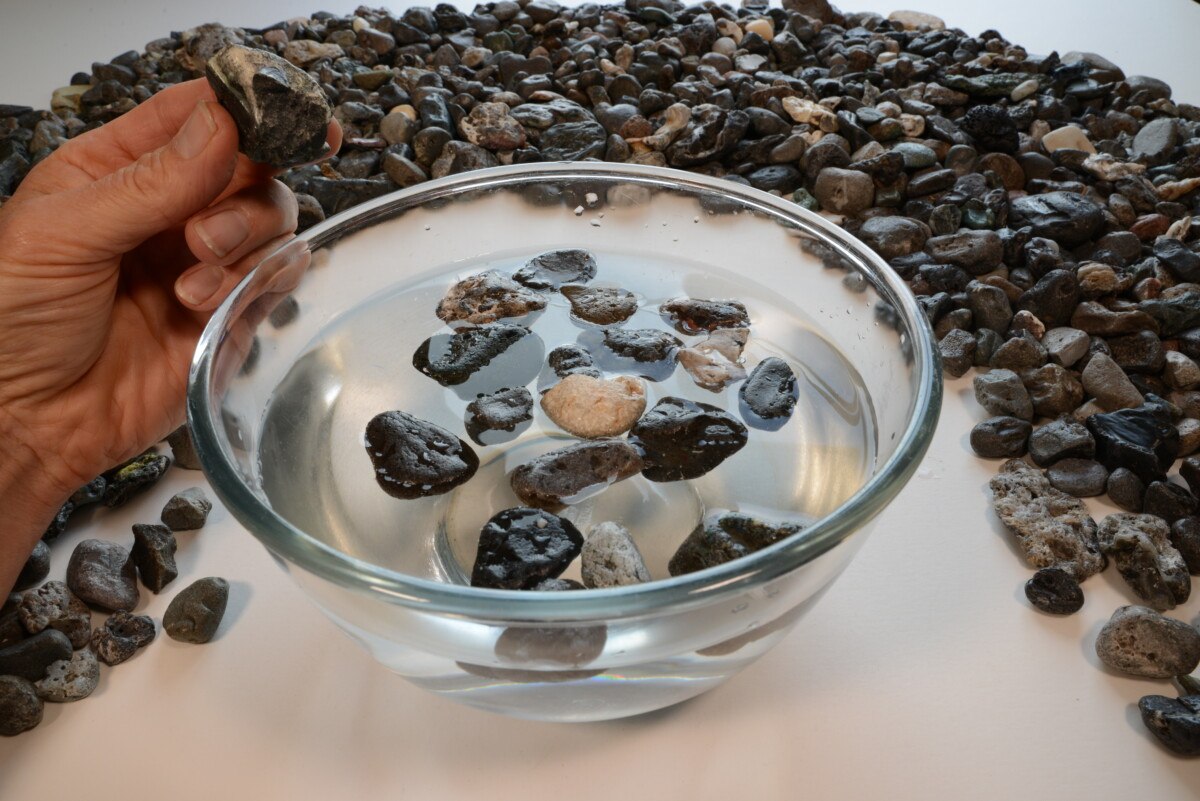
: Pyroplastics are small plastic remnants that look like rocks or pebbles (though weigh much less, and they float).They often are formed by melted plastic, either from being burned on a ship or thrown into the water. Analysis of them often indicate that they are eroded over time from other plastic trash. These are difficult to identify at a glance and there may be far more out there than predicted.

Plastiglomerate: Just like it sounds, plasticglomerate is the combination of plastic and conglomerates, making it like a combination-style sedimentary rock. It is formed by mixing and merging plastic with something like coral, cooled lava, or shells. It can be considered a subset of pyroplastics.

Plasticrust
: A subset of plastiglomerate, plasticrust is when plastic melts onto rocks of shorelines.This is going to be consumed more by land animals versus sea life. These are created by sea waves depositing the plastic on the shore and it melting onto rocks.

Anthropoquina: This is also similar to plastiglomerates in that it is a mix with plastic and other materials, resulting in a technofossil of both man-made items and natural items. They too are naturally created by sea waves and the sun molding things together.

Plastic soup: Plastic soup is considered the mix and mingle of all of the above. The term was coined by Captain Charles Moore in 1997 during a sailing trip from Hawaii to California. It refers to the plastic floating on the water surface, sinking to the bottom, and all the tiny pieces between. 

Neopelagic communities: When plastic trash hits the waterway, they can become a habitat for organisms. Often time, marine debris lands on a coastline. But, if it goes out into the open shore due to currents or weather systems (or other reasons), they become a raft-like habitat. It is not uncommon for some coastal creatures such as anemones, hydroids, and shrimp-like creatures to hop a ride and make themselves at home on floating marine plastic. As long as the creatures have food source, they may have found themselves their own little floating plastic house boat. This in turn can take coastal species to other areas where they are not native. At that point they have the potential to become an invasive species, threatening others around them. Additionally, it could take them to environments where these creatures are not suited for survival.

Now that we have a new and improved vocabulary...seems like our plastic habits need a definite step up. In this plasticized world, makes you rethink every plastic item you touch. Like I ask my own children and my students: do you want to be part of the problem or part of the solution. 

Saturday, October 2, 2021

Continuing to Make a Difference, One Act At A Time

According to Wonderopolis, a video goes viral when it tops 5 million views, typically in a very short time and due to multiple shares on social media.

Over 18 million views strikes me as viral. 

This video, posted by Pall Sidgurddson in April 2019, showcases both how pollution in the form of marine debris has impacted nature AND how connected the human and natural world can be. The video details scuba divers helping an octopus replace its plastic cup shell with something far more protective. You can learn more about the dive and experience on Upworthy's article entitled "Kind Scuba Divers Try to Convince a Tiny Octopus to Trade its Plastic Cup for a Shell." This one small act of kindness potentially saved both this coconut octopus and any potential, future predators from consuming that plastic cup. 

One small act of kindness always makes a difference!

Video from https://www.youtube.com/watch?v=DTJbdy097m0

Saturday, July 18, 2020

Sailing the Seas of Citizen Science

In the 3rd and final part of my series following some of the 2019-2020 Severn School Van Eney Fellows Projects, activism and advocacy continue as senior (now graduate) Baillie McNitt merged her love marine biology, citizen science, and global health initiatives to to a deep dive into microplastics. Her project involved constructing a Low-impact Aquatic Debris Instrument, or LADI trawl, which came to be known as True the Trawl. Additionally, she created a YouTube channel to curate & document her beach clean up and more.

Using her LADI trawl, she also analyzed and classified her microplastics findings into 5 groups to determine the original source of plastics: fragments, fibers, foams, nurdles, and microbeads. By having this level of research, Baillie was better able to make the connection to the item--which ultimately helps keep marine debris out of our waterways. From there, she created a set of guidelines to help people reduce their use of plastic.

Here is Baillie's 6 minute "TED Talk" style explanation of her project.
Van Eney '09 Fellows: Bailey McNitt '20 from Severn School on Vimeo.


To learn more about Baillie's design process and project, check out her Fellows website. Of particular interest, check out her video page on her website. My personal favorite: "Seven Household Products that Contribute to Micropollution."

Going forward, even though there will be college life after Severn, you can't take the environmentalist out of Baillie. She has plans to share some information from of her Fellows project with Severn's Surfrider Instagram page to promote reducing marine debris.

As you go forward, think about the big and little things you can do in your house to minimize your plastic use. If you don't use it, it certainly won't wind up in our waterways!

Video from https://youtu.be/L4L7fU806ww, Compilation image created at Canva.com using pictures from Baillie's website: https://severnfellows20bmcnitt.weebly.com and micro plastic image from https://severnfellows20bmcnitt.weebly.com/bullet-journal

Wednesday, April 15, 2020

Earth Day Quizzes

With Earth Day swiftly approaching just next week on April 22nd, it might be a good time to test your environmental knowledge. Earth Day Network has 7 online quizzes for you to do just that. Dive in and see where you are... and learn a little along the way.

Their quiz topics include:
  • Whale Conservation Quiz
  • Protect Our Species Quiz
  • Climate Change Quiz
  • Oceans & Plastic Pollution Quiz
  • Environmental Literacy Quiz
  • Deforestation & Biodiversity Quiz
  • Clean Energy Quiz
If you need more, you can also check out the Earth Day Quiz over at Conservation International.

Might be some good resources to send out if you are doing remote learning!

Wednesday, February 19, 2020

Sailing Seas of Plastic

There's a new data visualization interactive map/website in town: Sailing Seas of Plastic. It was created by Dumpark, a New Zealand based agency who has done other environmental graphics as well. 5 Gyres, Mapbox, and Natural Earth were also involved in the project.

In the visualization, you can investigate data to see how much plastic is currently floating in the ocean. The data was compiled from 24 expeditions over the course of 2007 to 2013. The estimated amount:  268,000 tonnes....or 590,838,863 pounds. Considering how light plastic is, that's a lot of plastic. On the map, each dot represents 20 kilograms of plastic (44 pounds). In plotting the map of estimated marine debris, 13 million dots are here on the map... the result of 5 trillion plastic pieces in the world's oceans.

These numbers are so mammoth, they barely feel real.

A wealth of information is available on this website by clicking the "Learn More" link in the bottom left hand corner of the interactive map. Be sure to check it out!

After investigating the map, you might be inspired to rethink the plastic wrap, ziplock bags, or other unnecessary plastic. Even better, you might be inspired to do a little beach or woods clean up.


Screenshot of the interactive map taken from their website: https://app.dumpark.com/seas-of-plastic-2/#

Saturday, November 16, 2019

Wands for Wildlife

One of the best ways to keep trash out of the landfill is to reuse. Often times, that's where people hit the wall given some items just don't seem to have a natural way to reuse them.

Take plastic mascara applicator wands, for instance. However, Appalachian Wildlife Refuge in North Carolina has come up with a great reuse for these with their Wands for Wildlife program.


Twice a year, in October and February, Appalachian Wildlife Refuge accepts mailed-in collections of old mascara wands. The little bristles on the wand are perfect for removing fly eggs and larva from the fur or feathers of orphaned animals or birds that need rehabilitation. All they ask you to do is soak them in soapy water and dry to get off the mascara residue. They had to move it to only a twice-a-year acceptance policy due to their initial flood of donations. That's definitely a good problem to have!

To learn more about how to join the "Wandraiser," check out their website.


Video from https://youtu.be/enFEPuz36zU, image from https://www.waste360.com/business-operations/wands-wildlife-puts-discarded-mascara-wands-work