Wednesday, March 30, 2022

Cherry Blossom Season

Washington, D.C. is a beautiful city in the spring...especially when the Cherry Blossoms pop. I've been fortunate enough over the years to live close enough to meander about the city just in search of the perfect photo op. This year I didn't make it down there, but my Facebook feed was filled with photos from friends who were able to make it there. Simply Gorgeous! 

If you are like me and can't make it to DC (or don't care to wrestle with the inevitable crowds of everyone else wanting to see the scenic view too), you can find a bunch of photos on the @CherryBlossomWatch's Instagram page or follow the beauty on their Facebook page.

According to Cherry Blossom Watch's website and its work with the National Park Service, peak bloom was predicted to "spring" into floral glory this past week, March 22 to 25th. Historically, the peak occurs around April 4th. While the peak bloom only lasts a few days (depending on weather conditions--especially wind and rain), the Cherry Blossom Festival now runs for almost a month. This year, the festival is from March 20th to April 17th this year. The festival annually is predicted to fall when peak season occurs, however it's always a bit of a guessing game. Late winter warmth can make the blossoms appear earlier, whereas a cooler winter pushes the season later. So it's a science of appearance that only nature truly knows.

The cherry blossom trees were a gift of friendship to the United States from Japan in 1912. The original gift of 3,020 trees were planted around the city, and after careful cultivation through the year, cuttings from these original trees have been replanted to maintain the original genetic line of the trees. Now the iconic blossoming views are around the Tidal Basin and Jefferson Memorial are part of our American culture; and here we are, 110 years later, still enjoying their beauty. 

Given global warming temperatures, the trend of when these trees blossom has been creeping earlier and earlier in the year. National Park Service has been tracking peak bloom dates since 1921. This winter, with the second warmest December on record and mild weather in February and March, the 2022 peak dates have come about a week earlier than the averages over the last 30 years. In fact, this year marks the third year in a row of earlier arrivals than normal. The reason? Warming trends and earlier blooms are a result of a warming planet. Grist.org has an excellent article that goes even deeper into the science of climate change and its effects on the cherry blossoms. The biggest reason that this is a big deal is because of the timetable of when the pollinators mature and can visit and fertilize the flowers... which then affects the timing of the resulting food chain of critters who feed on these pollinators. Further studies on the cherry trees in Japan and their blossoms indicate the same climate trend, where trees in Kyoto, Japan had their earliest blooms ever last year on March 26th, 2021.

This 2016 video created by the National Park Service Climate Change Response Program details the reasons behind the earlier season (along with some amazing views).


Saturday, March 26, 2022

Earth Hour 2022 Tonight: Sat., March 26th 8:30-9:30 pm

With #ShapeOurFuture as the 2022 theme, Earth Hour is tonight. By tuning off lights along with other nonessential lights from 8:30-9:30 pm tonight [Saturday, March 26th], you can take part of sharing with the collective, community vision of unifying for the planet.

For ideas of what to do during your hour of "lights out," check out EarthHour.org's "1 Special Hour, 7 Meaningful Ways to Spend It" (there are some GREAT activities listed here) as well as these past GTG posts: 

Additionally, you can browse Earth Hour events over at earthhour.org.

Looking for more ways to take part beyond the 60 minutes? Check out go EarthHour.org's "Going Beyond the Hour."

Hashtags to follow on social media: 

  • #ShapeOur Future    
  • #Connect2Earth    
  • #EarthHour    
  • #EarthHour2022     
  • #OnlyOneEarth
What are you doing tonight to turn off your lights and take part?

Image from https://www.conserve-energy-future.com/earth-hour-and-its-significance.php and https://www.earthhour.org/take-part/organise-an-event/marketing-materials, video from https://www.facebook.com/earthhour/videos/762790861791472/

Wednesday, March 23, 2022

Innovation Through Sketchnoting

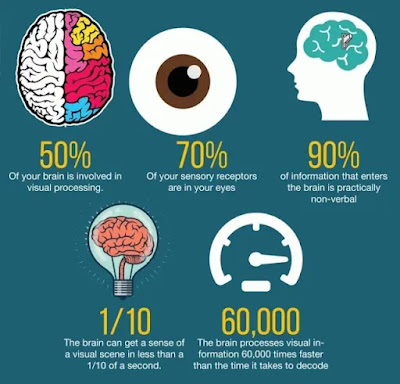
Sketchnoting is one of those "things" that have cropped up over the last several years, no doubt due to the visual nature of social media. Much like infographics, sketchnotes are a visual portrayal of information on a subject that is a doodler's dream. In that way, it's a specialized form of an infographic where the graphics are hand drawn (or "sketched") elements to make the information come to life. 

In a lot of ways, it's not surprising when the statistics look like this:


My guess too is given the digital interactions we all do, creative, innovative visualizations like infographics and sketchnoting will continue. 

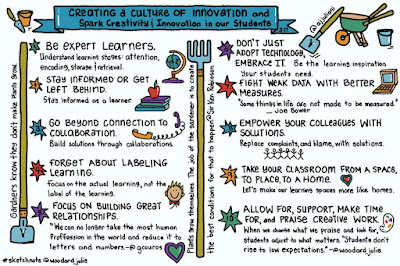
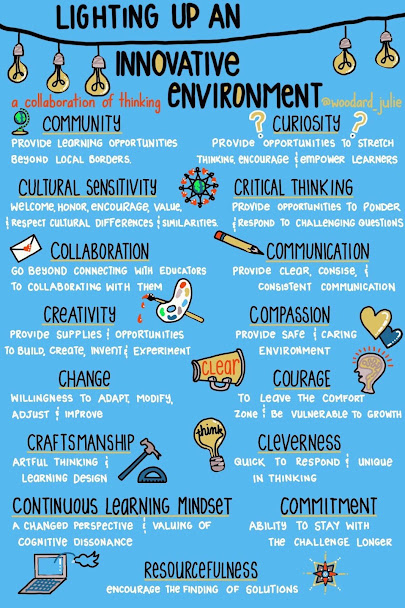
Given that, these two sketchnotes created by Julie Woodward are the perfect way to explore innovation. Building flexible thinkers who can help create future solutions is a definite goal of today's students!


Saturday, March 19, 2022

A Wealth of Women's History this Month

As we march the past halfway point of March, there's so much to take note of this Women's History Month. Resources abound in all directions: STEM, innovation, history, inspiration, and more.

One of my favorite discoveries is what is happening at the Smithsonian. Being a hop and a skip from DC, it's killing me that I may not be able to make it down there to see what is on display around the many Smithsonian Museums around the National Mall. The "IfThenSheCan" Exhibit is displaying 120 statues of women of famous contemporary female scientists. The catch: their distinctive orange 3D printed, life size nature makes them a highly visible stop and the largest ever collection in a single location of women statures. The exhibit hopes to promote the power and importance of women in STEM to inspire girls to pursue science, technology, engineering, and math. Currently, only 27% of the STEM field is women. The exhibit is on display March 5-27th, 2022. I can only imagine how powerful it would be to walk amongst these women! You can learn more about the featured women and take a virtual tour on the exhibit website.

Here are some other resources and points of interest this month: 

For 21 facts and a historical trek teaching you about some of the dates and stats surrounding Women's History month, visit this Woman's Day article. 

I subscribe to writer and history teacher's newsletter The Clever Teacher. In her latest post, she details 5 Women's History Videos for Kids. All 5 are great finds and I highly recommend them.

Back at the Smithsonian, the National Museum of National History has an exhibit called Girlhood [It's Complicated]. It investigates what it means to grow up female in America. If you can't get to DC, you can learn more at the link above or at the exhibition website.

A number of virtual events are happening this month through the Library of Congress. Additionally they have a research guide about Women's History

Learn about the 2022 Women's History Month Theme "Women Providing Healing, Promoting Hope" at the National Women's History Alliance.

Google Arts & Culture has a variety collection of resources too.

  • Google Arts & Culture has a wealth! Go there and search "women's history" to get 146 stories including:
  • For more, go to Google Arts & Culture and search "women and environment" for 20 more including:

Lots of resources abound. Be sure to check them out!!

Image from https://www.smithsonianmag.com/blogs/national-museum-of-natural-history/2022/03/08/120-3d-printed-statues-of-women-redefine-what-scientists-look-like/ Courtesy of IFTHEN® Collection, by Hannele Lahti

Wednesday, March 16, 2022

Earth Hour 2022: March 26th @ 8:30pm

10 days from now it will be the 16th annual Earth Hour. What started in 2007 as a local event in Sydney, Australia has now become a worldwide, global event that happens in your time zone, on the 4th Saturday of March from 8:30 pm to 9:30 pm. During that time, individuals and businesses are encouraged to turn off all non-essential lights for that hour to symbolize our collective commitment to the planet. By clicking those lights off, it shines a spotlight on the importance of every person and their ability to take action and make a difference. Likewise, it draws attention to our global energy consumption and how that affects climate change.


For a timeline of milestones from 2007 to today, ways to take part where you are, and why 2022 is so important, check out Earth Hour's website or WWF's Earth Hour site. Likewise, you can check out Green Team Gazette's Earth Hour archives.

Wondering what you can do to fill your evening--here are some good ideas, all from my 2018 Earth Hour post:
  • Stock up on candles and light them up as you knock out all your other lights at 8:30 pm.
  • Unplug and have some good ole fashioned non-tech time.
  • Play a game of night time Hide & Seek.
  • Have a candlelight dinner... perhaps al fresco.
  • Roast some marshmallows over a bonfire with good friends.
  • Take a moonlit stroll.
  • Spend some time in reflection and meditation.
  • Play board games with your family by flashlight.
  • Go stargazing.
  • Take a night hike.
  • Tell ghost stories.
  • Take time having great conversations and quality time with someone you love.
  • ...the sky is the limit! Create your own fun! Let me know what you are planning to do!

Sunday, March 13, 2022

A Pandemic 2 Year Anniversary

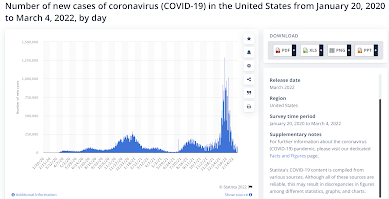
This weekend marks the 2 year anniversary when everything shut down in 2020 thanks to the growing numbers of Covid 19. 

As with any milestone in our lives, it causes us all to take pause.

It struck me especially earlier in the week when this image popped up in my Facebook memories from 2 years ago. Little did I know the extent of foreshadowing it really would be.


Thinking back more to Friday, March 13th, 2020, that was the day our school along with the majority of all schools across the country shut down. I had just come off a grueling recertification application for our school's Maryland Green School status. I'd been working nonstop on that application for about 8 weeks, which overlapped with approximately 2 weeks of school tech prep, trying to forecast needs for what our tech team thought would be a 2 week (or so) Coronavirus hiatus. My spring break travel plans to see my mom in another state were canceled and I spent my break instead on tech prep documentation. Spring break was followed by remote learning. Not 2 weeks, but 2 and a half months. My daughter's high school graduation went virtual. Her senior trip was canceled. Summer vacation plans were canceled. "Covid College" was a thing. At my independent school, we started the school year masked and hybrid, splitting classes into cohorts who went every other day. Zooming while teaching in class felt like we were juggling knives and living in triage. Meanwhile many others schools stayed remote for the bulk of the year, dealing with their own challenges. One year ago, a year into the pandemic, our school brought all students back full time, but it was rare compared to the public schools, and it was no where near what teaching had been pre-pandemic.

What we thought would last 2 weeks has now rounded out 2 years. [I remember flipping out when someone commented in April or May of 2020 that it could go until 2021!] 

Terminology such as the multitude of variants, "social distancing," "flattening the curve," "learning loss," "zoomers and roomers,""contact tracing," and "vaxed and boosted" have peppered our vernacular. We've gotten good at "doomscrolling" on our devices. We've also been either hopeful or stressed while mask mandates are lifted. This past 3 weeks at my school was "mask optional," and in some ways, I'm not sure I'll ever be ready to take off my mask in large groups. When the virus eased up last summer before Delta came, I had my mask off--now, I'm thankfully watching those positivity rates decline in our highly-vaccinated state, but I also am waiting for the other shoe to drop. Are we really ready globally to call it Covid-quits...or does the virus have another plan in store? I just don't know any more!!

Throughout the whole pandemic and its many phases, I've often thought of times in history when people have collectively gone through events that have changed them. War is often what comes to mind. I think of the victory gardens and rationing of WWII and how people worked collectively for the common good. I think of the way people of the world united over 9/11. Even globally, much of the world is collectively on the same side of the Russian invasion of Ukraine and the fight for democracy. Yet, fighting the pandemic didn't fall in that same category in our now-very-partisan country. As a teacher, following the science of the virus all seems so incredibly logical--yet not everyone has viewed Covid-19 this way. [But that's become a political rabbit hole, and one I'm not heading down here.]

Two years in "normal times" brings about a lot of change. During a pandemic: even more. We all are collectively changed. At times, I almost feel like it has literally changed my DNA. In some ways, perhaps we all are a little broken because of it.

There has been a lot of talk over the last two years about the "new normal" and what that is and what it should be... and how perhaps we should all "just return to normal." I think we are all still recovering--especially those of us who have lost someone to the virus. (Covid deaths over these two years in the US near the 1 million mark at 965,000 people.) Many of us are still mourning the loss, too, of missed milestones and hampered opportunities stolen by the pandemic.

While epidemiologists and medical doctors continue to learn more about Covid-19, its mutations and longterm effects, we as citizens are continuing to learn how to navigate this world. As in times of enormous change, that's when we re-analyze our priorities and make decisions how to go forward. Determining how to be with each other again after globally enduring a lot of isolation. No doubt, we will all be learning from this for quite some time. With any luck, it's rounding the bend. May we navigate it well, taking care of each other along the way as we do.


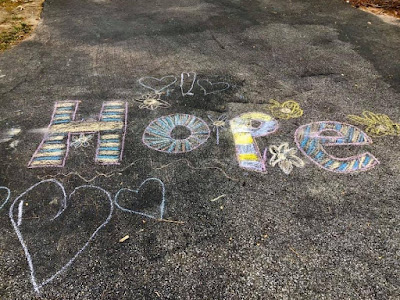
Warning graphic citation unknown, graph from https://www.statista.com/statistics/1102816/coronavirus-covid19-cases-number-us-americans-by-day/, Hope image from https://greenwoodcapital.com/life-after-the-pandemic/

Wednesday, March 9, 2022

Pausing to Ponder the Class of 2030

When I was doing my spin through all of the various Google Arts and Culture Experiments, I happened on on of them that caused me to take pause. 

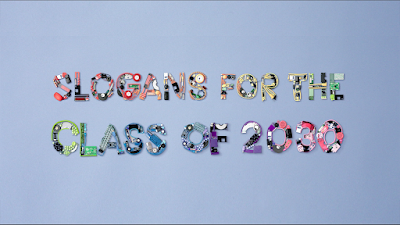
The title: "Slogans for the Class of 2030." 

We do a lot with the "Class of 20__" structure at my school. Given that, I knew that those students were our current fourth graders. Additionally, with the style of this video and with the young artist Celeste, it really left me wondering where we would be in 8 years in terms of innovation and technological advancement. For some predictions, check out this article/image gallery from Goodhousekeeping: "30 Facts About the Class of 2030."

Our world ahead is most certainly for our children to create! May we teach them well

Video from https://youtu.be/6-0pcsS2tkg, Image from https://experiments.withgoogle.com/douglas-coupland

Saturday, March 5, 2022

Harvard's Askwith Education Forum: How K-12 Schools Can Take Action on Climate Change

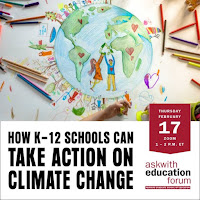
A colleague pointed me in the direction of Harvard's Askwith Education Forum's webinar: How K-12 Schools Can Take Action on Climate Change. Not only was it free to register, but free to watch for all after the fact. It was a powerful hour of discussion with moderator Bridget Long (Dean and Saris Professor of Economics at Harvard Graduate School of Education) and 3 amazing experts: 
  • John King Jr., President and CEO, The Education Trust; former U.S. Secretary of Education 
  • Pedro Martinez, CEO, Chicago Public Schools
  • Becky Pringle, President, National Education Association
[Side Note: One of the interesting things was John King Jr's approach given he is a fellow Maryland resident. When I started doing more digging on him, I also discovered that he is a candidate for the Governor of Maryland.] 

The conversation between these experts in this webinar focuses on how schools and educators can be leaders toward a more sustainable planet and society. Additionally, they discuss the multi-faceted impact of environmental justice and why there is such a great need to educate our students on these factors.

They also share information about the Aspen Institute's K12 Climate Action Plan and the Local K-12 Climate Plan's Key Questions to Get Started. These are two great resources for environmental educators.

To learn more, go to the Askwith Education Forum's page and watch the video and learn more about the webinar. You can also watch it here or below.


Wednesday, March 2, 2022

Environmental Good News

There's a lot going on in the world right now. Especially as we are approaching the 2 year mark of major global impact from the pandemic, (along with climate crisis, racial injustice, and polarized politics). The current events in the Ukraine feel extraordinarily heavy and hard. [In fact, if you and your children are having trouble with that, please check out this article at Very Well Family.]

Given the harshness of the 2020s so far, sounds like we need a heavy dose of "insert good news here."

IPS Positive News Stories does just that. The Inner Picture Stories (IPS) Project was created by Jellis Vaes. The purpose of IPS is to share forward stories connected to the beauty of life, opportunities that surround us, and ways of getting a better handle on healthy mental health. Sharing the good stuff!

In their December 24, 2021 podcast, they bring to light "5 Positive Changes in the Environment." It can be easy to be stuck in the doom and gloom especially when it comes to the environment. So here, they focus on these 5 stories, showcasing a short video for each on their website highlighting more about each one.

1. Search Engine Ecosia, where you can plant trees through clicks. They just planted their 100-millionth tree.

2. Nzambi Matee started her company Gjenge Makers to create bricks from recycled plastic. In addition to being lightweight and low cost, they are 5 to 7 times stronger than concrete.

3. In Oslo, Norway, they launched the Yara Birkeland, the first electric, self-propelled container ship. This cuts 1,000 tons of carbon dioxide.

4. A study from The Society of Conservation Biology has shown that conservation programs have aided in preventing 48+ animal extinctions during the 27 years between 1993-2020.

5. In Liguria, Italy the Ocean Reef Group launched Nemo's Garden, a first in the area of underwater vegetable gardening.

Image created at canva.com

Saturday, February 26, 2022

The Tree-mendous Benefits to Trees

One of the things I personally like about Facebook is that I follow a number of environmental and edtech sites. Given that, I am exposed to a lot of ideas from a lot of sources. Footpath Foundation shared this infographic created by Greenpeace. Definitely makes you understand why we have treehuggers out there--trees give us a wealth of benefits. 

Image from https://www.facebook.com/FootpathFoundation/posts/5082349455157205 created by Greenpeace.

Wednesday, February 23, 2022

Google Arts & Culture Experiments

I've been doing some investigating around Google Arts & Culture. Not surprising given it's connection to Google, there is definitely a wealth there!!

One of the really interesting parts of the Google Arts & Culture world is their Experiments, which is self-labeled as "the crossroads of art and technology, created by Artists and Creative Coders." 

Currently, there are 80 Arts & Culture experiments [though, at this writing, there are 1605 Google Experiments total on a wider scope than just the Arts & Culture Collection]. Of these, here are a few that have environmental tie-ins. You definitely could get lost here, spending a lot of time exploring each one!

🎨 Voices for Change--A Global Goals World -- A 3D virtual experience to learn about the 17 United Nations Sustainable Goals. Mixed in are 1500 voices and comments from people from 60 countries.


🎨  Pollinator Pathmaker -- Design a garden that's a pollinator's dream. When you finish, you get a certificate of authenticity along with planting instruction to bring to you own backyard.


🎨 Cold-Flux -- Discover what can happen to our polar icecaps as global temperatures rise.

🎨 Medusae -- Data visualization that shows what happens to jellyfish populations when water temperatures rise and acidify, and those waters are overfished.

🎨 The Lagoon -- A visual collage to show you what can happen to a coastal city as water rises.

🎨 Climate Change Impact Filter -- Hundreds of pictures and a sliding scale to raise or lower temperature show you what can happen to 62 species (plus human-created items) if our global temperature rises.

🎨 Plastic Air -- With microplastics in the air, unseen, this gives you an opportunity to see what you can't see but are breathing in.

🎨 Coastline Parodox Filter -- Take a look at actual and predicted global sea level rising due to the effects of climate change.

🎨 Diving into an Acidifying Ocean -- Interactive data visualization that shows the effect of warming oceans on marine life.

🎨 Timelines -- With the help of drone footage over two glaciers in Switzerlandand Google Earth, take a look at the glacial retreat over the last 140 years.

🎨 What We Eat -- Data visualizations of what you eat and the carbon footprint it holds.

Saturday, February 19, 2022

The Power of Music & Nature

This is one of the many beautiful stories that came out of the pandemic. I didn't hear about it at the time, but read about it in Jane Goodall's latest book written with Douglas Abrams: The Book of Hope: A Survival Guide for Trying Times (part of the Global Icons Series). [More on that book in a future post.] It showcases the power of music and nature.

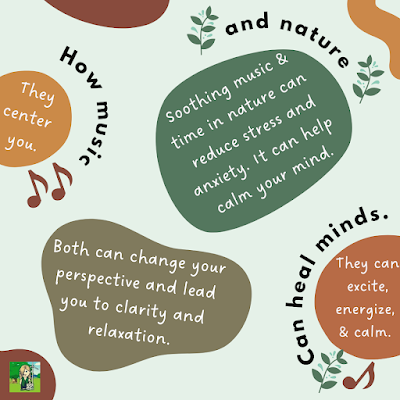
In June of 2020, at Barcelona's El Liceu Opera House, the string quartet live-streamed a concert. Performing Puccini's Crisantemi (Italian for "chrysanthemums"), the quartet In the thick of the pandemic, no people were allowed in, however there was only standing room available as every seat was filled with plants donated from a local nursery. 2,292 to be exact. The video is beautiful, hearing the music wrap around its colorful, cholorphyl-filled audience. Then what a gift for these musically infused plants to be given to Spanish healthcare workers who were enmeshed with patients struck with Covid-19.  Visionary Artistic visionary Eugenio Ampudia created this idea to bring music to the online world of folks in lockdown while also gearing at the importance of both music to support plant growth and how both nature and music can positively influence our mental health.

Bravo and standing ovations to all.


Video from https://youtu.be/HWMn0680cbo; image created at Canva.com 

Wednesday, February 16, 2022

The Six Americas

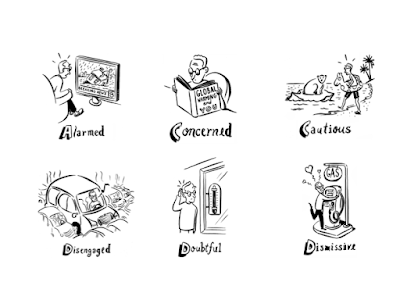
When I was reading Katherine Hayhoe's book Saving Us: A Climate Scientist's Case for Hope and Healing in a Divided World, I was struck by her chapter on the "Six Americas of Global Warming." This comes from the Yale Program of Climate Change Communication. Rather than Americans being merely binary as climate believers or climate deniers, there are really six different vantage points. They are pictured here:

The delineation is as such:
  • Alarmed--Climate change believers who feel it is here now as an urgent, human--created threat and are taking action as they can.
  • Concerned--People see it as a serious threat, but not immediate, therefor they give it less priority.
  • Cautious--Folks who are on the fence and haven't made up their mind about if it is happening, human-created, or a serious concern.
  • Disengaged--People who don't care, know little (if anything) about it, and are not interested in learning about it.
  • Doubtful--They do not consider it serious or even happening, or they may feel it is all part of t he natural planetary cycle.
  • Dismissive--People who do not believe climate change is "a thing," and they see it as a hoax or a conspiracy theory.
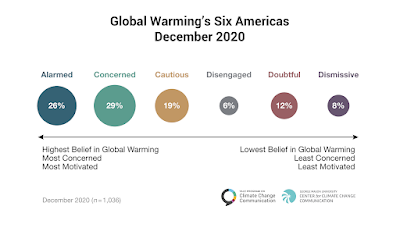
Yale's website has some impressive data visualizations as well as a video detailing each of the six perspectives and how they have changed over time. This infographic from their website shows where the numbers are per category.


Katherine Hayhoe referenced this information in her conversation about finding common ground to talk with others about climate change. (See my A Trio of Hope Messengers post for more about that.) She said that if you share why climate change is important to you based on what you know about your discussion-mate, you can help them to see why they might want to care. In relation to the Six Americas, you actually have the ability to reach others as long as they are in any of the categories except Dismissive. Dismissives are die hard in their disbelief of climate change. Your stories or experiences, no matter how compelling they are, won't reach them.

I found comfort in this, seeing it as far more promising than I had imagined by news stories of climate deniers. I also see it as encompassing the vantage points in perceived science deniers or even Covid deniers. The principles apply in both of those sets of views too. It's comforting because there are only 8% of the population that is so dogmatic with this issue, viewing climate change in the "hoax" department--meaning, that there's potential to reach the other 92%! 

Additionally, it shows a radical shift to the collective concern about climate change. That is what it takes to shift the balance in conversations, legislation, and activism!!

To learn more, check out Yale's "Global Warming's Six America's" video.

Images from https://climatecommunication.yale.edu/about/projects/global-warmings-six-americas/

Saturday, February 12, 2022

Nature-Inspired Valentine's Day

"Love, exciting and new....Come aboard, we're expecting you...." 

The theme song that fills my brain every Valentine's Day. The song is indeed a theme song--from the 1977-1986 hit TV show "The Love Boat" (an hour-long rom-com television show for those of you for whom this may have been a bit before your time).

As cupids and images of pink and red float about this "happy heart" holiday, maybe you can get some inspiration from nature this week. Here are a handful of sites with all sorts of Valentine's crafts and card ideas, all stemming from nature or natural items you can find outdoors. Fill you own heart with love of all the planet has to offer while you share forward your love for others.

Have a wonderful Valentine's Week filled with love!

Image created at canva.com


Wednesday, February 9, 2022

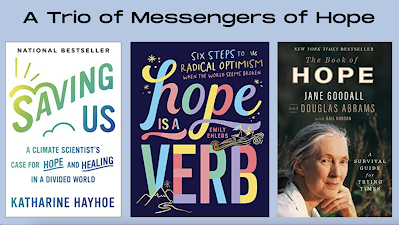
A Trio of Messengers of Hope

This fall and winter among the slew of books I've been reading, I read the three of these books--all of which made a powerful impact on me:
It doesn't take a rocket scientist to see the similarities by titles alone to know that they all are tied to hope in the time of climate change. On top of a pandemic (as well as deeply partisan politics and racial injustice), it is indeed is a difficult time to find hope. As authors and environmentalists, these three women (along with Douglas Abrams) had a daunting task as their main thesis. 

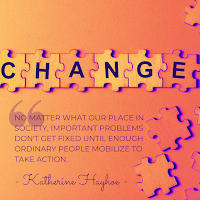
For me, the three books acted as different pieces of a puzzle, working together to build a larger picture. All three had ties to the pandemic and Covid--sometimes explicitly, and sometimes in more subtle ways. Additionally, I see parallels in the work to eradicate Covid as well as turning around the trajectory of climate change. Collectively, I needed all three, and I saw them as companion pieces. 

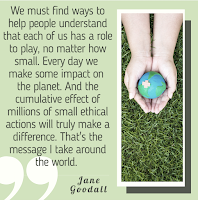
Within each of these books, the general sentiment that signs loudly is that hope comes from taking action. If we all do what we can, it is through all of our collective, individual acts that we make a difference. Even if our own small actions "feel like a drop in the ocean," (as Douglas Abrams said to Jane Goodall in their interview/conversational style book). However, Jane Goodall countered it with this quote: "But millions of drops actually make the ocean," [Book of Hope, p. 134]. Jane Goodall referenced multiple hope studies along with these four reasons for hope: "the amazing human intellect, the resilience of nature, the power of youth, and the indomitable human spirit," [Book of Hope, p. 35].

Katherine Hayhoe is both a climate scientist and a Christian from Texas--sometimes a dichotomous combination in our polarized world these days. She also speaks of the importance in taking action. Thought individual acts and working with others in the community, it perpetuates a cycle of action and support. "It's like knocking over the first domino: action eventually changes us all," [Saving Us, p. 205]. 

Given the title of Emily Ehlers book, hope is a verb. It's active--not wishful thinking not "just something you have; its something you do," [Hope is a Verb, p. 10]. Her book, full of art and a font that feels like you've stepped into her handwritten journal, makes it almost like a graphic novel. Perhaps some of the power comes from these visuals, one of which included this quote that also speaks to action: "We change and innovate when we have no other choice. What if we are about to step into a golden era where everything changes?" [Hope is a Verb, p. 51]. She goes on to say "Hope is not about closing your eyes to the world's problems and wishing they would disappear. It's about imaging a brighter future and then taking steps, no matter how small, to make that vision a reality," [Hope is a Verb, p. 146].

One of the pieces that I feel was powerfully similar in all three books was the concept of stories. Jane Goodall's book was a collection of stories about people she has met in her 8 decades and how their experiences have shaped all she knows and believes in as an environmentalist. She talks about how stories serve to move people more than data-driven statistics (which can often serve to be isolating or overwhelming). One of Katherine Hayhoe's biggest premises in her book is in the power of stories to connect with someone with opposing views. In doing so, then you can find common ground and can really begin to not only hear but also understand and appreciate each other. "Study after study has shown that sharing our personal and lived experiences is far more compelling that reeling off distant facts....Tell them why you care about climate change and others might too," [Saving Us, p. 19]. Emily Ehlers also shares the importance of storytelling by elaborating about Chimamanda Ngozi Adichie's TED Talk "The Danger of the Single Story." It is through the stories that we can see different perspectives and work to connect across the divides.

After reading all 3 books, I still struggle with hope sometimes when I watch the news--whether its about climate change, Covid, the angry world of toxic politics, or systemic injustice. But, as all 3 books explain, "hope" is an active job. At our most recent Baltimore Speaker Series event, political journalist Mara Liasson said "vote for everything and run for something"--meaning get involved in being part of the solution and part of the change. 

It can become easy to get overwhelmed by it all and want to run and put our head under the cover, but nothing will happen from there for sure. Even Jane Goodall admitted to having hard moments--but she still has hope. Seeing that, is what causes me to breathe more deeply. I find it comforting that Jane Goodall (just like Katherine Hayhoe and Emily Ehlers) still takes pause in the fighting spirit and determination of others who are taking a stand. Jane Goodall takes comfort and delights in seeing young activists step up as future leaders--she sees the power in active hope and engagement. "Without hope, all is lost. It is a crucial survival trait that has sustained our species from the time of our Stone Age ancestors....Hope is contagious. Your actions will inspire others," [Book of Hope, p. xiv].

What can you do today that will inspire others and cultivate hope?

Image created at www.canva.com using book art from www.amazon.com. Video from https://youtu.be/D9Ihs241zeg, Quote arts created using www.canva.com and book quotes from the 3 authors.

Saturday, February 5, 2022

Women in Innovation

The Smithsonian is known for its exceptional level of education--whether the museums in Washington, DC or their online counterparts. They know how to take learning to the next level.

One of the many ways it is doing that is by bringing the education to you in your homes and schools through their Poster Exhibitions. By going to their SITES Community website, you can order free print or digital content in their Poster Exhibitions to use as educational resources. They currently have an array of 13 different Poster Exhibitions to investigate.

The one I just ordered is their Picturing Women Inventors Poster Exhibition. It comes with 8 printed posters and educational material to go with it. Additionally, they have the posters available immediately with their digital download. I love that the inventors cross a variety of fields and showcase some amazing women. Women's History Month may be March, but these women are worth celebrating all year round!


Image acquired from https://www.sites.si.edu/s/topic/0TO1Q000000wz9hWAA/picturing-women-inventors-poster-exhibition 

It's Olympics Season

Olympic frenzy has hit the world! It is Olympics Season!

This year's Winter Olympics are in Beijing and underway, running from February 4th to the 20th.

Here are some ways to bring the Olympics into your classroom to capitalize on the excitement!

Image screenshot from Miss Hecht's Olympics Bitmoji Board https://linktr.ee/MissHecht?fbclid=IwAR2XjFRMe9tVrC97W3oZ4PQJJAp3xEjaDd45axQFddlArUvDj2AFfU31Dec; Video from https://youtu.be/FPdKq-MXQlk

Wednesday, February 2, 2022

An Evening With Walter Isaacson

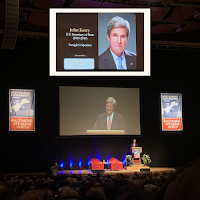
When you are a bit of an info-junkie, love at first sight comes in funny ways. It struck me in the pre-pandemic days when I was gifted a ticket to the Baltimore Speaker Series from a colleague to go see John Kerry. Her plans changed for the evening, opening up their ticket, making for a delightful evening for my husband and I to go to a beautiful venue and spend an hour or more listening to John Kerry talk on a multitude of topics. He is a fascinatingly brilliant man with a vast array of stories and experiences as well as an abundance of knowledge. Now, of course, he is ou first United States Special Presidential Envoy for the Climate.

The pandemic turned us all into homebodies for a good year and a half, but the Speaker series was always calling our names in the background...and now, mid-season tickets are ours for this year.

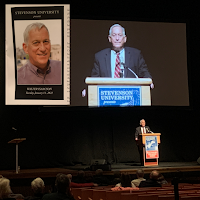
The first session we had tickets to this year was on January 11th. The speaker that night was historian, professor, and author Walter Isaacson. His curriculum vitae was extensive, being a former editor of Time Magazine, former CEO of CNN, and Fellow at the Aspen Institute (among other things).

As the author of what's come to be known as "The Genius Biographies," Isaacson knows a little bit about "genius," and the focus of his evening was the distillation of lessons learned from the many geniuses he has researched or interviewed and written about. And he should know since he's written books on Leonardo Da Vinci, Benjamin Franklin, Albert Einstein, Steve Jobs, Henry Kissinger, Jennifer Doudna (co-inventor of CRISPR and gene editing) and more.

As Walter Isaacson spoke throughout the evening, you came to see that "being smart" isn't enough. There are boatloads smart people out there.  But there's an extra "something" that makes "the greats" great. 

They have a sense of higher purpose and they push to see what they can do to push humanity forward. Additionally, what's key to inspiring creative and innovative, genius-level thinking are elements that innovators (and often entrepreneurs) have...YET, we all have it in us to do these exact things! Many of the these traits we nurture in our children; however, the true gift of genius is to never lose these gifts. We should spend our lifetime cultivating and curating the following to grow and enrich our lives:
  • Be passionately, playfully, obsessively curious--for his own sake.
  • Think outside of the box.
  • Be more observant.
  • Have a passion for your perfection, bringing beauty to what is important.
  • Simplicity is the ultimate sophistication
  • Have some humility.
  • Creativity is a team sport and innovation is a collaborative act.
  • Focus on the shared values, for they are greater than the ones that polarize us.
  • Celebrate the diversity that makes collaboration work
  • Gratitude is vital.
It reminded me of one of the ideals I hold most true: it will take innovation to solve our environmental issues. The same is true when it comes to social and environmental justice. It will take those with genius to "think different" (as Steve Jobs was known to say) to create the solutions necessary. 

Yet genius can be within all of our grasps. Continuing the love of learning and being open to possibilities are all part of the process. I love how we all have the power and potential inside us to do this exact thing!

Information junkies, for the win!

Book images from Amazon.com, other pictures from my camera.


Saturday, January 29, 2022

Urban Forests

What's a way to improve biodiversity and stockpile some carbon?

Create compact mini-forests in urban areas by planting native species close together in a dense area. These  mega, mini forests can have a way of packing a punch and taking a solid impact on climate change.

Video from https://www.facebook.com/UTWnow/posts/5831673740192193, Image created at Canva.com

Wednesday, January 26, 2022

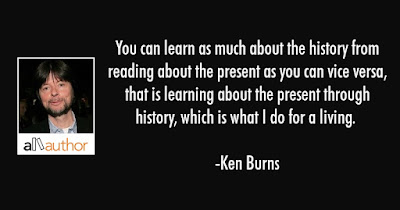
Ken Burns In the Classroom


Ken Burns has become synonymous with historical documentaries. No wonder, given he's been writing, directing, producing, and filming them for over 40 years. During his tenure and along with his collaborators, he has produced 36 films, most of which have aired on PBS, where you can also access them to stream online.

For teachers, this is a goldmine given he is the master of weaving together primary sources and archival footage.

PBS has set up a whole website dedicated to Ken Burns in the Classroom. There, you can search by film, era, topic, grade level, subject, and keyword to build your lesson plans.  Filtered searches can then lead you to videos, interactive, interactive lessons, lesson plans, audio, images, documents, webpages, and resource galleries that integrate with all of PBS's resources. 

The Ken Burns in the Classroom website also links you to the Ken Burns UNUM website, an extension digital world curated by Ken Burns in 2018 to build further connections. "Unum" comes from the United States motto: "E Pluribus Unum" which means "out of many One." His reasoning for both the name and the website--to create a visual history of a united shared history, even in divisive times. 
The goal is to remain impartial while layering together clips from past histories with the present day conceptual stories to see the greater meaning. Likewise, the intent is to help us return to civics education and civility.

UNUM is arranged by Featured content*, UNUM Shorts, Themes, Events, UNUM Voices, People, AP US History Themes, War, Places, Times, Conversations, and Opportunities from their Partners. Likewise there is a section for educators.

If ever you are looking for historical online resources, you may want to tuck this bookmarked page where you can find it!

*At time of writing, the Featured content includes his Facebook Live conversations in December 2021 with political historian, author, and professor Heather Cox Richardson.

Saturday, January 22, 2022

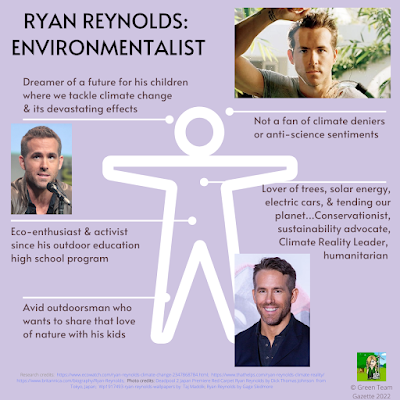
Ryan Reynolds: The Environmentalist

My mom loves Ryan Reynolds. Not in a weird way, but in a cute, her-grandkids-like-to-tease-her way, where she could possibly watch "The Proposal" every day. Especially with Betty White, it's a complete classic. Not to mention, he IS pretty darn cute.

More importantly, he was green long before 2011 when he appeared in Green Lantern (long before his Deadpool & Red Notice days). Being an environmental lover and activist has been part of his core for well over half of his lifetime.


He also is the voice of Canadian's January 2022 The Nature of Things "Curb Your Carbon" series (where curses! as an American, I can not view this! Argh!). [You can learn more about that series here.] Here's a trailer (and you'll get why I'm upset to miss it, as it brings that iconic, engaging Ryan Reynolds humor to the screen):


It sort of makes sense why Canada (and fellow Canadian Steven Page of Barenaked Ladies) wrote a love song to him, especially after he won the Governor General's Art Award for his work, entrepreneurship, and activism. May we all follow in his environmental endeavors and carbon footprints!


Infographic created at Canva.com--image credits on infographic, video from https://www.youtube.com/watch?v=8q4ph2XVelA and https://www.youtube.com/watch?v=nXulsCU1geg

Wednesday, January 19, 2022

TED's Think Like A Coder Series

I've been working on some coding activities with my younger elementary students at school. For my very youngest students, we use Bee-bots as a way to introduce the concept of programming. Then Code.org and their CS Fundamentals courses are the perfect introduction to block coding for young students. From there I always like to bounce into Scratch Jr on the iPad.

The students love it and always beg for more.

Coding and computational thinking are definitely key literacy skills for today's students.

That's why, TED-Ed's "Think Like a Coder" Series is brilliant! Partnering with YouTube Learning Playlist, TED-Ed has created these ten short animated adventures teach the principles of coding through videos challenging you to think them through. To learn more about the series, go here. With names like Prison Break, The Resistance, and more, they will capture the interest of students of all ages!

Here's the trailer:

Episode 1: Prison Break

Episode 2: The Resistance

Episode 3: The Furnace Bots

Episode 4: The Train Heist

Episode 5: The Artists

Episode 6: The Chasm

Episode 7: The Tower of Epiphany

Episode 8: The Gauntlet

Episode 9: The Factory

Episode 10: The Finale: The World Machine

Video from :https://youtu.be/qhAAmyGnA-M, Image from https://blog.endlessnetwork.com/blog-1/how-one-ted-ed-producer-thinks-like-an-artist-to-inspire-others-to-think-like-a-coder


Saturday, January 15, 2022

If Trash Could Talk

We all want a voice, because in having one, then we can be heard.

Archaeologists have long since been the historical voice through their archaeologist digs. You can learn a lot through the remains, and that remains true for both ancient and modern day trash. In that way, archaeologists are trashologists or garbologists!

Just like the Lorax spoke for the trees, these resources below speak for the trash. The video (🎥) may bring a smile, the book (📙) of poems might bring some enjoyment, and the experiments (🧪) might bring some hands on science... but more than that, hopefully they cause you to pause and rethink what you are using in order to go forward making different choices.

📙 If Trash Could Talk: Poems, Stories, and Musings (2018) by Jacquelyn A. Ottman

🧪 If Trash Could Talk experiment from the American Museum of Natural History 

🧪 Trash Talks from AIA Education Department

🧪 Trash Experiments from KonnectHQ

🎥  If Trash Could Talk from Buzzfeed Videos: