1 teacher. 1 world. Eco-friendly. EdTech-friendly. Classroom-friendly.Teacher-friendly. Kid-friendly. Parent-friendly. Planet-friendly. Sustainability. Innovation. What can we do to increase the likelihood that this one li'l world will be here eons from now? Whether you are a teacher, a parent, or just someone who firmly believes that every tiny bit helps, let's all be part of the solution rather than adding to the problem, knowing that innovation along the way is the way to make that happen!
Ahhh... to be known as a "rockin' eco hero," a comedian, and a magician. It might just be the trifecta.
Steve Trash holds this triangular title, and has been in action since 1984 spreading the message of recycling, sustainability, and being an environmental steward.
He's taken his show on the road just about everywhere: North America, Europe, Asia, multiple news channels, PBS, and issue of Weekly Reader, and more. He's got a YouTube channel with well over 250 videos. He has 2 albums and music videos along with his Trash TV series and more. He has a blog he's maintained since 2008. He even has a bank of solar panels in his front yard. He's all in, and all about ecology, science, STEM-STEAM, and even some videos on character development like manners, bullying, taking responsibility, empathy, being a good friend, digital literacy, and more.
He's everything you'd want an environmental educator to be! Definitely check out the plethora of resources he has on his website and YouTube channel when you are wanting to bring a little zip to your classroom eco unit!
As the recent host of a slumber party with seven 14 year old boys in my house, I know loud. These were perhaps some of the loudest people in America (or so it seemed on that Saturday night). But they were having clean, wholesome fun so how bad can that be.
Just as "loud" has a place in our world, so does "quiet." More often than not, though, quiet is quite the commodity. Background noises such as binge-watched television, show streaming, or catching a half-dozen Youtube videos is what more and more of us are gravitating toward in our free time. Or music--often with headphones (that would be my two teens at home--though back in the day a generation or so ago, it was loud music blasted from the stereo). Even social media these days is more often in video versus visual form with snaps, Insta-stories, or other videos. When my students get overly chatty at school, I discuss how we need to cut back on the "noise pollution," and we have enough pollution as it is!
As mindfulness is on the rise, so too is the move to #SaveQuiet. This is a hashtag started by Quiet Parks International. From their "About" page, looks like I might be onto something with this "noise pollution" thing. Much like animals, "quiet" is becoming an endangered species. With air zones overhead, highways near by, city sounds surrounding, noise is everywhere. A startling statistic from this page: "90% of children will not experience natural quiet during their lifetime." Yikes! That makes my ears hurt just writing this!
I co-lead an twice-a-week elective for 4th and 5th graders called "Funtography." It's a combination of photography and digital design. The photography side (run by my colleague) ultimately feeds the yearbook by building digital photography skills. On my digital design side, we talk about all sorts of graphic design elements (like color, typography, and layout). In both halves, there's a lot of opportunity for student exploration and creativity.
This year, we're going with a "going green" theme, which ties to playing with color, and delving into some environmental pursuits including a green screen project. That green screen project will be for my students to make an eco-tourism commercial.
I began by compiling a Wakelet board. Wakelet is a website that allows you to curate everything you want to share with students (or any other group of people). The best part is that with a QR code, link or an embed code, it's one-stop-shopping to all the resources I need for my students to have for the entire project, with the exception of doing their own research. Here's my Eco-Tourism Wakelet board, which details everything from resources to assignment for their green screen activity. I can't wait to see what they come up with!
After writing about Richard Powers' The Overstory, this seemed like the natural next step. One of the characters in Powers' book was deep into the science of how trees communicate with each other. In the book, this character was initially scoffed at by others based on her sentiments--which isn't surprising as it does sound rather odd. Yet there is actual science behind this line of thought.
These two videos from BBC and National Geographic do an excellent job of explaining the conceptual phenomenon of talking trees and the "Wood Wide Web."
.
Given the fact that intra-forest communication comes from the tallest, eldest trees, it definitely speaks (pun intended) of making sure we don't take down the oldest trees among us--even if reforesting plans are in place by planting new, younger trees. This, in turn, conveys the importance of maintaining those threes in order to maintain the resiliency and longevity of the forest.
So up until we can understand their language, we're still going to need the Lorax to speak to us for the trees!
I recently read Richard Powers' Pulizer Prize winning book "The Overstory." The title was poignant for multiple reasons--it's terminology refers to a layer of foliage in the trees--a common thread in how the book was divided into sections all based on tree terminology: Roots, Trunk, Crown, Seeds. But more than that was the over-arching story, the "over story" of how trees were vital to each of the 9 main character. Additionally, the trees themselves were one of its greatest characters in the book.
I will say, my favorite character was in fact a tree--the American Chestnut. I enjoyed learning about both its true history and how that tree's history was woven into the fictional life of one of the main characters. As the characters came together, the initial part of the eco-activism storyline reminded me of my own time last summer in California's redwood forest and of Julia Butterfly Hill. An added piece of connection--I read much of the 500-page tome outside, under the trees of my own backyard.
Digital Citizenship Week, mid-October, has been an annual "event" for the last several years. This year, it falls October 14-18.
Of course, some argue that in today's day and age, is it "digital citizenship" or just plain "citizenship" as the only difference is the device. As parents and educators, we want to be encouraging our kids to be good people out in the world no matter what--both online and off. And, in a world where sometimes this is lacking, the importance is stronger than ever before.
#DigCitCommit is a partnership between 17 major technology and edtech companies urging all to commit to digital citizenship. Their focus is on 5 major strands that encourage all (students and adults alike) to be inclusive, informed, engaged, balanced, and alert. By focusing on these 5 competencies, we build future leaders:
The year now is 2019. The month, October. Meaning we are almost at 2020.
30 years ago, when we do that rounding up, it was nearly 1990.
I was in college.
Yes, I'm showing my age.
30 years from now, it's going to be roughly 2050. By then, hopefully, I'll be really old (because it certainly beats the alternative!)
30 years of difference--3 decades--on either side. Two environmental resources I've run across really nailed that piece home. One was Time Magazine's September 12th issue, which was entirely dedicated to Climate Change: "2050: How Earth Survived." The other was The Years Project Video: "Thirsty World" video, prophesizing on where we'll be if we aren't careful. It's not pretty. Population growth is not going to stop or reverse. In fact, the expected population by 2050 is 9.8 billion (compared to our current 7.7 billion). Yikes!
Begs the question--why are we still here? They mention a 30-year wake up call/reality check. It is from this vantage point that details why they dedicated this entire issue to climate change (only the fifth time in their 96-year history they've dedicated entire issues to one subject.) I like how they are clear that they are convinced in the unquestioning science backing climate change, and no climate skeptics are featured in the issue.
Featured in the issue is their "Voices" section, where they take some of the climate thought leaders who write their thoughts on the subject. There are too many good ones to list, so click here to click through and read them all. If you only have time for a few, my favorites are Jane Goodall's, Al Gore's, and Graça Machel's.
There's also a great multimedia 3D piece entitled "The Dying Rainforest" narrated by Jane Goodall on the perils the Amazon Rainforest is facing. Add in, articles on the following:
The 124°F heat of Jacabobad, Pakistan may be foreshadowing to global rising temperatures.
The Great Green Wall of Africa where growing nearly 5,000 miles of plants is helping mitigate the effects of global warming;
Bottom line--there's a lot here!! All of which is excellent reading. Imagine the world if we all read and absorbed this issue!
3 decades of time on either side. It makes you wonder, where will we all be 30 years down the line in 2050. Hope and optimism are two of my governing traits, so I pray it is NOT where The Years Project projected! May we all follow the lead of so many mentioned here, and the young activists like Greta Thunberg who were leading the way this past September!
As the Technology Specialist who talks a lot about the Design Process at school--both in and out of our Maker Lab, these images from the Bioconstruccion's Facebook page show some amazing and massive cardboard construction projects. Now granted, these are not small projects, but they might serve as creative inspiration for your students!! Check out the pictures below!
What a super way to repurpose--especially with the glut in the recycling industry where cardboard sometimes does get recycled in some communities. Add in, in today's age of a lot of Amazon.com and other delivery boxes that come right to your door, cardboard as a building material is pretty easy to come by!
For more inspiration, watch this and check out the following links of ideas & watch this video:
In the wacky world of today, we all need a li'l bit o'love... and a whole lot of optimism. Like love, I think it makes the world go 'round.
This video "140 Seconds of Optimism" from Climate Optimist follows suit with the sentiments I wrote about earlier in the month in my post "Handling the Emotions of a Rough August," plus it ties with the "Climate Change Solutions Quiz."
To learn more about how to be a Climate Optimist, check out there website. While there...
The "Good News" stories--things that are happening world wide to help solve climate change and move the needle forward.
Read the Climate Optimist Manifesto. (My favorite line: "Because hope beats fear. It’s the attitude that inspires progress.... And when we succeed this time, we’ll solve more than climate change. Renewable energy means jobs. Solar energy can help free people from poverty. Cutting pollution benefits our health.")
It can become easy to be fatalistic, hopeless, or fear-filled. but why? Optimism is a much more pro-active, energized, and positive way to go. What can you do to begin to make a difference?
Several articles I've recently read discussed how the design process was often a staple in the high schools, but not always in the elementary schools. That's almost downright silly, as PK-5th grade is the perfect age for making and inventing. The illustration here highlights the design process we use with our elementary students, one we've been using for over 6 years. It's a key part of our MakerLab activities and something I've written about before.
Teaching about the Innovation Mindset, you come to see the importance of problem solving, brainstorming, planning, testing, creating prototypes, retesting, redesigning & iterating, then finally sharing. We discuss the key feature of "failing forward" (and I often refer to "fail" as "First Attempt In Learning.") It governed us as we learned to walk, ride a bike, and do many new things in our lives. We can only get better by trying and retrying something, modifying as we go. As Lily Barnett wrote in Peninsula Press' "Design-Thinking Trickling Into Elementary School Classrooms," it's a key feature in Carol Dweck's growth mindset. It builds confidence through the creation and ability to tackle challenges.
Empathy too is an important part, because it helps with the tie-in of real world problems. By trying to take on the vantage point of another, students can see the importance of trying to solve a problem that serves the needs of others. Empathy is a piece that is significantly missing in today's world. Just check out social media or today's partisan politics!
As Rikke Dam & Teo Siang wrote in Interaction Design Foundation's "Design Thinking: New Innovative Thinking for New Problems," it is through new ways of thinking that problems are solved. We need to be able to think outside the box. As educators, we need to help shape our students to be the next generation of people to bring about better solutions to our global problems. It becomes the merging of both logic and imagination, science and creativity, empathy and analysis. Usually collaboration and critical thinking are also woven in there as well. All the essential skills future employers will want from our current students--even those that are still very young. The power of play in the elementary school environment is not all that different from what innovative companies like Google or Apple are doing to craft a creative workspace.
But as Megan Collins points out in her Edsurge article "Design Thinking Is a Challenge to Teach — and That’s a Good Thing," the design process is not set in stone. It's a framework that works for big and small classroom projects. Reflection after the fact to discuss how the process progressed is also key. Being able to see where you could or would do things differently next time is a valuable skill. This might mean teachers need to shift their own thinking and teaching along the way to also "include growth, reflection and failure. They [too] become designers” of both their curriculum and a classroom of creativity.
So for my teacher friends out there who are designing both lessons and students: here's a list of engineering challenges & resources for grades K-12. I made sure to curate this list with both general engineering challenges and also design challenges with a "green lean!"
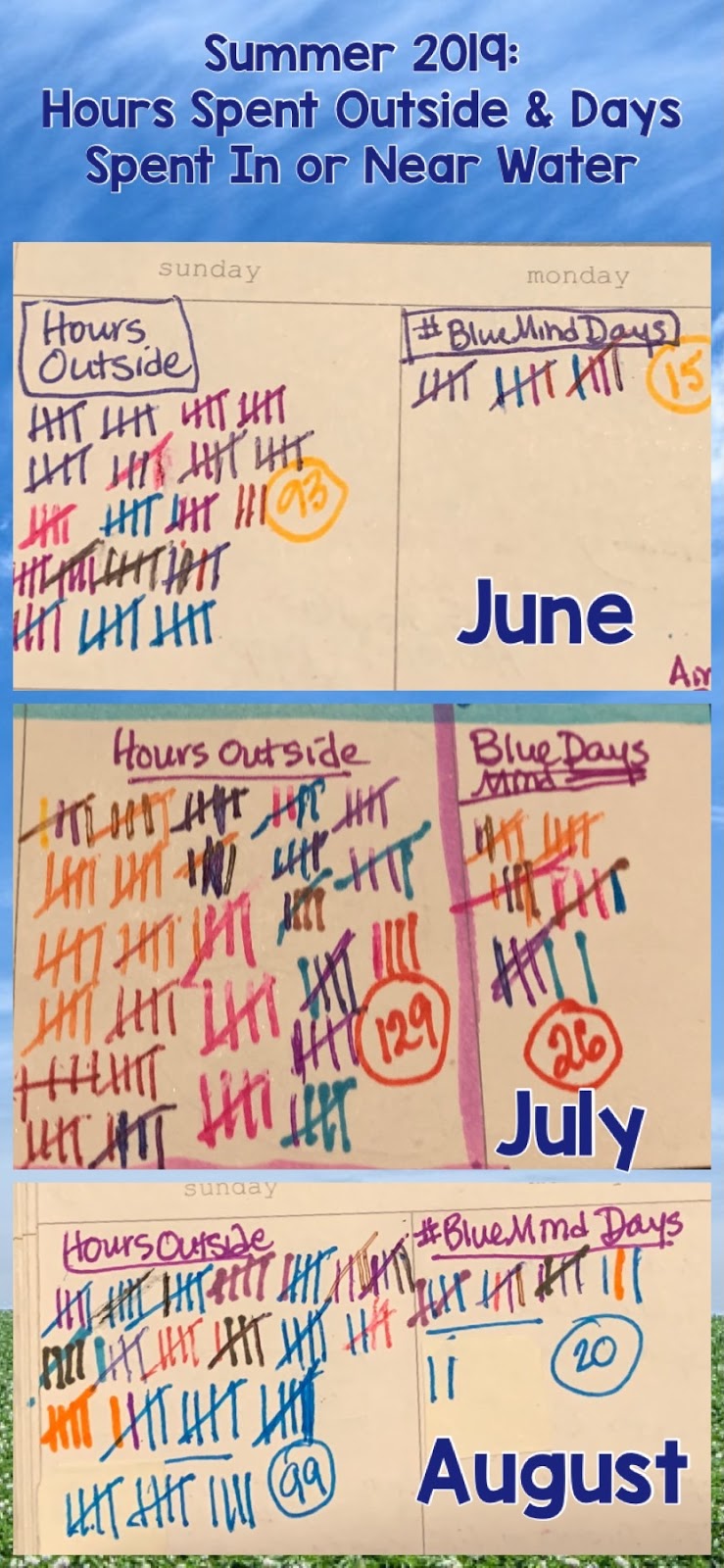
Last summer I decided to do a little outdoor accounting of the number of hours I spent outside after learning about the blog 1000 Hours Outside. You can read more about that personal challenge here and then read about my results (here). I was delighted to surpass my goal of 200 hours outdoors and get 269 hours...which also was more than the seasonal math (given 100 hours) of 250 hours for the summer.
Well as we all know, summer 2019 has come, the days are starting to cool, and fall is officially here (at least by the calendar date).
Traveling back to the end of May 2019, I was once again inspired to carve a corner of my monthly calendar into a tally section, trying to see if I could do it again. Having read Nature Fix and being reminded of the neurological and emotional effects of nature on people, I was certainly up for it. Additionally, having read Blue Mind, I decided to add an extra layer, counting my #BlueMind Days to see how many days I could be in water (usually my pool) or near water like a stream, fountain, river, lake, or the Chesapeake Bay (which is in our neck of the woods).
My results:
Over the 94 days of summer (which was the 3 summer months plus September 1 & 2 due to it being Labor Day weekend--you can see the separation line in my August calendar), I totaled 326 hours outside and 61 days (2/3 of my summer) with some time in or near major water. I'm rather proud of those numbers and the benefits I gleaned from them.
My takeaways:
I am a girl who craves and thrives when I have bulk time in the outdoors. Reading out there, or writing, basking, sitting, being in the pool, hiking, biking, or more. I had a hard time getting back into the "back to school" routine of being back indoors. (I'm reminded I had that bit of culture shock last year as well.) The first week of school meetings and then starting back with students had me going through a little Vitamin N & solar withdrawal. There just weren't enough hours in the day for me once school started back in session to get in my full daily desire!
The pool is my meditation and exercise space. I read in the pool, exercise our crazy canine there, and it's one of my favorite places to watch the wildlife that visit the backyard or the bird feeder.
A tropical family vacation in Punta Cana definitely was significant to my July numbers!
As much as I like my backyard critters, mosquitoes got in my way! I'm one of those people they love to chow on. Bug spray alone wasn't always enough, and after awhile, around dusk or so, I'd be forced indoors after feeling like I was their "feast de la resistance!" If the world had no mosquitoes, I'd have been outside even more!!
"BlueMind days" could have been "my everyday" if I went to stand next to my backyard pool. However, I didn't feel that alone counted. It had to be meaningful water--either me in it, on it, or going out of my way to be near it. It did get tricky when visiting my mom in the Midwest--but I found the lake, a fountain, or a duckpond to help me satisfy my quest. It got doubly tricky when I had a minor dermatology procedure that left me with stitches on my ankle for two weeks right before school started. Stitches should NOT be allowed in the summer time!
The difference (both in my ability to notate the numbers AND get outside) does shift dramatically when I'm working versus when I'm not. I kind of hate that. It has made me make sure to approach my evening and weekends more consciously, using the gifts of the beautiful outdoors in every way I can.
This summer we went to Punta Cana in the Dominican Republic for a family vacation. In addition to it being a fabulous way to spend every day outdoors, we went on a breathtaking excursion that was adventures and memories packed all in one! It was also a great way to get both my Vitamin N & my #BlueMind satisfied, all in one!
Scape Park at Cap Cana is an outdoor playground of ziplines and waterholes (and sometimes the two were combined) in the Dominican Republic rain forest. We had an 8 hour packed day, but we certainly couldn't do everything! Here's a sneak peak at all of their offerings:
Their attractions that we did take advantage of (as there just wasn't time for the beach, horseback riding, and all that we did):
Doing 8-10 ziplines along their ecotour--the last of which landed in water!
Trekking the Cultural Route--a rebuilt village of the Tainos Indians with historical boards detailing Christopher Columbus' invasion.
Splashing about under a waterfall.
Swimming in a crysaline underground cave, a treat all to ourselves.
Jumping into Hoya Azul, a ceynote (which is a sink hole that filled with water).
Visiting the True Bat Cave: Iguabonita Cave--with helmets on to protect us from the bat droppings!
It was a remarkable way to spend 8 hours outdoors. Here's a peek at some of our favorite memories of the day.
When it comes to traveling and/or outdoor adventure, do it. Just the mere fact of encountering something different is what life is all about. It widens your perspective and gives you new experiences. Some of those may include a glimpse at other cultures. When. you can see the wider world outside of yourself, it it builds perspective, empathy, and even more when some of those experiences are outside!
A good online quiz is quite satisfying. Here's one that won't name your Hogwarts house or which Friends character you're most like, but it will teach you a thing or two about how to be the best planetary protector you can be!
CNN's Climate Change Solutions Quiz was created by Drew Kann, Will Houp, Judson Jones, and Sean O'Key (April 19, 2019). Created in coordination with the group Project Drawdown and their rankings of effective climate change solutions, it has 8 questions based on the following categories:
Our food
How we move goods & people
Our homes & cities
How we use our land
Electricity use
Materials & waste management
Empowering women
Can you rank the top 5
For each category, the quiz challenges you rearrange the 3-5 options in the order of greatest to least impact to cut down on climate change. Once you answer each question, it rearranges your choices (if necessary), shows you your choice order versus the real order, and it gives answers in the following format: "This would be similar to taking ___ million cars off the road." Then it provides vital information explaining the data, and it labels the actions by whether they are ones that can be tackled by individuals, companies, or policy makers.
Having read the book Drawdown (edited by Paul Hawken) last year, I thought for sure I'd ace this quiz. Let's just say, this served as an excellent (and necessary) refresher course.
Go forth, check out CNN's Climate Change Solution quiz, learn along the way, and then see what you can do to start making a difference.
The Teacher Resources indicate that this online module was created for 4th-8th graders, and two 45-minute sessions should be enough to work your way through all 11 sections. It's a wonderful way (for students and adults alike) to learn more about the importance of Maryland crabs--both to the local industry and to the health of the Chesapeake Bay.
Today is September 11. Of course your calendar tells you that, but so too does your heart for anyone who was around on September 11, 2001. It's one of those dates you remember where you were and what you were doing. Life changed to where it's remembered "before 9/11" and "after 9/11."
Today, let us all pause to remember that day in American history. In world history.
This picture is from my hometown this summer. It was a monument I had never seen. I was moved at the memorial. Even more so when I later learned that the steel beams were from the World Trade Center site.
I recently got reintroduced to TED-Ed at a one-day summer "Tech Tools" workshop I attended. In addition to being able to build lessons around a TED talk or animation, you can also use ones that others have created or customize it yourself. I like how the depth of investigation and questioning you can build in is structured around their "Watch - Think - Dig Deeper - Discuss" format.
Upon all my investigations of all TED-ED has to offer, I ran across their series, and the following are just some of their offerings--all of these have some great environmental education connections that are perfect for back to school season. I've included the number of videos in that series at the time of writing in parentheses following the series names. There are some overlaps between series.
And a fun last one--Periodic Videos, which has the periodic table as a graphic, with each element being a link to a TED-ED video.
Of course this is just a fraction of what's available over at TED-ED. For a wealth of more on a many more subjects, be sure to click their "Discover" button for both series and lessons!
August has been a hard environmental month. The start of September hasn't been any better with Hurricane Dorian rearing its ugly this past weekend, dumping copious amounts of water and destruction over the Bahamas, and now moving along the East Coast with its ultimate landing yet to be determined.
What makes it both maddening, saddening, and worse: all of the events of the last month have essentially come at human hands, emphasizing the perils we pose to the planet. A brief synopsis:
1. Iceland's Glacial Funeral
Funerals are always hard. No one likes seeing the passing of someone (or something) important. The same holds true when glaciers cease to exist, all because of a warming that should not be.
2. The Wildfires of the Amazon My son was highly perturbed by the lack of news about the fires in the Amazon rainforest. In fact, he brought it to my attention days before it came on the national news front (having seen it along social media). Sadly, the news cycles in a way to show our priorities, and sadly climate change and planetary problems often fall lower on the news hierarchy than a lot of other published pieces.
3. But wait, there's more!
These are the other climate events that have occurred this past summer. Ones that didn't get quite as much news coverage. I ran across them in the August 28th WGBH article "Flooding, Melting And On Fire: 6 Stories That Show The Dramatic Impact Of Climate Change Now" by Emily Judem. In it, along with mentioning the Amazon fires, Judem details 5 other news-worthy climate events this past August. Everyone of them ultimately came about at the hands of humans, over time. Listed here are the main stories Judem shared (but you should read her whole article linked above):
*Sigh* It's heavy. And disheartening. And a whole lot of bad news.
* * *
As I was pondering all of this, I was sharing my concerns with a very dear and equally die-hard environmental friend. While we were commiserating via email this past weekend about the weight of it all, I shared with her a text from my middle-school son. Last week he texted me at work asking me if it was true that we only have around 17 months to fix our planet before it's past fixable. That's a lot of weight for someone so young. I answered him as best as I could, but it left me wondering what to do with all of this weight, other than bury my head in the sand or curl up in the fetal position due to the fatigue of such fatalistic news.
Ironically, in the exchange with my friend, we both landed upon the same conclusion--simultaneously, while separate. When we continued our conversation, we discovered that we were (again) of like minds. She stated it so much more succinctly than I did:
"I saw a scientist on NPR last week who was giving all kinds of climate change information, but he was so optimistic. He didn't talk about 'we missed our chance' or 'if we don't do it by this amount of time...' or anything like that. So I got to thinking: why not be optimistic? Anything we do will help to make it less worse. What's the alternative? Why not be optimistic? Not ostrich optimistic. We have to travel through this life until we die. I don't want to spend my time being fearful, regretful, and defeated. We have to keep caring and pushing and doing. And voting."
Yes. I came to that same place of optimism as I was staring at my trees from the happy place of my pool this Labor Day, and again later as I was biking through a local park. We can't get consumed by the doom and gloom--as easy as it feels to land there. We have to embrace the hopeful variety of optimism, because truly, what other choice is there. We have to fight for it by doing everything we can. We need to get outdoors and encourage our loved ones (both our young ones and our older ones) to get outside, to appreciate the beauty and magnitude of our planet. By loving it, we will protect it. By becoming stewards and by building young stewards, we can make a positive benefit. We can create the next generation that may actually be able to show us all how change happens. Perhaps it's in feeling the potential loss that we can all actually reach out, grab it, and protect it like never before!
Backyards and gardens are a science experiment we create daily.
Well I don't, but my husband does--he's the one in the family with the green thumb! His latest addition that's taken off this year was nurturing and adding to the milkweed he planted last year. It didn't do much last year, but this year it really took off, and we got a chance to witness the transition from milkweed to monarchs.
We were struck by the many chunky caterpillars that nibbled, and grew, then each one aligned him or herself along our fencing to create its own unique, individual chrysalis. At one time we had at least 8 chrysalis lined up on our fence--one crawling all the way to the protective corner quite a ways down. We also hoped and assumed that some of the caterpillars crawled to our neighbor's side of the fence. These are all pictures from our backyard, creating a montage of the lifecycle. My favorite is seeing the caterpillar curl into chrysalis formation.
Upon sharing it on Facebook, former Eagle Cove colleague Lindsay Moore shared her video of one of her classroom caterpillars transforming into a chrysalis and gave me permission to share it here. With the help of iMovie, I created the full video shown here. Watching that caterpillar, it's amazing what can happen in 5 minutes.
What also was neat, was while in Illinois, visiting my mom, we found these two signs during our local zoo visit.
We head back to school this week. It will be the start of my 27th year of teaching.
Given I have a 20th anniversary around the corner, AND a rather big decade birthday. I'm not sure how I'm able to speak in such large numbers! Sometimes it feels like I've been teaching forever, and sometimes it feels as if it should only be my 3rd or 4th year of teaching. Time, can indeed, be mind-blowing!
It seems as if the I've been seeing those Facebook back-to-school pictures of my friends' kids during the whole month of August. Some parts of the country go early, some go late. It makes our near-Labor Day back-to-school season seemingly late and fortunate. (I know my kids are grateful for the fact that its this week versus a few weeks before!) But I also know folks who don't go back until the last Labor Day hurrah.
Between my own back-to-school meetings, I've been listening to copious amounts of Vicki Davis' "10 Minute Teacher Podcast."My episodes had been stockpiling! I love this podcast as it's daily but only bite-sized bits of inspiration and new ideas. It's a quick listen, and there's always a great take away. It's been good at getting me mentally prepped fro the school year ahead. It always is a little melancholy, saying goodbye to summer. This year, I was doubly in need of mental prep as I have had to take a 2 week hiatus from my backyard pool (aka my backyard Zen place) right before heading back to school due to a minor dermatology procedure. [I've got another week until the stitches come out and I can go back in. I am indeed giddy with anticipation!] My biggest hope is that the water stays warm and I can squeeze in as many days as possible here in the month ahead before fall fully settles in.
Ergo... I've been soaking up Vicki Davis' podcast instead of my pool lately. I was struck by one episode where Vicki talks about how summer is a healing time after our school year--akin to birthing a baby. We've spent the 9 months prior to summer doing essentially the same thing--birthing a classroom community of learners where we take on their troubles, their celebrations, and their academic, social, and emotional triumphs and struggles as well. Just like new mothers, we need our bodies (and minds) to rest and recuperate. We need to sleep while the "baby" is sleeping. For teachers, that's our summer. We don't expect new mothers to bounce right back after giving birth. Teaching is exhaustive in a different way from other professions due to the degree and times we open our hearts and give to others on a daily basis. It's different from other professions. Not better, not worse, just different in a way many don't understand, unless they know, love, or are a teacher!
My hope (here at the end of August) is that you teachers out there have had a restorative summer and are ready to bound into an exciting and adventurous school year ahead. That you worked through the decompression session right after getting out of school (it takes a bit to shift into summer mode), that you got all your appointments in, and that you tackled the items you never can quite get done during the school year (especially around the house). But again, to quote Vicki Davis, "we are human beings, not human doings," so I hope you had time to just chill out, have fun, laugh, sleep, get away, connect with those important to you, read books, spend time in nature, and just "be." All of these things are vital to carve out time for during the school year too--and not just on weekends.
(These things are also all the same things I need to remember mid-October when enmeshed in all the craziness of school and calendars and kid sporting events and more!)
Here are some of my favorite 10 Minute Teacher Podcast episodes--may the help to inspire you to make the most of your first month (and more) of school. Likewise, may they be a welcome listen on those hard days we all have! Cheers to your new year and all that you will birth and build--in yourself, your students, your schools, and your home.
The mission of Green Team Gazette is to advocate and educate for environmental stewardship, to promote positive examples of "green" living (both in & out of the classroom), to inspire readers to pursue more sustainable choices, and to encourage teachers to embrace technology in their classrooms as a way of capturing student creativity, collaboration, & innovation. It is through engaging teaching practices and forward thinking that our future leaders will flourish.
It's not always easy being green, but I'm pretty passionate in my pursuit! A lot of times, innovation & edtech will get you there! Just don't forget to go outside!!
All posts and commentary are my own and not necessarily those of any organization I am affiliated.