Images & videos from our back yard, either our Kiwibit camera or my own.
1 teacher. 1 world. Eco-friendly. EdTech-friendly. Classroom-friendly.Teacher-friendly. Kid-friendly. Parent-friendly. Planet-friendly. Sustainability. Innovation. What can we do to increase the likelihood that this one li'l world will be here eons from now? Whether you are a teacher, a parent, or just someone who firmly believes that every tiny bit helps, let's all be part of the solution rather than adding to the problem, knowing that innovation along the way is the way to make that happen!

I ran across this Field Mag article on the Children & Nature Facebook page, and felt it was the perfect follow up to my pride Month post: "Pride Month: Out In the Wild." In the article, aptly named "28 LGBTQ+ Outdoor Groups Supporting & Celebrating Diversity in Nature," you get the location, mission, structure, Instagram page, and a donation link to 28 LGBTQ+ friendly organizations. The list is divided into both national organizations and regional groups.
Additionally, from Children & Nature's "LGBTQIA+ Youth & The Importance of Safe, Outdoor Spaces Stat Sheet" (see the side bar on this page), these statistics further emphasize why both representation and finding affinity groups is important:
This summer I've been very fortunate. I've been able to see....
Images created at Canva.com, using Canva images and Ordinary & Happy's Facebook pages https://www.facebook.com/ordinaryandhappy Presentation link: https://www.canva.com/design/DAGrdlXbb1A/ubmcu_vGl5V24clXE88-mg/view?utm_content=DAGrdlXbb1A&utm_campaign=designshare&utm_medium=link2&utm_source=uniquelinks&utlId=hb8637527c4

The waving rainbow flags are pretty and the parades and events can be entertaining. But more importantly, they are empowering. Just as the planet needs biodiversity to thrive, so do we as humans. There's no thriving in nature on sameness. We need the richness of diversity to keep our food webs and habitats healthy; in doing so, we keep our plants and animal species from becoming endangered or extinct. Our wild variety is what maintains our environmental resilience. Our communities and cultures, like our ecosystems, are the healthiest and most vibrant when varied and diverse. Skin colors, sexual/gender orientations, religious beliefs, and all the differences in between.
Nature seemingly is neutral--and yet, that isn't always the reality. Politics have creeped into environmental issues in more ways than one--and with the onset of social media, there's certainly way too much politics.
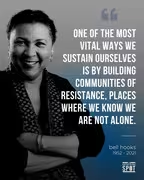
Additionally, the outdoor world isn't as gender-non-specific as you'd imagine. A lot of the outdoor industry is geared to straight, white males. That can make it hard for LGBTQ+ and BIPOC (Black, Indigenous, and People of Color) folks to feel comfortable out in nature. Instead, they can feel more "outsiders" than "out in nature-ers." Outdoor spaces may not always feel safe--both physically and as a place to feel emotionally safe to be out and openly queer. Hate crimes are real, and sadly, LGBTQ+ people are at a higher risk of being victims of these. People not only deserve safe places, but they want and need to feel included, represented, and like they are a part of a community of like-minded individuals...where they are surrounded by connection versus limitations, segregation, or exclusion.
Along those lines, representation and seeing yourself in certain circumstances matter. People matter. Everyone's uniqueness matters. The right to feel comfortable in spaces where you want to be...they matter. Everyone is entitled to the right to be comfortable in their own skin, living a life that works for them, being treated with kindness and respected for who they are. Outdoors or environmental education affinity groups can help to build a more inclusive outdoors, as can the knowledge, the acceptance, and the intersection of LGBTQ+ pride along with racial or environmental justice and outdoor recreation too.There’s a growing field of study known as Queer Ecology. Queer Ecology counters the assumption that nature is rigid or binary. There's a lot of fluidity out there in nature: species that change sex (clownfish and slipper limpets) and same-sex partner paired animals (penguins, bonobos monkeys), and male-birthing seahorses. Imagine if we had that level of openness in our human species and greater communities.
So maybe for the remainder of this Pride Month, now that schools are out and kids, teens, and grown-ups alike are all out and about, playing outside more than before, we can celebrate not only the healthiness of nature's biodiveristy but that of our human kind too. Inviting anyone to climb trees, hike trails, and find their space and place in nature, in a safe way, in a welcoming way, in an everyday way!For more resources that embrace the intersection of pride, planet, environmental & social justice, check out the following:One I recently came across was "nelipot"--a word I was not at all familiar with (which is the frequent point of this Instagram page and posts).
Having recently come back from the beach, where toes in the sand are a must, it's no surprise it spoke to me. Maybe too because it's Labor Day Weekend, and the last hurrah of summer. The barefoot days of summer (which are dwindling a bit faster each day) just sing of freedom, comfort, and a state of greater relaxation. But I think it also stayed with me because I like to live life barefoot most of the time. I'd work barefoot if I could get away with it!There also is a whole level of products you can purchase to bring some of that grounding (and its benefits) indoors, but I like getting Earth's energy from the source--being barefoot outdoors and the beauty of the nelipot concept.
I've written about grounding twice before:
So next time you've had a stressful day of work (or maybe even this Labor Day weekend), maybe what you really need is to kick off your shoes and stretch your toes in some backyard grass or some beachy sand, soak energy from beneath your feet while maybe even the sun from above. It literally may make you feel more grounded!
As a follow up to my Watching Wildlife post earlier this summer, it seems only natural to share a little Canva creation I made from our family's Cape Cod adventure last month where we did just that: watched some wildlife. Whales, in fact. We booked a whale watching excursion through Dolphin Fleet of Provincetown, Massachusetts. Leaving from the very tip of Cape Cod, we traveled further north where we witnessed a show of nature.
Cape Cod map from https://www.tripsavvy.com/cape-cod-marthas-vineyard-nantucket-maps-3265660, Video created in Canva using my photos/videos from our whale watching trip.
4th of July, our country's birthday, is definitely one of our biggest national holidays in the US.
Parades, picnics, barbecues, flags, festivities, and fireworks all are part of this national celebration.
Were there to be a red, white, and blue birthday cake, we'd be placing 248 candles on the cake for the country that was "born" on July 4, 1776.
Every 4th I like to post a little something about the holiday:
Assume the role of an avid environmentalist. What are some thoughts or tie ins to Father's Day?AI did not disappoint. Here is the verbatim response. Normally, I would not use AI in this way--as a direct quote. In fact, I really do not use it often. When I do use it, I use it as a springboard of inspiration. Then I "tweak the heck out of it" adding in my own thoughts and insights... definitely making it sound more like "me" as it has a blocky, formulaic sound to its writing
Never forget--you are out in their natural habitat--THEIR zone... so leave them alone!
The birds always catch both my eyes and ears, as do the flutter-by butterflies that come this way. For years, we've had a little patch of milkweed that my husband tends--some years more fruitful in their crop of hatching monarchs than others.
I ran across this video, from Atlas Obscurer, which is amazing... and probably does not do the beauty of the monarch's justice in a way a camera can never compare to real life. The video, from 2019, highlights Phil Torres at the El Rosario Butterfly Sancutuary in Mexico, one of the places where monarch's overwinter.
As a companion piece, there is a video by Joe Hanson for his series, "It's Okay to Be Smart" which goes a bit more into the science of why monarchs do what they do. It's seriously fascinating!
If these 2 videos had you hankering for more and you are feeling the need to read up on morehere's a list of top 10 "must read monarch" books from SaveOurMonarchs.org.
Here's hoping our milkweed patch this summer has a good monarch harvest and can be part of this whole migratory cycle!
Video from https://youtu.be/mXc1ZeRlOe0?si=SuBrhyYi_EsxLeaj and https://youtu.be/fBakLuH6kDY?si=1J9VlLN-4CPJXmoL, Image created at canva.com
It's the 2024 version of "Chicken Little."
Everyone right now has Eclipse Fever.
If you have been living under a rock, start here. It's our first total solar eclipse in the US since 2017....and the next is approx 2 decades away, slated for August 23, 2044.
I have friends flying into Dallas to view the totality to soak it up in its entirety. To find where you are on the eclipse map, check it out here.
As a product of the '80's, I have it burned on my brain (versus my retina) that YOU DO NOT LOOK DIRECTLY AT A SOLAR ECLIPSE FOR FEAR OF EYE DAMAGE. Therefore, I am a more of a fan of the pinhole camera for solar eclipse viewing. Gotta say: the solar glasses scare me. No matter which approach you take--be safe out there people, and protect your eyes!
For where I live, the height of the eclipse is approximately 3:21 pm (right during after school dismissal and high school sports--tell me, are high school kids going to play lacrosse or run track with solar glasses on?!?), with it's 2 hour, 28 minute span lasting 2:08 pm to about 4:33.
Be safe out there people, since this is key after school prime time.
It's been all over the news these last few days, let alone few weeks, so I feel redundant sharing too much....except for this:

And these are just plain interesting and/or funny--things I landed upon in the wonderful world of social media:
Chicken image created using Canva.com's Magic Media, Eclipse path: https://www.washingtonpost.com/weather/2023/10/17/total-solar-eclipse-2024-path-totality-locations/, videos from https://youtu.be/sAwSQHFRpp4? and https://youtu.be/DoD5ACZfzHU?si=oBWGC52rBdeR4Tr8si=HYD6th4pKuOYC_t-; Oreo eclipse found on social media.
Someday we may be the proud owner of some bees and a bee box (or two). My husband's been looking into it with some county education classes--much to my son's chagrin. (My son will come around one day).
Bees are vital to many areas of our grocery story, yet bees are in decline. So doing what we can to help them is a good thing!
You don't have to join BeeKeepers of America to lend a helping hand to our flying little friends. It can be as simple as what you plant in your own yard. This illustration from Hannah Rosengren gives some great ideas on how to build a bee-friendly yard.
Video from https://youtu.be/r7EpQnzbwA8?si=v7G3zpkDhqKpSwjr and https://youtu.be/LmBUq103u-M?si=jXvIJAZyTSOVjfsW; image from https://www.hannahrosengren.com/help-save-bees
This is what happened to me regarding parklets.
A parklet is a little do-it-yorself mini park, which urban areas and city dwellers are creating more and more of to counter green up the space, cutting down on the concrete jungles of urban areas. They help soothe both our physical and mental health by providing these pockets of green.
I ran across parklets in the the OneTreePlanted article by Gabrielle Clawson entitled Good News! 30 Positive Environmental Stories From 2023, which I used for the creation of my March 6th blog post "Postivtive Environmental Stories for 2023." Parklets was listed as Clawson's #12 item.
Parklets reminded me of downtown Annapolis during the pandemic. Restaurants took away parking places on the street to bring out planter boxes and more tables so that people could have the restaurant experience while dining outside. String some lights, make it cozy, bring in the greenery, and voila--goregous outdoor seating, with friends and family, for safer, accessible, open air dining during Covid times.Next thing I know, parklets and their nature and health benefits are everywhere!
Parklets started their modest beginning in 2005 in San Francisco, and since then have begun popping up in many different ways. They bring about greater connections and a sense of community. They widen and invite greater outdoor living. It all is part of what makes a community "livable."
In the market to make your own? Check out Happy Eco New's How to Build a Parklet DIY.
With spring having sprung, makes me want to go out and find a li'l parakeet of my own to go and just soak in the sun, maybe a snack, and enjoy a little people watching along the way!
Images from https://scs.georgetown.edu/news-and-events/article/7858/creating-community-sense-of-place-parklet and https://www.strongtowns.org/journal/2023/1/19/baltimore-wants-permanent-parklets and https://www.cincinnatimagazine.com/citywiseblog/covington-parklets/ and https://www.capitalgazette.com/2019/09/01/parklets-in-west-annapolis/
Tech Integration Teacher @ Severn School.