Showing posts with label gardening. Show all posts

Saturday, August 16, 2025

New Year, New Mindset: A Garden of Ideas


Summer always feels like an invitation to breathe differently. It's a good respite after 10 long months of teaching. It's a time and space to create life differently, reset, and refresh.

This time of year, teachers everywhere are doing what I am: reflecting on their summer, readying for the racetrack ahead. We all are taking in how the summer went, making mental notes of how we want to shape the school year ahead.

So, looking back: did I dabble in some back to school techno-babble, digging into the world of AI, lesson planning, sharpening skills through some professional development over summer? Of course I did... because that's what we teachers do. We grow our skills. 

But I'm happy to say it certainly wasn't a summer of "all work and no play." I made plenty of time for reading, pool-lounging, sleeping in, running around with my family, working out, road-tripping, appreciating my husband's gardening and the fruits his labor (or rather: vegetables), and more. 3 cheers for sun & fun, and R & R!

Stepping away from structure and slipping into the slower side of summer definitely includes travel, as I mentioned last week. Travel is the ultimate teacher:
  • In Quebec City, I could see the connectedness of both history and people as I stood in this fortified city, gazing upon centuries-old walls that were originally designed to protect, but now serving as an embrace of the many who gather in this multicultural city. 
  • In Montreal, I stood amongst the 1976 Olympic Park, now reimagined & "repurposed" through innovation to bring joy to visitors by way of the Biodome and surrounding sights that are now a concert stadium, a pool, a planetarium, and more. The same could be said of my experience at Bota Bota Day Spa, a former ferry boat turned health and wellness oasis.
  • In the Midwest, I drove stretches of highway from Chicago to the center of the state to reunite with family... much in the same way I walked stretches of beach in Ocean City, Maryland. This opened time and space to think about pace: in life, in the moment, and even ultimately thinking forward to this fall's school year and how I want to run my classes.
The destinations changed, but the throughline stayed the same: 
Connection. Curiosity. Perspective.

These 3 guiding principles are the same things I want to bring back with me to the upcoming school year and to my classroom. 

Teaching, like traveling, is not about the destination, but rather the journey. It's about what grows and happens in between. It's what we take in when we slow down and let the unexpected shape us. Teaching too is like gardening. It is the roots that anchor everything down. They support the growth and harvest ahead.

Connection, curiosity, and perspective do all of this.

Before the first school bell rings, here are some nature-centric points to ponder while putting up bulletin boards, unpacking boxes, and setting up shop. Plant these questions like seeds in your mind. Growth comes from steady care and the courage to nurture what matters. 

🌱 How can I "grow forward" this school year ahead?

🌱 What connections can I make (to both people, students, and ideas)?

🌱 Where can I grow in my curiosity and shift my perspective?

🌱 How can I innovate and create when needed, shooting and rooting for potential not perfection?

🌱 How can I remind myself that "letting go" is part of growth: letting go of expectations, self limitations, fear of failure, control (always a hard one), the past and "how things have always been done." One thing I’m letting go of this year… 

🌱 How can I make it a year to stretch, branch, and bloom....as a person, as a teacher, as a global citizen in a partisan world, as an educator navigating this ever-expanding edtech world?

🌱 How can I teach smarter not harder, always aligning with these values?

🌱 This year, I want to feel more ______ in my teaching.

🌱 A student strength I want to notice (or encourage) more this year… 

🌱 A space in my classroom I want to reimagine or make more alive… 

🌱 One edtech tool I’m excited to try (or try differently)… 

🌱 One way I’ll bring more nature, climate awareness, or global acceptance into my classroom…
Images created at Canva.com

Saturday, May 17, 2025

Yay or Nay to "No Mow May"?

temp-Image4-Tnv-FO
I’m sitting outside, observing nature, weekend chillaxing, and pondering my words—not an unusual approach to my weekends here at this time of year. Especially as out school days are dwindling. It’s sort of my outdoor office. 

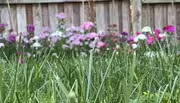
As I gander about at the flowers my green thumb husband has planted to beautify our yard, I’m noticing the heavy doses of rain from the week have made our grass shoot up. It’s time to mow…but it isn’t happening today.

temp-Image-Z2-HQOm
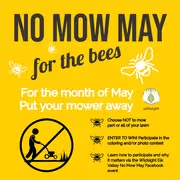
All of which brought to mind the concept of “No Mow May” since we are still here in the middle of that month.

To mow or not to mow…that is the question. And a rather controversial one at that, I’ve come to discover. 

The benefits are striking. By skipping mowing, you …
  • Allow your lawn to flourish with wildflowers (preferably native) to provide safe comfort and nectar for pollinating bees and butterflies.
  • Promote biodiversity by creating a yard habitat for a variety of wildlife.
  • Improve your soil health by letting your grass grow longer, which in turn aids in water retention. 
  • Save your own time and effort by letting your lawn go “au naturel.”
  • Reduce pollution by leaving your lawn mower in your garage.
  • Can create a healthier, more resilient lawn that is more drought resistant.
But the downsides are also numerous:
  • If not tended properly, you can inadvertently create an unwelcome pests: ticks, mosquitoes, and rodents, to name a few.
  • You grow more weeds than grass or maybe some invasive species take root, which then takes up an unruly life of its own, overtaking the “good grass.”
  • You may even get some unwanted tree seed growth that blow your way in the wind. Woody plants over time are harder to get rid of than weeds (should you change your mind later on with the no-mow business).
  • Some home owner associations and local municipalities get a little grumbly over the overgrowth. Might be worth checking you HOA rules and bylaws, which might come with fines.
  • Long grass gets heavy over time and the blissful meadow you were hoping for may come to look like a neighborhood eyesore and a no-mowed abandoned lot instead. (see HOA above!)
The short term benefits may not be worth the long term costs—to you, your home aesthetics, and the road back to a healthy lawn. So before you make the decision to finish off May in a no-mow-kind-of-way… or if you are pondering jumping on the band wagon for next year, it’s worth doing your research. 

Maybe creating a native plants garden patch in your yard is the best way to get maximum benefits with minimal side effects.!

These are good places to go to learn more:
Image from https://wildsight.ca/events/no-mow-may/ and my backyard, grass level


Saturday, May 3, 2025

Hummingbird Are Heading Back

'Tis the season for hummingbird spring migration. The further south you are, your hummingbirds may already be back. This map and Accuweather's article "Hummingbird Migration Underway in the US: Here's When They'll Reach Your Garden" will help you know when you need to get your feeder out in your own backyard!

Image from  https://www.accuweather.com/en/weather-news/hummingbird-migration-underway-in-the-us-heres-when-theyll-reach-your-garden/1753177#google_vignette

Saturday, June 1, 2024

Marveling at Monarchs & Their Migration

As the days warm up, I'm definitely outside more. Sitting at my patio table or lounge chair: sipping a cool beverage, reading a book, listening to the sounds of nature, or maybe even typing my latest GTG post for here.

The birds always catch both my eyes and ears, as do the flutter-by butterflies that come this way. For years, we've had a little patch of milkweed that my husband tends--some years more fruitful in their crop of hatching monarchs than others. 

I ran across this video, from Atlas Obscurer, which is amazing... and probably does not do the beauty of the monarch's justice in a way a camera can never compare to real life. The video, from 2019, highlights Phil Torres at the El Rosario Butterfly Sancutuary in Mexico, one of the places where monarch's overwinter.

As a companion piece, there is a video by Joe Hanson for his series, "It's Okay to Be Smart" which goes a bit more into the science of why monarchs do what they do. It's seriously fascinating!

If these 2 videos had you hankering for more and you are feeling the need to read up on morehere's a list of top 10 "must read monarch" books from SaveOurMonarchs.org.

Here's hoping our milkweed patch this summer has a good monarch harvest and can be part of this whole migratory cycle!


Video from https://youtu.be/mXc1ZeRlOe0?si=SuBrhyYi_EsxLeaj and https://youtu.be/fBakLuH6kDY?si=1J9VlLN-4CPJXmoL, Image created at canva.com

Wednesday, April 3, 2024

"Bee" Kind to Bees 🐝

Someday we may be the proud owner of some bees and a bee box (or two). My husband's been looking into it with some county education classes--much to my son's chagrin. (My son will come around one day).

Bees are vital to many areas of our grocery story, yet bees are in decline. So doing what we can to help them is a good thing!


You don't have to join BeeKeepers of America to lend a helping hand to our flying little friends. It can be as simple as what you plant in your own yard. This illustration from Hannah Rosengren gives some great ideas on how to build a bee-friendly yard.

Video from https://youtu.be/r7EpQnzbwA8?si=v7G3zpkDhqKpSwjr and https://youtu.be/LmBUq103u-M?si=jXvIJAZyTSOVjfsW; image from https://www.hannahrosengren.com/help-save-bees

Saturday, October 1, 2022

Building Leaders Through Outdoor Education

I ran into this quote the other day and it really spoke to me.


It took me back a few schools ago (probably to the tune of 20 years or so), and I am reminded of a former 3rd grader of mine. (Let's call him Trey.) 

Trey was a struggling student in my class. A medicated ADHD student who's impulsivity got him in a thick of trouble every time he turned around. His parents were frequent fliers for parent conferences with me. Trey had a strong ability to think outside the box, he made great connections, and you could see he had an incredible entrepreneurial spirit. But he struggled. Somewhat academically, but mostly behaviorally. He just had to get from 3rd through 12 grade of school without falling victim to his own demise.

In the spring that year, our 2 third grade classes decided as a grade level to build a butterfly garden on campus. Administration gave us a plot of land that we needed to clear and a budget for some pollinator plants and milkweed. Here is where Trey came to life. It bears repeating--here is where he really thrived! He did the work of 3-4 people and got right down to business. He was a master with the shovel. He was the leader of that butterfly garden. My partner teacher and I talked a lot about Trey in this role and the other couple of kids that really shined during this project. What if we could have them out there every day for a half hour before school doing something like this!? It was completely their wheelhouse and it was leadership in action. 

Getting kids outside more in our classroom requires a bit of thinking outside the box. National Geographic has an excellent post on "backward planning." A big perk in planning and teaching this way: it gives students more agency and control in their own learning. Author and educator Alison Katzko gives four tips on how to achieve your best through backward planning in this article entitled ""How to Get Students Outside? Try Backward Planning" By making outdoor excursions part of your regular routine, and looking for curricular connections, you can meet the standards in ways that truly impact your kids! 

She has a second article in the series called "Why Abi Henneberry Takes Her Class Outside Each Day". Not only does this activity bring hands-on learning and engagement, but it also builds empathy, community, and helps broaden perspectives. Again--all key features in leadership!!

Think of the leaders we as teachers can help shape and create!


Saturday, August 27, 2022

Growing Together With Community Gardens

We've all come to know the saying, "It takes a village."

That seems to go with just about everything. 

Community gardens is another way to grow together and strengthen both relationships with your neighbors and work to build something together that benefits you all. The concept of urban gardens is not a new ideas, but like ideas--there's always a number of ways they can be created. They can be in a shared neighborhood lot, alleyway, or local area accessible to all. Many big cities have neighborhood lots dedicated to just this where it's tended together and the fruits of the labor are shared together. Not to mention, it can be very rewarding volunteering your time and energy on a shared project like this.

There's also the idea of yard sharing. The Food is Free Project details what this might look like:


The ideas of yard sharing could have a unique appeal, but of course there are always ideas to consider, including your local laws and municipalities or any HOA restrictions.  Not everyone is keen on the native yard look!

To learn more about how you can share the wealth of health and grow together as a community, check out these resources:

Wednesday, March 2, 2022

Environmental Good News

There's a lot going on in the world right now. Especially as we are approaching the 2 year mark of major global impact from the pandemic, (along with climate crisis, racial injustice, and polarized politics). The current events in the Ukraine feel extraordinarily heavy and hard. [In fact, if you and your children are having trouble with that, please check out this article at Very Well Family.]

Given the harshness of the 2020s so far, sounds like we need a heavy dose of "insert good news here."

IPS Positive News Stories does just that. The Inner Picture Stories (IPS) Project was created by Jellis Vaes. The purpose of IPS is to share forward stories connected to the beauty of life, opportunities that surround us, and ways of getting a better handle on healthy mental health. Sharing the good stuff!

In their December 24, 2021 podcast, they bring to light "5 Positive Changes in the Environment." It can be easy to be stuck in the doom and gloom especially when it comes to the environment. So here, they focus on these 5 stories, showcasing a short video for each on their website highlighting more about each one.

1. Search Engine Ecosia, where you can plant trees through clicks. They just planted their 100-millionth tree.

2. Nzambi Matee started her company Gjenge Makers to create bricks from recycled plastic. In addition to being lightweight and low cost, they are 5 to 7 times stronger than concrete.

3. In Oslo, Norway, they launched the Yara Birkeland, the first electric, self-propelled container ship. This cuts 1,000 tons of carbon dioxide.

4. A study from The Society of Conservation Biology has shown that conservation programs have aided in preventing 48+ animal extinctions during the 27 years between 1993-2020.

5. In Liguria, Italy the Ocean Reef Group launched Nemo's Garden, a first in the area of underwater vegetable gardening.

Image created at canva.com

Wednesday, September 9, 2020

Backyard Butterflies

This is our second summer of harvest of Asclepias syriaca...that's common milkweed to you and me. My husband doubled our plot this summer. Despite the fact that we're about 3-4 weeks later in seeing any visitors than we did last year, we finally have been recognized on the monarch mapping system as a safe place to land. We are now reaping the bounty of that harvest with the whole variety of life stages of Danaus plexippus: The Monarch butterfly.


Yesterday's count showed me 35 chrysalis at various places in our back yard & 5 caterpillars on a very stripped patch of milkweed. Those little 5 are going to have a hard go of it as there are no milkweeds left! Seriously, my photo dates show fully blossomed and leafy milkweed from just two weeks ago! Amazing how much they chowed down in that two week time period!

What also has really struck me is the great distance some of them have gone to set up their chrysalis shop. A couple even scurried quite a ways to create their chrysalis on the netting of our backyard lacrosse goal. Not your safest spot, li'l guys!!

 
It all struck me by Barbara Kingsolver's book Flight Behavior, which I read earlier in the summer. It's the fictional tale all about monarchs and their surprisingly northern migration resting spot due to the warming result of climate change. 
 
Along the way, I ran across this Native Pollinator lesson plan from National Wildlife Federation. It has more than just monarchs, but is a great resource. 

I have a feeling, next year our Milkweed & Monarch plot will be even bigger. It's been wonderful being a part of putting beauty into the yard by way of my backyard.


photos & video from my backyard.

Saturday, May 30, 2020

The Benefits of Gardening

I am not a gardener, tho I am married to one and my dad had a massively green thumb and certification as a Master Gardener. But I do like the benefits of having always lived with a gardener.

I ran across this and found it a lovely follow up to my earlier "Nature = Necessity Not Amenity" post. If you aren't a gardener, maybe this will inspire you to pick up a trowel and plant something...or at least take advantage of a beautiful garden near you.


Photo from https://www.facebook.com/customconceptlandscapes/photos/a.703164543434240/969322516818440/?type=3&theater

Saturday, August 31, 2019

From Milkweed to Monarch

Backyards and gardens are a science experiment we create daily.

Well I don't, but my husband does--he's the one in the family with the green thumb! His latest addition that's taken off this year was nurturing and adding to the milkweed he planted last year. It didn't do much last year, but this year it really took off, and we got a chance to witness the transition from milkweed to monarchs.

We were struck by the many chunky caterpillars that nibbled, and grew, then each one aligned him or herself along our fencing to create its own unique, individual chrysalis. At one time we had at least 8 chrysalis lined up on our fence--one crawling all the way to the protective corner quite a ways down. We also hoped and assumed that some of the caterpillars crawled to our neighbor's side of the fence. These are all pictures from our backyard, creating a montage of the lifecycle. My favorite is seeing the caterpillar curl into chrysalis formation.

Upon sharing it on Facebook, former Eagle Cove colleague Lindsay Moore shared her video of one of her classroom caterpillars transforming into a chrysalis and gave me permission to share it here. With the help of iMovie, I created the full video shown here. Watching that caterpillar, it's amazing what can happen in 5 minutes.


What also was neat, was while in Illinois, visiting my mom, we found these two signs during our local zoo visit.


For more butterfly inspiration, read Orion Magazine's Biking with Butterflies by Sara Dykman.


Video from https://vimeo.com/353127571; photo collage from my backyard, sign photos taken at Scovill Zoo.