1 teacher. 1 world. Eco-friendly. EdTech-friendly. Classroom-friendly.Teacher-friendly. Kid-friendly. Parent-friendly. Planet-friendly. Sustainability. Innovation. What can we do to increase the likelihood that this one li'l world will be here eons from now? Whether you are a teacher, a parent, or just someone who firmly believes that every tiny bit helps, let's all be part of the solution rather than adding to the problem, knowing that innovation along the way is the way to make that happen!
Showing posts with label World Water Day. Show all posts
Showing posts with label World Water Day. Show all posts
World Water Day is an annual United Nations observance that celebrates water, bringing to attention the global water crisis. The Sustainable Development Goals (SDG) #6 is to achieve safe water and sanitation for everyone by 2030. This year's theme is "Water & Gender: Where Water Flows, Equality Grows." It highlights how gender equality is tied to safe water and water acquisition... and what happens when they’re not. This also ties to SDG Goal #5 through gender equality. Through both of these, the message is clear: safe water and sanitation are rights, not privileges, for all people and all genders.
Unfortunately, women and girls are disproportionately affected by water problems because of many reasons: unsafe or distant water sources, poor sanitation, and the fact that women are often left out of the decisions about how water is managed. Additionally, women and girls in many countries are the ones fetching the water, walking for hours to access the water. This in turn prevents them from being able to attend school or working in a paid position. It also places them in multiple unsafe situations along the journey, leaving them exhausted and more prone to sickness. It also creates additional issues of sanitation during times when girls and women are menstruating.
Despite the fact that access to safe drinking water is a human right, billions of people worldwide still lack access and safe management of water and sanitation services. Globally unsafe water, sanitation, and hygiene (WASH) are responsible for deaths of approximately 1,000 children aged 0-5 daily.
When communities secure reliable, safe water, and sanitation close to home, you start to see:
Girls who are able to spend more time in school and less time questing and walking for water.
Women who are able to take part in paid work, community leadership, and decision-making.
Health improvements overall--from individuals to families, which then spreads economically in their ability to work and then spreads to their communities.
By ignoring women’s experiences and their knowledge when it comes to these factors, water systems fail the people who use them most. Women need to be at the table when it comes to these decisions. In doing so, it builds a more hopeful future, one drop of water and one decision at a time.
To learn more about World Water Day, check out the following resources:
UN World Water Day Activation Kit with activities for schools (listed by age ranges), communities, and other ways to actively engage and spread information about the importance of women, water, and safety.
If you saw my last post, you saw the "Save the Date" for tonight's Earth Hour. (If you didn't, go back and do so to up your learning potential!)
Your mission: Turn off your lights from 8:30-9:30 pm in your time zone. In doing so you take a stand with the environment by being a part of a global event, raising awareness for environmental sustainability, and promoting the importance of conserving energy.
As it happens, March 22nd is also World Water Day, as it is annually. (Earth Hour is usually the 4th Saturday of the March.) This United Nations Environmental Day was created to emphasize the global importance of clean water access to everyone.
This year's theme is "Glacier Preservation.
So perhaps while you are flipping the switch to turn out your lights this year for Earth Hour, you'll stop and think a bit about what a precious resource water is... and of ways to conserve water too!
I love days that are dedicated to the environment. I sporadically write about them (you can click my "environmental days" GTG tag). There's even a whole online digital calendar of days dedicated to it at TerGo's Eco Calendar.
One day that didn't make the TerGo eco-calendar is tomorrow/July 23rd (annually)'s World Blue Mind Day.
World Blue Mind Day....not to be confused with World Water Day--Annually March 22nd--the United Nations observance created in 1993 that raises awareness about the global water and sanitation crisis.
Likewise, not to be confused by World Ocean Day--Annually June 8th--another United Nations designated day (since 2008) which works to enlighten and engage the public and policymakers about the importance of tending our global oceans for a healthier climate.
Obviously, both of these days are important on their own eco-standing!
The point and purpose of World Blue Mind Day annually is to "soak" up the physical, mental, and spirtual benefits of being in and around water. Wallace J. Nichols says it best here in this short video:
You can find World Blue Mind Day & Wallace J. Nichol's discussion board event here on Facebook.
As detailed in my last post, World Water Day (and its importance) is today. If you missed it, make sure to scroll back for a revisit to learn about why water is so important...and why we have the need for a World Water Day.
While knowledge is power, action leads to traction. From the UN World Water Day site, here is a list of things you can do today, even if you didn't plan ahead. Easy actions you can take to show a personal commitment to making this world a little better place. How many can you do? Even better: How many people can you inspire to join you to conserve water and take part in making a global difference?
And sneak preview....Earth Hour 2023 is this Saturday, March 25th from 8:30 pm -9:30 pm in your time zone. Not sure what Earth Hour is all about, check out some of my past posts. More coming this Saturday!
I've said it before (and I'm not the only one): water makes the world go round. We all need it, in a variety of ways to maintain our health and wellness!
That is the basis for World Water Day. Since 1993, the United Nations has centered on March 22nd as World Water Day as a day to raise awareness to the global water and sanitation issues that challenge our planet. Not only a day for learning, but a day for inspiring action, World Water Day highlights that all are not equal when it comes to clean water. In fact, here are some sobering facts taken straight from their website:
This year's World Water Day theme is "Accelerating Change." Eight years ago, in 2015, the UN Sustainable Development Goals were established as ways to address 17 major global issues by 2030. Goal number 6: "Ensure availability and sustainable management of water and sanitation for all." Given that 2030 is a mere 7 years away, we are behind given the statistics above. What started as a theme of "Be the Change" shifted to "Accelerating Change." We all need to take part given we all consume water. How we manage the water we use can make a difference. For this reason, it's not a government issue, it is a global and individual issue.
Purposely overlapping World Water Day is the UN 2023 Water Conference, taking place March 22-24, 2023 in New York City. It is slated as the first event of its kind in almost 50 years. Individuals are inspired and encouraged to make personal commitments, which will then be added to those of nations, companies, organizations, and other collectives. The combined commitments will build the Water Action Agenda and serve as their main outcome.
In this 2 minute, animated video, you can get an overview of World Water Day 2023 and its theme of "Accelerating Change."
World Water Day--What Can You Do? What will you do?
Water is that one thing we all need--and it's one thing that can be hard to come by, depending on what population you are a part of. The book "Thirst" by Scott Harrison instantly comes to mind. So too does the saying "water water everywhere and not a drop to drink." We've got this marble-esque blue planet (which definitely brings to mind #bluemind), yet the percentage of potable water on this planet is a problem given the majority of our water being housed in salty oceans.
Additionally, anytime a system is privatized, it has done so for a reason; namely--for a company to make a profit. This could get (and in the past many times, has gotten) in the way of doing things in an environmentally healthy way--for both us (as humans) and our planet. This also can become enmeshed in economic issues, leading things to fall on one side or the other of the dividing line of between the "haves" and the "have nots."
This social experiment really helps to put it all into perspective:
Here are some past posts that tie to the importance of clean water! It doesn't need to be World Water Day to make this a priority or a focus--it just so happens to be that's a lot of when I wrote about it!
Fitting too, to share these thoughts during Earth Week!
In reading this book (which came recommended from a colleague at school), it made me realize why I love my pool so. Now that Spring has sprung and the warming has begun, I've got some of my neighborhood hot spots and watering holes on my mind. Also, I have a greater intention to get there more often.
Here are some take aways from this brain-based, research-backed book on the effects of water on the brain and body... and the science of happiness:
💧The key questions of the book: “What is water? Why are we humans so enthralled by water? Why is this question so obvious and important, yet so hard to adequately answer?” ( page xviii)
💧“The name for this human-water connection: Blue Mind, a mildly meditative state characterized by calm, peaceful, unity, and a sense of general satisfaction with life in the moment. It is inspired by water and elements associated with water, from to color blue to the words we use to describe the sensations associated with immersion.” (page 6) Some of those "words" that have infiltrated our vocabulary: Times when we are 'in the flow' of creativity; when we have 'waves of emotions;' we can feel like 'fish out of water' when we are uncomfortable; or we might have a 'sea of questions.' There's a million of them!
💧The opposite of Blue Mind? Red Mind. A more attention-to-detail, stress-driven, anxiety-fear-anger-ridden mind. The mind that lives in this age of instant-global-connection, hyper-aware, tech-driven world that has us always overstimulated, over-stressed, over-screened. The exact reason why we need to let go of multitasking and spend more time being digitally mindful. Just like in Florence Williams' book Nature Fix (which this is a great companion piece for), being in nature (near water particularly with Blue Mind) gives our frontal lobe a break and helps equalize our emotions and build our empathy. Empathy--what connects us to all things (and perhaps what is missing when it comes to the polarized political world in which we all are living--and needing to disconnect from!)
💧Which of these lists sounds better and more helpful?
💧“What if your doctor handed you a prescription for stress or ill health that read, ‘Take 2 waves, a beach walk, and some flowing river, and call me in the morning?’” (page 141)
💧Water has power. It is a basic human need. As Americans, we use 80-100 gallons a day. Yet we know that approx 1 in 10 people in the world don't have access to clean water. (Roughly 663 million!) Our bodies are made up of 78% water. Water energizes us via hydration, water splashed on our face, or even just our proximity to it. If climate change doesn't get addressed, the waters will rise and coastal communities will be in danger.
💧Water is also a 5-senses experience:
See: Light takes on a new look when playing on water.
Taste & Smell: You can smell and taste the saltiness near ocean water or smell the freshness after a good rain. Smells can also trigger memories.
Sound: I can hear it now: the waterfalls, the swish of waves, even the trickling of water in a stream or the rain hitting the wind.
Feel: We feel like we weigh less in water and we notice it in our buoyancy. Water exercise or aquatherapy is highly beneficial due to this. I know my aging knees certainly are much more capable in the pool than on land these days! Additionally, between the water pressure, the flotation sensation, and all of the above--our senses tend to come more alive in or near the water!
💧There are 3 perspectives when it comes to people and nature:
Egocentric is when you put yourself at the center and only can see what nature can do for you personally.
Anthropogenic is when you broaden from the self and consider everyone, but more "how nature serves humanities needs and desires." (page 250)
Biocentric is when you see "humanity as part of nature, rather than separate." (p. 250) It broadens the perspective to help you realize that you are part of something bigger than yourself. By connecting with nature or water, you become not only more engaged and attentive, but also more invested. You begin to care... which leads to empathy and an emotional drive to take care of it so you can share it with others.
💧“Being in nature quiets my mind, and out of that quietness is where the real art happens." ~ Sculptor David Eisenhower (page 223)
💧"The real voyage of discovery consists not so much in seeking new territory, but possibly in having new sets of eyes." ~ Marcel Proust (page 269)
💧“I go to nature to be soothed and healed, and to have my senses put in order.” ~ John Burroughs (page 84)
Haunted--in a good way. In a gratitude-sort-of-way.
I got the book for my birthday, made sure to go through the steps to have the book purchase donated to charity: water. The book was an amazing read--of Scott's own mother's environmental health struggles, his dive into NYC nightlight, and then his inspiration to climb out and give a charitable year of his life to Mercy Ships...which ultimately led to his realization of our global problem of over 600 million people worldwide not having access to clean water. This, in turn, led to his life mission and the creation of charity:water 11 years ago.
It's inspired me to give the book as a gift, and it also inspired me to share Scott's 20 minute video "The Spring" with my family. This then inspired us to be a part of the solution for the global water crisis. We joined The Spring, becoming monthly donors to charity:water.
In addition to this, after finishing the book, I needed more. I found Scott on The Good Life Project Podcast. I've visited a number of the videos on charity:water's website, and ran across this video here, in particular. I like the simplicity in its illustrated nature, finding it a very kid-friendly resource.
May watching this video cause you to take pause this holiday season, grateful for what you have (definitely a theme for my season this year), and may it inspire you to be a part of something bigger than yourself--whether it is this cause or another one that speaks near and dear to your heart.
My birthday is next week. Not a "big" one, but I'm getting close, only a year away to "a big one."
After listening to one of my favorite podcasts, the Model Health Show, I was inspired. I think this year I'm going to donate my birthday--in 1 of 2 ways.
Not only is Scott's story compelling, but it's also a carries environmental bookends given his family's monoxide poisoning in their new home when he was a boy to his inspiration to create Charity: Water.
Additionally, here are some facts about clean water--and the lack there of:
663 million people worldwide live without access to clean water. (That's almost 1 in 10 people--or twice the population of the US.)
Women and girls are impacted the most--they are primarily the ones who walk miles/hours to get clean water, carrying 40 pound canisters of water--sacrificing their education and sometimes even their personal safety.
Diseases from dirty water cause more deaths (especially among the young) than all forms of violence--including war.
Donations to Charity: Water has funded nearly 30,000 projects--with all public donations going to the projects (versus any kind of internal financial management or salaries.)
$30 is enough to provide clean water for one person.
To learn more or get involved...watch the video below:
And then there's World Water Day, which is next Thursday: March 22nd. Celebrated annually since1993, World Water Day is an international observance to bring about active awareness and consciousness about how vital water is to each of us on this planet. Unfortunately, clean, safe drinking water is a commodity which not everyone can access.
The theme this year is "Nature for Water." The focus is on how to use nature to best support our current day environmental concerns for water. Their fact sheet is chock-full of both statistics (like in the video below) as well as some ways nature-based solutions to guide our management of this precious resource.
Here's a video I created using Adobe Spark with images provided on World Water Day's Resource page. May it inspire you in multiple ways to think twice before that long shower or that running faucet while you brush your teeth.
For more environmental days to mark your calendar, check out these 3 sites:
Cape Town, South Africa is currently between a rock and a hard place. They are at a critical water crisis due to historic drought, leaving their 4 million people fearful about "Day Zero"... the day when the water is done and dry and officially turned off at homes and businesses. Right now that day is slated for May 11th of this year. Less than 3 months away. Scary.
At Day Zero and beyond, citizens will need to hit up one of the 200 ration points in the city to collect water. Daily limit will be set at about 6.5 gallons of water. That's hardly enough for the drinking, cooking, bathing, and toilet use they'll need each day.
Here in America, this is what 6.5 gallons of water get you (you get to pick only one of the following):
2 flushes of the toilet
A 3 minute shower
2-3 minutes of running water while brushing your teeth.
"Watch me pull a rabbit out of my hat!" The proverbial catch phrase of a magician. Making something happen when it is seemingly impossibly, out of thin air.
Making water out of thin air feels just as magical, but it's not. It's innovation at it's finest as this movie illustrates.
Not to mention, quite necessary when you consider that 1 in 3 people globally don't have access to clean drinking water.
This turbine, or the WaterSeer (as it is called) condenses water from the atmosphere in a low tech, low cost way that is a win for all. Best part: no added chemicals or power, making maintenance cheap and easy.
To learn more about the specifics of how it works, check out this article and watch the video below.
Since 1993, March 22nd has been a United Nations' internationally-designated day centered around water related issues. This year marks our 24th World Water Day. It's a day to bring about awareness on the importance of clean water, especially given that approximately a billion people world wide don't have access to clean water. That one billion people--that's 1/7 of our global population. That's mighty!
This year's World Water Day theme centers around the power of water and jobs, and their transformative nature to make a difference in lives. Not only does water quality impact people, but water is vital for all jobs--therefore all employees need both access to quality water as well as fair labor laws.
For more information, resources, or even donation opportunities, check out the following resources:
Additionally, you might be inspired to take a break and unplug from your technology by taking the UNICEF Tap Project Challenge. By opening up UnicefTapProject.orgon your cell phone (this is the important part), then NOT touching your phone, you can help the UNICEF donors give funds for water for those in need. This is open for the entire month of March, and this is what is certainly called a win-win all the way around!
Hence why these stats (though interesting) are less-than-helpful at solving the drought problem.
While solving the drought problem is a doozy, we can begin to tackle it with information. Here's where my newly-discovered li'l info-gem of AJ+ enters. AJ+ is a news medium that has made it their mission to change the way we look at news. Gearing it toward the video-and-visually-minded, social media-oriented consumer, AJ+ tells the news through video stacks, and an active social media presence at YouTube, Facebook, Twitter, & Instagram. There's also an app for that (both on iTunes & for Android).
Their vision:
"AJ+ is a global news community for the connected generation. We highlight human struggles and achievements, empower impassioned voices, and challenge the status quo. We bring you the stories that are shaping our world. Do you ever laugh, cry, get angry or inspired? You’ll fit right in." ~ From AJ+'s About Page on Facebook
Perhaps if we flood all avenues with this type of environmental conversation, more people will start opening their eyes while simultaneously starting to make a difference!
Given some of my last entries have felt heavy-handed on the "doom and gloom" of the severity of the situation, it seemed like a natural place to end looking at what you can indeed do to conserve water and make a difference!
Watch or track your water intake today. Or think about how far that water could go for those who don't have it. Really think about what you can do to reduce your usage. Limit your bottled water intake, which also wastes plastic. Donate to a charity like Plan International USA that give gifts of water.
Dive into the 5 Gallon Challenge. Can you live on only 5 gallons? That's the Amount recommended for healthy & hydrated living a day. You can do it. If we all cut back a little, we'd save a lot!
The infographic below, created by Seametrics back in 2012, is still just as current today. (Interestingly, it was shared on MindBodyGreen on Oct. 31st, 2012--a year [to the date] after the United Nations declared world population hit 7 billion). The demand for water continues to grow. If we don't all stand up and take notice, we're going to find ourselves indeed in a Global Water Crisis!
Here in this continuing series on World Water Day 2015, we turn to Christiana Z. Peppard. In her TED-ED lesson "Where We Get Our Fresh Water" she has a video just over 3.5 minutes that sums up the limited yet valuable resource of water. She includes some post-video questions for your students to ponder, as well as some additional links in her "Dig Deeper" section.
Water is the one thing that truly makes the world go 'round. Just as you don't fully get to see the way the wind blows, you miss the way the water flows, until it goes!
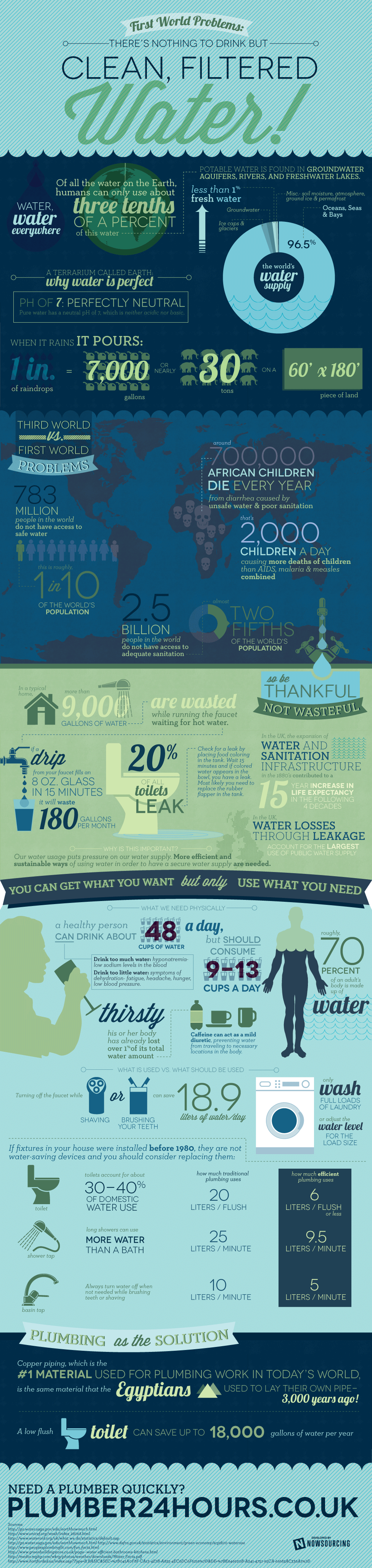
Here's an interesting infographic investagation on the "First World Problems" of bottled water. A great infographic to ponder this World Water Day week!
World Water Day is annually every March 22nd. Sponsored by the United Nations, this day is a day of emphasizing the importance of clean water on our global community. The UN's overriding theme is "Water Is." What is water? All these things, straight from their website:
Water is health.
Water is nature.
Water is urbanization.
Water is industry.
Water is energy.
Water is food.
Water is equality.
Water is at the heart of our global sustainability.
To learn more about the vital importance of water on all 7 of these levels, go to the UN World Water Day Learn page. You will certainly be struck by some significant statistics as you read this page, from how much water it takes to...
produce plastic (some of which sadly returns back to our water ways as marine debris that never deteriorates),
raise beef cattle,
meet the global water demand for manufacturing.
You'll also see the number...
and percentage of people who live in cities,
of people who do not have access to clean water,
of hours a day women in developing countries spend retrieving fresh water for their family.
For lessons to use in your classroom, check out Project WET.
Think consciously this week, leading up to World Water Day!
What can you do to make good choices to conserve water?
The mission of Green Team Gazette is to advocate and educate for environmental stewardship, to promote positive examples of "green" living (both in & out of the classroom), to inspire readers to pursue more sustainable choices, and to encourage teachers to embrace technology in their classrooms as a way of capturing student creativity, collaboration, & innovation. It is through engaging teaching practices and forward thinking that our future leaders will flourish.
It's not always easy being green, but I'm pretty passionate in my pursuit! A lot of times, innovation & edtech will get you there! Just don't forget to go outside!!
All posts and commentary are my own and not necessarily those of any organization I am affiliated.

 Unfortunately, women and girls are disproportionately affected by water problems because of many reasons: unsafe or distant water sources, poor sanitation, and the fact that women are often left out of the decisions about how water is managed. Additionally, women and girls in many countries are the ones fetching the water, walking for hours to access the water. This in turn prevents them from being able to attend school or working in a paid position. It also places them in multiple unsafe situations along the journey, leaving them exhausted and more prone to sickness. It also creates additional issues of sanitation during times when girls and women are menstruating.