Showing posts with label green schools. Show all posts

Saturday, April 18, 2026

Earth Day: Gamified

My students are major fans of Blooket.com, a website dedicated to the gamification of learning new information. Given that, here's my Earth Day Blooket I created to add some Earth Day knowledge to your classrooms! Perfect to play this April, leading up to Earth Day: April 22nd!

Teachers, create a free login at Blooket.com

Then invite students to go to the website https://play.blooket.com/ and log in with the game code Blooket generates for you.

Blooket game created by me and can be found here: https://dashboard.blooket.com/set/69baacc06b519e9ae3abb824

Sunday, April 13, 2025

Reduce, Reuse, & Recycle: 3 Decades of Teaching Materials Go In the Bin

temp-Imagef-Uk-Hq-OIt's Earth Month, so what better time to get your declutter on and go knee-deep-in reducing, reusing, and recycling!

I recently spent about 11 hours over the course of a weeekend doing just that--tho maybe more like neck-high-in! 

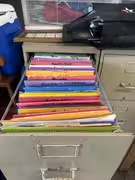
My mission: to purge two 4-drawer file cabinets and a dozen tubs and boxes in my garage. Lighten up and make space. 

The contents: 30+ years of teaching materials. 

Having been a teacher since the fall of 1991 (with the exception of one year between schools where I was moving, pregnant, and having my first child), I've accumulated and created a lot of materials over the years. The majority of my career has been in homeroom classrooms in about 6 different elementary schools. Ten of the last 11 years, the majority of these teacher materials have been living in my garage--untouched as I moved from teaching 3rd grade (or 2nd... or Kindergarten... or 5th grade) to teaching Technology. 

In this day and age, files are definitely more digital than anything, and it was time to "let go." No, not retiring yet, but my garage certainly was getting out of hand--just ask my husband! Plus I was settling on the answer of "no" to these questions: "Would I want to go back to a regular homeroom classroom? Would I ever use all of this again, even if I did?"

11 hours of purging about 33 years of materials gives you a lot of time to trip down memory lane. Upon pulling open the first file drawer, I had a pang. Did I really want to do this? I was thinking about the blood, sweat, toil, tears, and lamination/creation time I was about to get rid of. Yes, I'm doing this. It's time to reduce, reuse (via donation), and recycle!

7 garbage bags, 2 filled large yard lidded-recycle bins, at least a dozen bags and boxes of paper stacks of files to recycle, 20 or more dead binders that housed teaching units, and a half a dozen boxes of books to donate, I was in a lighter place. 

Yes--I got to see windows into each and every school I have taught. 

Yes--there's a lot of money that I have put into my teaching career. 
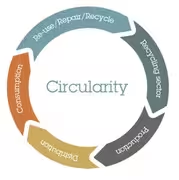
temp-Image40q-Il-QThe biggest yes--there's a lot of irony in recycling binders of environment and green school lesson plans a couple weeks before Earth Day. The "circularity" was striking, though maybe not picture perfect when describing the circular economy of true sustainability. But I did mentally hear the "Circle of Life" song from the Lion King going through my mind.

But, also yes--all of this served me at its time. It was there when I needed it. It all helped mold me into the teacher I am today. 

And yes--some of the items (ditto copied resources and even transparency overlays from my early days in mid-1990s teaching) should have already been long gone. Maybe, just maybe, I've been an organized hoarder--or at least compiler of teaching materials. I was "curating" long before Pinterest even thought of it. Mine was just the file cabinet version.
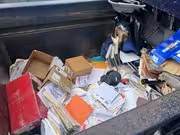
temp-Image-VYWIKdThe true moment of circularity for me came when my mission was completed and I realized there were far too many materials to put all out at the curb. Boxes of paper won't weather well when setting them out the night before an early trash/recycling pick up the next day. Given that, I loaded my dozen boxes into the back of the car and trekked to the local recycling center. Up and over the ledge into their bin all the boxes went.

A neat field trip we once took at the Maryland Green School I used to work at was to the local landfill and recycling center. I definitely flashed back as my files when floating in the bin. 

Yes, full circle. 

Graphic from https://www.pactcollective.org/pactresources/circularity, other images from my camera.

Saturday, October 19, 2024

Climate Change Course Comes to College

According to the Education Data Initiative's website, approximately 19 million people went to college this fall in some capacity: full or part time, freshman through senior. undergraduate or graduate status. 

As a parent of "big kids," I know a few of those 19 million people.

The purpose of college follows this quote of Oprah Winfrey:
“Education is the key to unlocking the world, a passport to freedom.” 
Additionally....
  • Education is a lantern that lights up our mind, illuminating knowledge. 
  • It's a compass that guides us to navigate through fact, fiction, mis- and disinformation, understanding, and perspective. 
  • College is a bridge to new ideas, an avenue to insight, and a doorway to the future. 
This year, one college is opening that door even further for their new first-year students. UC San Diego has added the Jane Teranes Climate Change Education Requirement. This new course requirement was named for a long time professor of the Scripps Institution of Oceanography in November of 2023.

Beginning this fall, student schedules over their college tenure will need to have a one-quarter class on the subject of climate change. (UC San Diego runs on a quarter system.) Students have a choice of selecting one of many classes from a range of many cross-disciplinary options. Why? Being a school that has had long ties to climate research, UC San Diego and its administration solidified this commitment to broaden global awareness and create a mindset of environmental problem solvers. This change in their college requirements does not affect the total number of requirements as this class will overlap with the current general education/diversity requirements.

Click here to see the approved courses, nearly 50 classes ranging from Climate Justice, Religion & Ecology, Climate Ethics, Ocean Studies, Literature and the environment, and more.

Imagine a world where 19 million people heightened their awareness by taking a class in eco-stewardship.  Think about where we our world would be.

If this has gotten you curious to expand your own climate change knowledge, check out UC San Diego's Scripps Institute of Oceanography Climate Change Resources page.

Saturday, October 1, 2022

Building Leaders Through Outdoor Education

I ran into this quote the other day and it really spoke to me.


It took me back a few schools ago (probably to the tune of 20 years or so), and I am reminded of a former 3rd grader of mine. (Let's call him Trey.) 

Trey was a struggling student in my class. A medicated ADHD student who's impulsivity got him in a thick of trouble every time he turned around. His parents were frequent fliers for parent conferences with me. Trey had a strong ability to think outside the box, he made great connections, and you could see he had an incredible entrepreneurial spirit. But he struggled. Somewhat academically, but mostly behaviorally. He just had to get from 3rd through 12 grade of school without falling victim to his own demise.

In the spring that year, our 2 third grade classes decided as a grade level to build a butterfly garden on campus. Administration gave us a plot of land that we needed to clear and a budget for some pollinator plants and milkweed. Here is where Trey came to life. It bears repeating--here is where he really thrived! He did the work of 3-4 people and got right down to business. He was a master with the shovel. He was the leader of that butterfly garden. My partner teacher and I talked a lot about Trey in this role and the other couple of kids that really shined during this project. What if we could have them out there every day for a half hour before school doing something like this!? It was completely their wheelhouse and it was leadership in action. 

Getting kids outside more in our classroom requires a bit of thinking outside the box. National Geographic has an excellent post on "backward planning." A big perk in planning and teaching this way: it gives students more agency and control in their own learning. Author and educator Alison Katzko gives four tips on how to achieve your best through backward planning in this article entitled ""How to Get Students Outside? Try Backward Planning" By making outdoor excursions part of your regular routine, and looking for curricular connections, you can meet the standards in ways that truly impact your kids! 

She has a second article in the series called "Why Abi Henneberry Takes Her Class Outside Each Day". Not only does this activity bring hands-on learning and engagement, but it also builds empathy, community, and helps broaden perspectives. Again--all key features in leadership!!

Think of the leaders we as teachers can help shape and create!


Saturday, March 5, 2022

Harvard's Askwith Education Forum: How K-12 Schools Can Take Action on Climate Change

A colleague pointed me in the direction of Harvard's Askwith Education Forum's webinar: How K-12 Schools Can Take Action on Climate Change. Not only was it free to register, but free to watch for all after the fact. It was a powerful hour of discussion with moderator Bridget Long (Dean and Saris Professor of Economics at Harvard Graduate School of Education) and 3 amazing experts: 
  • John King Jr., President and CEO, The Education Trust; former U.S. Secretary of Education 
  • Pedro Martinez, CEO, Chicago Public Schools
  • Becky Pringle, President, National Education Association
[Side Note: One of the interesting things was John King Jr's approach given he is a fellow Maryland resident. When I started doing more digging on him, I also discovered that he is a candidate for the Governor of Maryland.] 

The conversation between these experts in this webinar focuses on how schools and educators can be leaders toward a more sustainable planet and society. Additionally, they discuss the multi-faceted impact of environmental justice and why there is such a great need to educate our students on these factors.

They also share information about the Aspen Institute's K12 Climate Action Plan and the Local K-12 Climate Plan's Key Questions to Get Started. These are two great resources for environmental educators.

To learn more, go to the Askwith Education Forum's page and watch the video and learn more about the webinar. You can also watch it here or below.


Saturday, July 31, 2021

Summer PD: A Walk on the Wild Side

I mentioned in my toe-dipping into back to school ideas that I've been attending a series of one-day summer institute professional development days at school. They're run in-house and on a completely optional basis (though paid!) and cover a variety of subjects. One of the nicest parts is that you can gear it toward your own professional learning and interests. Additionally, it is a great way to meet up with a variety of our preschool to grade 12 colleagues and get to know them better. Classes run from from anywhere to 6-20 "students" (aka other teachers), so a quick connection builds and the discussions can become quite rich--both on topic during class and off topic during lunch.

Like most teachers, I love learning new things. I also often teach a class or two in the summer. This year, I co-taught a class called "Walk on the Wild Side: Integrating Environmental Education in Your Classroom" with an Upper School Science teacher. We taught it in Summer of 2019, and rebooted it this year. One of the fun perks is that we have all of the participants bring their bikes and we bike the 2+ miles between campuses on the community bike trail and picnic and geocache about halfway along the way. 

In addition to discussing  Florence Williams' book Nature Fix and the health benefits of why we need to get outside, we incorporated some tools such as scavenger hunts and nature observations which can help teachers get in touch with the outdoors. 

One of our activities was to inspire our participants to come up with a setting outdoors for a 2 inch Playmobil figurine using only natural items. (My kids loved these when they were little and we have a ton of them. They make the perfect teaching tool!) The neat thing about this activity is the curricular connections: it could serve as inspiration for a story students would then write;it could be to build and showcase a chapter in a book; or it could be a maker activity putting the design process to work solving a problem. Our adult creations and backstories were phenomenal. Plus, it got the juices flowing for other ways teachers could modify these (and other) activities in class.

Along with afternoon work time for teachers to think of their own ways to infuse the outdoors in their classes, we invited participants to add to the growing document of ideas that we started, that grew in 2019, and grew even more this year. The list is housed in a professional development part of our online portal and available to all. Here are some of the inspirational and collective ideas from our teachers to you! We broke them down into time periods so anyone could find something that fits with whatever time block they have available!

5-10 Minute "Walk On The Wild Side" Classroom Activities to get kids outdoors--Many at this time period could be"brain break" events:
  • Hide and seek with objects or people -- especially in foreign language classes
  • Pato pato ganso (Duck Duck Goose in Spanish) or on hot days, drip drip drop or tie in with new vocabulary (example: noun, noun, adjective)
  • Numbers freeze dance on playground using sidewalk chalk and music
  • Compare our weather to weather in target country
  • Sidewalk chalk recording and illustrating the themes in the book as an anticipation strategy prior to reading
  • An inside activity, but daily: tally the number of days or hours you DON’T need to turn on lights due to lights coming into the room.

10-20 Minute Activities
  • Scavenger hunt with nature vocabulary, team building, or tie to concepts and bring it outdoors
  • Bury magnetic letters in sandbox and have preschoolers dig out and identify letter
  • Book Club Activity based on a novel about survival/nature
  • How many triangles can you make with 9 sticks?
  • Practice writing letters using water and paintbrushes
  • Play season detective and scour the schoolyard for all the signs of the given season 
  • Use sidewalk chalk to create a grid where kids can count and sort objects
  • Build a nature structure using “found nature” items outside for a “character” (Lego or Playmobile figure). Put a time period on it. Photo and share (or annotate), museum walk, etc. Put on parameters about how tall, wide, the perimeter, etc.

20-30 Minute Activities
  • Maximizing the exploding can (hydrogen coffee can experiment)
  • Bohr Model of the Atom Amphitheater
  • Build a Structure for Lego person and calculate “you size” (scale/dimensional analysis?)
  • Soccer with language immersion (foreign language)
  • Collect flowers and leaves and do leaf rubbings with crayons (younger students)
  • Novel read aloud at outdoors- have the kids “act out” different characters and add stage directions to the text 
  • Shape walk, followed by sketching and labeling what you saw
  • Write math problems on the blacktop with chalk and have students find pinecones, rocks, etc., to represent the answer.
  • Build a model of a topographic map with natural items

30-45 Minute Activities
  • “Escape Room” that takes place/incorporates outdoor space 
  • Have students chalk compass directions onto the blacktop and take note of what they see in each direction. 
  • Form adjective list, then go on a walk or on schoolyard nature trail and try to find an object that matches each descriptive word.

45-60 Minute Activities
  • Kite flying (and making) for the Breadwinner chapter book unit
  • Book-themed party hosted outdoors w outdoor challenges/activities 
  • Scavenger hunt from PD Day 
  • Solar Ovens/Wind Turbines
  • Water Quality in pond or stream
  • Carbon sequestration (tree diameters)

An Hour-long + Activities

Apps & Other Goodies

Art from my camera or created on canvas.com

Wednesday, July 8, 2020

MAEOE's Cavalcade of Collected Resources

I love collective nouns. Those unique words that describe a bunch of something.
An atlas of maps.
A cache of jewels.
A quiver of arrows.
A blush of robins.
A charm of hummingbirds.
A wonder of stars.
A kaleidoscope of butterflies.


When it comes to a knowledge base, I like to think of it a a "cavalcade of collected resources." If you are looking for a wealth of nature-based info, Maryland Association of Environmental & Outdoor Education [MAEOE] is the place to go. Given their dedication to environmental education & green schools, it's no surprise!

This summer, they are creating weekly newsletters entitled: "Engaging With Nature: Weekly Ideas for Parents & Caregivers Newsletter." Here they have a collection of outdoor, nature-centric ideas to connect you with nature in a variety of no tech, low tech, and high tech activities, camps for kids, and adult inspiration. At this writing they have Summer Edition 1 (June 19) & Edition 2 (June 26).

In addition to their Resource Library, they have another page of a multitude of resources dedicated to providing parents & educators loads of links. Their Home-Based Environmental Education Resources (Teachers, Parents and Guardians) page has links to resources on all of these:
  • 50th Anniversary of Earth Day resources
  • Bay Backpack Resouces
  • National Wildlife Federation Resources
  • Project Learning Tree 
  • Green Center Partners
  • Virtual Field Trips & Tours
  • Spanish Reosurces
  • Climate Education Tools
  • Community Science Tools
  • MAEOE Video lunches
  • Professional Development & Webinars
  • Activities
  • Videos 
    • Wednesday Lunch and Shares--A google drive folder filled with all of their weekly lunch recorded events since April 1st
      • April 1, 2020: Taking a Purposeful Pause
      • April 8, 2020: Share ideas for connecting families with nature nearby or inside
      • April 15, 2020: Climate Change and COVID-19
      • April 22, 2020: Earth Day and Citizen Science
      • April 29, 2020: Climate Education and Art Online
      • May 6, 2020: Online Portals and Virtual Learning
      • May 13, 2020: Engaging With Volunteers During COVID-19
      • May 20, 2020: What's the Buzz: All About Native Bees
      • May 27, 2020: Conservation and Agriculture
      • June 3, 2020: Environmental Forums and Virtual Green Team Meetings
      • June 10, 2020: Virtual Encounters with Live Animals
      • June 17, 2020: Agricultural and Virtual Education Resources
    • Environmental Educators Collaboration Meetings:
      • March 30, 2020: Working Collaboratively Together
      • April 14, 2020: Equity and Inclusion
      • April 27, 2020: Place-Based Learning
      • May 11, 2020: Aligning Virtual Resources to Standards
      • May 26, 2020: Engaging in Nature this Summer & Communication Strategies
      • June 8, 2020: Continuation of May 26, 2020 Meeting (Engaging in Nature this Summer & Communication Strategies)

Wednesday, July 1, 2020

Maryland Green Schools

I've written about our Maryland Green School recertification process a time or two. Given the process parameters of what you need to do, it's certainly a daunting task. It was one I spent hours upon hours on, and that was with a committee of folks working alongside of me to help gather our 4 years of data, checking boxes as we went.

But in the category of "great success comes from the feeling of accomplishment from hard work," it was a significant triumph indeed when we were awarded our recertification designation  on June 3rd.

This video from Maryland Association of Environmental & Outdoor Education was a nice tribute to our school and the many others that did the hard work.


Video from https://youtu.be/C3TcLnUedJE

Saturday, June 13, 2020

Why We Need Environmental Education

It seems forever ago, but this past February I shared some in-house professional development with a group of colleagues at school. The first 5-10 minutes of my presentation (entitled "Infusing Environmental Education Into the Classroom" detailed some statistics and the health benefits of nature, and is here below. The remainder of the hour was spent detailing a multitude of classroom activities.

Given the numbers, percentages, what nature lowers, and what it improves, it's a strong statement of how important it is to get ourselves outside a lot more often. What are you going to do outdoors today?


(Much of the research I included here came from sessions I attended early February at Maryland's Association of Environmental and Outdoor Education's annual conference.)

Link to my presentation: https://docs.google.com/presentation/d/1lcRig9zhnVdyXcCcRiVwzKAl5VeiqnAUsk-ulXuH6RE/edit?usp=sharing

Saturday, April 4, 2020

Recertifying as a Green School: A Reflection

I alluded to the fact a week or so ago that I had been knee deep during the last few months working on our Maryland Association of Environmental & Outdoor Education [MAEOE] Green School recertification. Our school was initially certified in 2016, and given it's a 4 year process, we were back in business this fall and winter collecting data and navigating the MAEOE checklist.

I'm happy to report that our green school recertification has officially been submitted, meeting the St. Patrick's Day deadline. (A humorous irony that I appreciated.) What a huge relief to send that off, as it had become the 'round the clock life for me and my committee, especially during the last two weeks. A "perfect storm" tie in during the last 2 weeks before our Spring Break while we also were busy facing the daily changes that needed us to put do some tech triage to get all systems ready for remote learning if needed.

The MAEOE application included deep investigation on all the following parts--a task that seemed to grow considering the nature of our Preschool to 12th grade independent school program. Additionally, everything needed documentation. The requirements were as follows:

   Summary of the School & Top 5 Achievements (over the past 4 year certification period)
   Objective 1: Systemic Sustainability
        1.1 Curriculum and Instruction: Environmental Issue Instruction
        1.2 Professional Development
        1.3 Sustainable Schools
        1.4 Celebration
   Objective 2: Student-driven Sustainability Practices (4 of these 8)
        2.1. Water Conservation/Pollution Prevention
        2.2. Energy Conservation
        2.3. Solid Waste Reduction
        2.4. Habitat Restoration
        2.5. Structures for Environmental Learning
        2.6. Responsible Transportation
        2.7. Healthy School Environment
        2.8 Citizen Science / Community Science
   Objective 3: Community Partnerships, Awards and Special Recognition
        3.1. Community Partnerships
        3.2. Awards and Special Recognition (Optional)

The school as a whole answered our committee's emails or division surveys to indicate what they had been doing, environmentally-speaking. Our team of 7 went out on expeditions in the school's Flickr account, the school website and digital newsletter, our elementary division's digital portfolios, on foot taking classroom pictures, and in person--hitting up our teachers for all sorts of documentation.  There was also a metrics form to be filled out and submitted, separate from the website we needed to create to compile all of this eco-information.

As I mentioned, this was our recertification process, so we had our 2016 website application as our springboard. I've also taken part in helping another school maintain its certification 2 other times, so it was not a new process. But big jobs are big jobs, no matter what!

That said, as I reflect on it (now that I've comfortably met the deadline AND caught up on my sleep), a few things come to mind by way of reflection:
  • While the task was large--one might even say behemoth, the results were rewarding. For us to see our completed package of all of our green accomplishments--it felt good, and continues to feel good. More than just from a "tackling the task" perspective, but also from being able to see the sum total of all our school collectively created over the past 4 years.
  • Were there times I wanted to give it all up, as head of our committee? You better believe it! But not only was it too important to me (as a resident greeniac), but it was important for us to continue to fight the good fight. It certainly was an experience in dedication, perseverance, responsibility, and grit--all lessons that we teach our kids, and ones we are never too old ourselves to learn, relearn, and be reminded of!
  • Are we perfect? No. But then again, no one (or no school) is. Part of the whole Green School certification process is about "darkening our shade of green." We have maintained elements we put in place in 2016 and have shown we have grown from there, environmentally-speaking. Again, that feels good, and it's something of which to be proud.
  • Will we pass? Who knows. We certainly gave it a valiant effort, so that alone stands on it's own two feet. And, if we don't, it becomes part of the design process, where we tweak and modify, then resubmit. It becomes a "First Attempt In Learning" if we initially fail. It is what we teach our kids. It is who we are.
Revisionist history might find itself in places like this, after the fact. Much like having a baby, people don't necessarily want to relive the pain of actually giving birth--but the baby is certainly worth it. Looking at all we accomplished these past 4 years across the board in all grades and all divisions... it certainly was worth it!

Now, all we have to do is cross our fingers and wait!


MAEOE images from https://maeoe.org/news/2018/maryland-green-school-program-grows-to-618-schools-27-of-all-maryland-schools,"Outdoor Education" image created at canva.com, and Quote image from http://quotespictures.com/adopt-the-pace-of-nature-her-secret-is-patience-2/

Saturday, February 29, 2020

Science App Recommendations from Project Learning Tree

Project Learning Tree always is rich with resources.

Their article "12 Engaging Science Apps for Middle & High School Students" is right there along the lines of super finds.  Best part about all of these apps: they're free, and all with a focus on climate change, trees, conservation, & weather.

Here's the short list, but be sure to click the link to this article in order to get a brief synopsis of each one!
  1. Carbon Capture
  2. Code Carbon
  3. Earth Now
  4. Global Change
  5. Globe Observer 
  6. Leaf Snap
  7. Offset
  8. Oroeco
  9. Space Science Investigations: Plant Growth
  10. Survive Global Climate Change
  11. Trees Pro
  12. Water Wiz
Plant Snap is an app similar to Leaf Snap which I have used, written about, and recommend as well!


Image from https://www.plt.org/educator-tips/science-apps-middle-high-school-students/

Wednesday, October 30, 2019

Steve Trash! To The Rescue!!

Ahhh... to be known as a "rockin' eco hero," a comedian, and a magician. It might just be the trifecta.

Steve Trash holds this triangular title, and has been in action since 1984 spreading the message of recycling, sustainability, and being an environmental steward.


He's taken his show on the road just about everywhere: North America, Europe, Asia, multiple news channels, PBS, and issue of Weekly Reader, and more. He's got a YouTube channel with well over 250 videos. He has 2 albums and music videos along with his Trash TV series and more. He has a blog he's maintained since 2008.  He even has a bank of solar panels in his front yard. He's all in, and all about ecology, science, STEM-STEAM, and even some videos on character development like manners, bullying, taking responsibility, empathy, being a good friend, digital literacy, and more.

He's everything you'd want an environmental educator to be! Definitely check out the plethora of resources he has on his website and YouTube channel when you are wanting to bring a little zip to your classroom eco unit!

Video from https://youtu.be/LMypY08YWqA, photo from http://www.stevetrash.com/bio

Wednesday, August 14, 2019

E-STEM = Eco Education + STEM

In the world of innovation, it only makes sense that STEM and environmentalism pair together in the classroom. Sometimes called E-STEM, this pairing of eco-education and the science, technology, engineering, and math fields fits just as nicely as STEAM (A = Art) or STEEM (The additional E is Entrepreneurship). Given the breadth of environmentalism, it's more than just the "science." It's going to be the innovation that "stems" from the all the STEM subjects combined that will solve our world's problems!

Check out these E-STEM resources for a wealth of learning ideas to marry this dynamic duo:
Image created at Canva.com

Saturday, June 1, 2019

Make Way For Ducklings

Mama Duck is a smart cookie. For the 5 years I've been teaching at my current school, a majority of these years she's decided every spring to lay her eggs in a secure, small courtyard within the walls of our building. Add on, she's got a history that is longer than mine at the school. Two years, she also made our campus her egg-laying home, however she branded out, once outside the Fifth Grade classroom (NOT a great plan, as it led to the Great American Duck Rescue of 2017 as the nest was right next to a drainage pipe, leading to a resident drainage pond). Last year, I think Mama Duck made her home on campus again, but near a more open water retention ditch.

The beauty of the safe confines of the courtyard is that is is protected from the predators that abound... 4 legged critters and larger birds. (We have osprey and an eagle that nests nearby.)

Add to that, Mama Duck, when she settles into the courtyard, gets a little Bed and Breakfast service all summer long by the Business Manager and our Admin staff at school.

Like I said, she's one smart cookie.

Well, this week, we discovered not only was Mama Duck back, but she  was not alone. To the tune of 11 darling ducklings! There's nothing like watching Mother Nature in action, in nature... except maybe Preschoolers to 5th graders, noses at the window, looking outside, in awe of the duckling darlings!


Pictures from my camera!

Wednesday, May 29, 2019

Rewilding--The Missing Piece of the Personal & Planetary Puzzle

The books I read often shape the posts I write here. My latest: Marc Bekoff's 2014 book Rewilding Our Hearts: Building Pathways of Compassion and Coexistence. Marc Bekoff might not be a household name, but he's got a litany of credentials: Professor Emeritus of Ecology and Evolutionary Biology at the University of Colorado, scientist, ethologist, behavioral ecologist, author (of 31 books and 1000+ articles), and a person who's made his life mission one to study animal ethics and human behavior.

The premise of this book is to reconsider our relationship between human and nonhuman animal species through the lens of compassion (which, in turn, begets compassion). "Rewilding" as a mindset shift... and I will say, it took some getting used to considering animals as "nonhuman animals" (for we, too, as humans, are animals). In both the videos below, both Marc & George Monbiot give two similar definitions to each other of rewilding and their impact to both the planet and ourselves as individuals.

Rewilding (as related to people) is closely tied to getting us more in touch with nature, countering nature deficit disorder and "solastagia" (the antithesis of nostalgia--a feeling of stress and loss to our changing environment).

It is through compassion that "we might begin to undo the alienation and fragmentation that currently defines our damaged relationship to the natural world. Compassion will also help us heal our damaged, alienated and fragmented relationships with each other" (page 4).  [That sentence alone reminds me of our current relations with each other on a multitude of topics, all front and center on the current news cycle.] We have lost track of our connection and empathy for others and nature. We have been "unwilding," where we have "eroded our relationships with nature and other beings" (page 35). We need to get back in touch with nature.


I feel like Marc Bekoff and George Monbiot (see below) would be great friends--and make fascinating guests at a dinner party with Richard Louv, Florence Williams, and Wallace J. Nichols.

Major takeaways:
  • We're encouraged to be activists,  not "slacktivists." Even small acts add up when put together.
  • We are born biophiliacs, with the love of nature inside of us.
  • Interconnectedness and interdependence is not just human to human--the greater animal world is tied to that.
  • The "8 P's" of Rewilding include being "proactive, positive, persistent, patient, peaceful, practical, powerful, and passionate" (page 72).
  • We need to get our kids outside--at home AND at school. Recess alone is not enough.
  • "Ecocide is suicide"(page 148).
On that note, I'm closing my laptop (though I was reading and writing outside today) and heading to a local woods with the kids and the dog.

For more follow-up on Marc Bekoff and rewilding, check out his website and read his post on Wildlands Network.

 Videos from https://www.youtube.com/watch?v=f8M3OCGSxxc and https://www.youtube.com/watch?v=8rZzHkpyPkc, Image from Amazon.com and https://quotefancy.com/quote/61653/John-Muir-One-touch-of-nature-makes-the-whole-world-kin

Saturday, April 13, 2019

Earth Day is on the Way

During an Earth Day lesson this week this week with first graders,  I told them that Earth Day was my favorite holiday. I left out the part about my teaching experience at previous school that was über environmental. I also left out the part about writing an eco blog for the past 9+ years. But they got the impassioned point, none the less, and who knows, maybe they could guess the rest.

Earth Day, just like your birthday, is annually on April 22nd. This year, Earth Day turns 49. The 2019 theme: Protect Our Species.

For teachers, Earth Day is ripe for lesson plans and curricular tie-ins at every level. Here's a collection of resources for you if you are still looking for something for the next week or so ahead. (Though, one could argue, environmentalism can and should be taught all year long!)

🌎 Earth Day Network
This is your first stop on Earth Day, from the source. Their mission: "To work year round to solve climate change, to end plastic pollution, to protect endangered species, and to broaden, educate, and activate the environmental movement across the globe."

There, you'll find a wealth of toolkits & background information for teachers and groups including:
  • Organizers' Toolkit
  • Primer & Action Toolkit
  • Teach In Toolkit 
  • Climate Education Toolkit
  • Mobilize U: Campus Teach In
  • Cities & Leaders Toolkit
  • Faith Leaders
Likewise, you can take part in Billion Acts of Green and other campaigns. You can also test your knowledge (or your students') with a variety of Earth Day quizzes including the following: 
  • Protect Our Species Quiz
  • Climate Change Quiz
  • Oceans and Plastic Pollution Quiz
  • Earth Day Environmental Literacy Quiz
  • Deforestation and Biodiversity Quiz
  • Clean Energy Quiz
🌎 Climate Change Resources for Students and Teachers from Common Sense Media

🌎 Ecology and Environmental Science Apps, Games, and Websites from Common Sense Media


🌎 We Are Teachers Website's 12 Meaningful Earth Day Activities for Every Grade

🌎Also, if you teach using Seesaw Digital Portfolios/Learning Journal, be sure to browse the Seesaw Activity Library for "Earth Month in Elementary" section for approximately 100 Earth Day related student activities.

🌎 And... if you still can't get enough, there's always the GTG Archives of Earth Day Activities


Images from https://www.worldatlas.com/articles/why-and-when-is-international-mother-earth-day-celebrated.html and https://billboardinsider.com/threatened-species-displayed-across-the-us-for-earth-day/

Wednesday, November 7, 2018

Diving into Project Learning Tree

Project Learning Tree is NOT just for Halloween STEM Activities.

It is an integrated program and a philosophy--one based on the importance of environmental literacy in promoting eco-stewardship. Their avenue: taking the learning outside, "using trees and forests as the window on the world." As any environmental educator will tell you, it is through knowing the world and nature around you that you become connected and committed to conserve it. Project Learning Tree does this through its curriculum, its professional development, and the network of support it offers.

Those are all great ways to fend of #NatureDeficitDisorder!

Take a peak into the minds and hearts of 13 Inspiring Examples of Young Environmentalists. Here, you'll see the following young activists dive in with their heart, for the betterment of their community and our world. Cheers to these environmental youngsters:
  1. Alex Lin: Reducing eWaste
  2. Green Ambassadors in Houston, Texas: Transforming a "Food Desert into a 'Greenbelt'
  3. Destiny Watford: Creating a Solid Waste Incinerator
  4. "Students for Sustainabiliy" Club in Washington State: Realizing Reforestation
  5. Ta’Kaiya Blaney: Singing Activist
  6. Cole Rasenberge: Challenging Fast Food Packaging Industry 
  7. Baltimore High School Students: Transforming a Dumping Site
  8. Olivia Bouler: Fundraiser for Gulf Coast Oil Spill Relief
  9. Livermore, California Middle School Students: Reducing Campus Waste
  10. Jersey City 8th Graders: Driving a Drone to Map Trees
  11. Salt Lake City, Utah High School Students: Converting a Bus to Biofuel
  12. San Lorenzo Valley High School Students in California: Organizing an Environmental Conference.
  13. Xiuhtezcatl Martinez and more: Suing the Government for “their failure to protect the atmosphere and their future.”


For your own deeper dive into the environment via PLT, follow these 13 environmental examples. Here's a list of some other Project Learning Tree resources:

Project Learning Tree's Mission & History

~Curriculum Offerings, by Grade Level
Activities for Families

Downloadable Green School Investigations

Environmental Education Resources

STEM Strategies

Educator Tips

Recommended Reading, by Grade Level


PLT Logo from http://sustainability.fullerton.edu/U-ACRE/links/links.php, video from https://www.youtube.com/watch?v=6RO4BMYWUrw

Saturday, October 20, 2018

Green Roofs

Once, a long time ago (about 7 years), I helped to build a green roof, on the roof of the greenest school in the world. Unfortunately, about 4.5 years that school shut down. It still breaks my heart.

I did a drive-by about 2 weeks ago, and well... sadly that green roof is not being maintained well. But... I digress.

What is a green roof? GreenRoofs.org and Kids.Net.Au both have a straightforward rundown on why they are so helpful for reducing storm runoff and other perks.

Additionally, there are these videos. Seems to me, everyone would want to have one!!


Video from https://www.youtube.com/watch?v=howO82-Fd1o and https://www.youtube.com/watch?v=FlJoBhLnqko

Saturday, April 7, 2018

Earth Day 2018: Teaching Activities & Lesson Plans


As a Part 2 of my Earth Day 2018 Series...

Here's a baker's dozen of links (in absolutely no order) that takes you beyond Earth Day Network. These will connect you to a multitude of resources out there to inspire you for planning your Earth Day classroom (or even home) activities.

The best part... these aren't just limited to Earth Day. It makes for a grand excuse to make everyday Earth Day!!

Wednesday, April 4, 2018

Earth Day 2018: History & The Network

April 22nd, 1970 was a day that will live in history.  That marked the very first Earth Day, nearly 5 decades ago. This video gives a great overview on Earth Day and how it all began.


The Earth Day Network is your go-to place to learn all about it.  "End Plastic Pollution" is the theme
for this year. There's a bounty of educational resources here:

Stay tuned for Part 2 of my Earth Day Series: Teaching Resources!


Video found on https://www.plt.org/educator-tips/earth-day-activities/, originally on https://www.youtube.com/watch?time_continue=175&v=6WA8FpGI5Sw; logo from https://www.earthday.org/