Showing posts with label social justice. Show all posts

Friday, June 19, 2026

From Freedom to Future: Juneteenth, Father's Day, and the Obama Presidential Center

What do fathers, freedom, financial planners, and forward thinking spaces like Obama's Presidential Center have in common?

They all are tied to this weekend ahead, at least here in our house. Simultaneously, they all point to the same big question: What will we leave behind?

Here at home, my husband and I started the weekend with a Zoom call with our financial planner. This has become a relatively regular occurrence every month or two. Looking at longevity, legacy, and long-term care ultimately has us staring at that “someday” end date. 
We all have one, and no one gets out of this life without landing on one. Of course, we all hope it's later versus sooner. Add in the reality of parenting near-adult kids, and Father’s Day starts to feel a little different too. Aging, watching medical concerns trickle into our friend groups, and quietly wondering how on earth we got here so soon!

Then add in all the news of our first African American President, Barack Obama, unveiling his beautiful Presidential Center. More than a library, this community-centered campus includes outdoor green spaces for learning, playing, organizing, and creating together. It's a place to learn about civic engagement and democracy, serving as a place to honor the stories of those behind us as well as a springboard to build and imagine a future greater than the world in which we live. As I watched the speeches and unveiling, I felt the hope and optimism of building a collectively great place. That for me completely memorializes the power of our 250 years here in America.

It also highlights the vision and importance of Juneteenth, and feels powerful that the Center's opening was on June 18th. Juneteenth commemorates June 19, 1865 when the last group of enslaved Black people were finally told they were free in Galveston, Texas. This happened more than 2 years after Lincoln's Emancipation Proclamation that put an end to slavery on January 1, 1963. Juneteenth became an official national holiday in 2021. It is seen as the "second Independence Day," celebrating freedom, equality, resilience, and social justice.

This weekend invites us to reflect on legacy in different ways. As we pay tribute to the history of Juneteenth, honor our dads and grandfathers here on Father’s Day, and celebrate the Obama Presidential Center and its focus to the future, we can feel the swirling power of "legacy." It feels living. It feels like a verb. It certainly feels like a hope for what's to come next.

We feel the stories of our own family histories as we celebrate our fathers, the stories of our country's history, and the stories we hope to build going forward. Much like the community gardens that are a part of the Obama Center, legacy is a place to go together. A place to grow together. It is through history and community that we do indeed grow. Perhaps that is the truest meaning of "legacy."

To all who celebrate:
  • May Juneteenth be a day of remembrance, history, and renewed commitment to freedom; 
  • May your Father’s Day be filled with gratitude, stories, and time together; 
  • And may the Obama Presidential Center stand for a vision of hope, serving as an inspiring gathering place to many... keeping us learning, leading, and leaving a better world behind.


Saturday, May 16, 2026

Social Media's Big Tobacco Moment

I've seen "it" slated as "Social Media's 'Big Tobacco' Moment" in at least a half dozen locations.

What is the "it?" The "it" is the fact that social media court cases are starting to loudly prove that yes, social media is an addiction, and it can cause harm to kids. 

Two landmark trials have been in the news in the past six weeks. Earlier this year on March 24th Meta (parent company to Facebook) was ordered by a jury in New Mexico to pay $375 million due to violating state consumer protection laws, viewing both the Facebook and Instagram platforms to be "a breeding ground for predators." The very next day, March 25th, a lawsuit in California sided with a 20-year-old female who was suing Meta & Google (who owns YouTube), awarding her $6 million for causing years of mental health issues. The endless scrolling, algorithms, and purposeful addictive nature created by social media companies were ruled to be the blame for endangering children. And while tech companies are appealing these verdicts, multiple additional lawsuits are cropping up. The very loud message: tech companies knew the dangers in these devices, platforms, and programs... and sold them to our kids anyway.

So the table is turning when it comes to technology, apps, doomscrolling, and more. 

For those who don't get the "Big Tobacco Moment" reference, here's the backstory. Smoking, which long goes back in our historic timeline, really became glamorized throughout society from the 1920s to 1960s. Seemingly everyone smoked. Despite growing scientific studies over time that this is not a healthy habit, smoking had been pitched as "It's all on the person, and it is a personal choice." Awareness and science began leaning more heavily to "The product is the problem, and we need to pitch the product as such." Tobacco companies put a lot of money into advertising and debunking these claims. The tide slowly began turning in 1965 when a Congressional ruling stated that cigarette packages need mandatory warning labels. Then, TV and radio ads were banned in 1970. But despite all of this, smoking continued to be a large part of global culture, with people viewing it as "cool," relaxing, and socially acceptable, regardless of what science had to say. 

Things significantly began changing in 1994 when several cigarette company CEOs came before Congress to say that nicotine was not addictive nor dangerous to your health (despite scientific evidence proving otherwise). The downfalls continued to come with multiple lawsuits. In 1998 there was a Master Settlement Agreement for over $206 billion, covering 46 states and making it the largest settlement in US history. This loudly emphasized that yes, smoking causes serious health risks, diseases, and cancer. This led to a 2-3 decade decline in smoking, where now in 2025 less than 10% of American adults smoke. Clearly the pendulum has swung and a majority of Americans now outwardly see the perils of this habit.

Which now takes us back to "Social Media's Big Tobacco Moment." With the first iPhone coming out in 2007, we are now nearly 2 decades into this "social experiment" of allowing handheld mini-computers into our daily lives. Not just adults, but kids and teens too. Throw in iPads, tablets, and ready-to-use laptops at every age, where are we now? Many of us (grownups and kids alike) are completely sucked into our devices:
  • autoplaying the next video,
  • scrolling scrolling down the suggested path created by stronger and more stringent algorithms than even a decade ago,
  • fearing the loss of our "streaks"which brings us repeatedly back every day,
  • riding the comparison mentality, stuck in social media with FOMO (fear of missing out),
  • neglecting those around us while being addicted to what our online friends have to say,
Then insert AI in here, which makes everything even more complicated, addicted, and fuzzy as to where the blended line separating reality and "fake news" actually exists. All of which leads to an overwhelming state of loneliness and disconnectedness despited the moniker of "social" media.

And none of these features came by accident. Designers and programmers built these devices to act exacty in this way: holding our focus, bringing money to the company through our hijacked attention, and profiting off our clicks. 

And I must admit: I fall just as victim to it as all the rest! I am no better than any of the rest of us. Despit my "tech teacher, book reading" self! It makes us feel weak for getting sucked into the vortex and having no self control. And I'm an adult. What about our kids and our teens and our young adults?

But maybe... just maybe... it's all in the addictive nature of the dopamine-hitting design versus our own willpower. Just like the addictive nature of tobacco. Souds like it's not a fair fight. How are we ever to win? Perhaps though more guardrails that tech companies clearly need to help protect us all, old and small.

What that means is that we all need to both become informed citizens, and then start behaving like them. Advocate for safer design and legislation--especially those that protect our kids. That might look like taking action, signing petitions, or voicing your concerns to your community.

Additionally, we the parents, educators, and consumers all need to step up and fight the addictive nature and parent both ourselves and our children. This can also do include:
  • Turning off all non-essential notifications to help us become less connected to our devices.
  • Eliminating "tech-grazing time" by building in more boundaries in our homes and schools. This could look like "no-phone-zones" or windows of time where we don't use tech. (For example: before bedtime, right when we get up, less multi-tasking on multiple devices).
  • Removing the apps on our phones that suck us in the quickest: games, social media, and other ones that get our most addictive attention. We need to break our own bad habits.
  • Carefully curating your feed. Make it a space of inspiration, not gloomy news or topics that lend toward depression or anxiety, pulling you deeper into doomscrolling.
  • Building in time limits on your kids devices, and creating opportunities where you "tech together" then play or learn together in no-tech ways too. 
The pull is hard. But it's not just us. The game IS rigged. And now by way of social media's 'Big Tobacco Moment," courts, doctors, researchers, educators, parents, and even some platform designers are saying what maybe we have already felt for a long time: The problems isn't just us or our willpower. The product is flawed by designed to keep us stuck. 

So it's up to all citizens to keep up the noise, the lawsuits, the conversations, the advocating for better guardrails, and the protection of our kids. It's also our role as parents and educators to really speak about how these tools work our brains, hearts, and emotions. Tech is a tool... but it isn't our everything or even a fraction of what is important. People are. That is certainly worth fighting for.


Saturday, September 20, 2025

Outdoor Groups Supporting & Celebrating Diversity

I am a firm believer of "representation matters." 

I ran across this Field Mag article on the Children & Nature Facebook page, and felt it was the perfect follow up to my pride Month post: "Pride Month: Out In the Wild." In the article, aptly named "28 LGBTQ+ Outdoor Groups Supporting & Celebrating Diversity in Nature," you get the location, mission, structure, Instagram page, and a donation link to 28 LGBTQ+ friendly organizations. The list is divided into both national organizations and regional groups.

Additionally, from Children & Nature's "LGBTQIA+ Youth & The Importance of Safe, Outdoor Spaces Stat Sheet" (see the side bar on this page), these statistics further emphasize why both representation and finding affinity groups is important: 

  • 5% US high school teens are questioning their gender identity.
  • 9.5% US teens (aged 13-17) identify as gay, bisexual, or transgender
  • LGBTQ+ teens are twice as likely to feel sad, depressed, or a sense of hopelessness than their straight peers.
  • 52% people aged 14-24 identified spending time in nature as improving their sense of calm and overal mental health.
  • Suicide attempts are 2.5 times higher among LGBTQ+ teens who do NOT feel they are respected for their identity and pronouns than their LGBTQ peers who are.
So what are you into? Hiking? Camping? Adventure trips? Surfing? Snowboarding? Skateboarding? Climbing? Outdoor education? Communing with nature? Connection with a view? Community with a social justice slant? Environmental stewardship? If you are in LGBTQ+ and in need of finding "your people," definitely check out Field Mag's article "28 LGBTQ+ Outdoor Groups Supporting & Celebrating Diversity in Nature." 

Honoring & supporting pride should not be merely one month!

Saturday, June 21, 2025

Pride Month: Out In the Wild

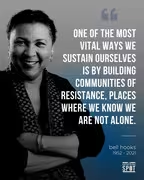
June. Pride Month. A time to honor our right to joy, resilience, and a reminder
that we all have the right to be free and to be our own personal selves. 
Nothing in nature asks for permission to grow--nor should we feel like
we have to ask for similar permission.

 
Pride month is a month of identity. It's biodiversity in human form. It's a good time to grapple with deeper questions like: Who gets to feel safe? Who gets to be seen? Who gets to belong? The answer is--we all deserve that right. 

The waving rainbow flags are pretty and the parades and events can be entertaining. But more importantly, they are empowering. Just as the planet needs biodiversity to thrive, so do we as humans. There's no thriving in nature on sameness. We need the richness of diversity to keep our food webs and habitats healthy; in doing so, we keep our plants and animal species from becoming endangered or extinct. Our wild variety is what maintains our environmental resilience. Our communities and cultures, like our ecosystems, are the healthiest and most vibrant when varied and diverse. Skin colors, sexual/gender orientations, religious beliefs, and all the differences in between. 

Nature seemingly is neutral--and yet, that isn't always the reality. Politics have creeped into environmental issues in more ways than one--and with the onset of social media, there's certainly way too much politics.

Additionally, the outdoor world isn't as gender-non-specific as you'd imagine. A lot of the outdoor industry is geared to straight, white males. That can make it hard for LGBTQ+ and BIPOC (Black, Indigenous, and People of Color) folks to feel comfortable out in nature. Instead, they can feel more "outsiders" than "out in nature-ers." Outdoor spaces may not always feel safe--both physically and as a place to feel emotionally safe to be out and openly queer. Hate crimes are real, and sadly, LGBTQ+ people are at a higher risk of being victims of these.  People not only deserve safe places, but they want and need to feel included, represented, and like they are a part of a community of like-minded individuals...where they are surrounded by connection versus limitations, segregation, or exclusion.

Along those lines, representation and seeing yourself in certain circumstances matter. People matter. Everyone's uniqueness matters. The right to feel comfortable in spaces where you want to be...they matter. Everyone is entitled to the right to be comfortable in their own skin, living a life that works for them, being treated with kindness and respected for who they are. Outdoors or environmental education affinity groups can help to build a more inclusive outdoors, as can the knowledge, the acceptance, and the intersection of LGBTQ+ pride along with racial or environmental justice and outdoor recreation too.

There’s a growing field of study known as Queer Ecology.  Queer Ecology counters the assumption that nature is rigid or binary. There's a lot of fluidity out there in nature: species that change sex (clownfish and slipper limpets) and same-sex partner paired animals (penguins, bonobos monkeys), and male-birthing seahorses. Imagine if we had that level of openness in our human species and greater communities.

So maybe for the remainder of this Pride Month, now that schools are out and kids, teens, and grown-ups alike are all out and about, playing outside more than before, we can celebrate not only the healthiness of nature's biodiveristy but that of our human kind too. Inviting anyone to climb trees, hike trails, and find their space and place in nature, in a safe way, in a welcoming way, in an everyday way!

For more resources that embrace the intersection of pride, planet, environmental & social justice, check out the following:
  • Children & Nature's Celebrating Pride Month (which includes links to many resources, organizations, and inspirational stories)
~ ~ ~ ~ ~ ~
Postscript:
This Pride Month post was already in the works when this past Wednesday's decision came out that the Substance Abuse and Mental Health Services Administration is closing the 988 Suicide & Crisis Lifeline’s LGBTQ+ Youth Specialized Services program, effective July 17, 2025 (30 days after the announcement).

Timing, as they say, is always everything.

Given this, please take note if you or a loved one need these of a crisis lifeline service, the Trevor Project is here for you. The Trevor Project provides advocacy, affirmation, eduation, and crisis support 24/7 for LGBTQ+ youth. Crisis services include:  
  • Lifeline—The only national 24/7 crisis intervention and suicide prevention lifeline for LGBTQ+ young people under age 25, available at 1-866-488-7386.
  • Chat—A 24/7 free instant messaging service for LGBTQ+ youth that provides live help from trained counselors, open daily.
  • Text—A 24/7 free service through which LGBTQ+ young people can text a trained counselor of The Trevor Project for support and crisis intervention, available daily by texting START to 678678.
"Biodiversity" image from https://www.muddypuddleclub.co.uk/post/why-we-need-pride-in-outdoor-learning; "Our Minds Matter" from https://ourmindsmatter.org/2022/05/31/lgbtq-minds-matter/"It's Pride Month" image from https://www.nathab.com/blog/wild-about-pride-the-nature-of-belongingTrevor Project logo from https://www.thetrevorproject.org/Pride Month quote picture created at www.canva.com using their Magic Media tools

Saturday, May 24, 2025

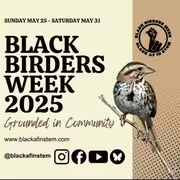
Black Birder Week 2025: May 25--May 31

temp-Image-Vi86c-K
It might seem odd that "Black Birders Week" 
is "a thing."  It is. 

It is an annual even that takes place the last week of May, this year on May 25--May 31st. The first was in 2020--a year we may all remember as being under the cloud of Covid. 2020 was also the year of the murder of George Floyd, which was perhaps watched by many more than perhaps would have seen it because of the pandemic quarantine and so many at home due to the lock down for health reasons. Additionally, this is the year that Christian Cooper, a black man in Central Park, New York City was out watching birds yet was falsely accused of racial discrimination and threatening a woman and her dog. 

It brought about an awareness of the issue that Black people can often face safety issues when out in the field in STEM professions. One wouldn't think that environmentalism would fall on racial lines, as nature and the environment are there for everyone to enjoy and celebrate ... however there are surprising number of social justice issues related to environmentalism. Representation matters, and historically black environmentalists have been underrepresented in outdoor spaces

So began the concept of Black Birders Week, created by TheBlackAFinSTEM Collective and supported by the Audubon Society, the NYC Bird Alliance, and the Feminist Bird Club (started in 2016 for similar representation reasons).
The mission:
temp-Imagex-Rl1r-MThis year's theme is "Grounded in Community."
Images from https://rtipress.scholasticahq.com/article/125415 and https://www.blackafinstem.com/

Saturday, February 22, 2025

Learning Through Laughter: Comedy & Climate Change

Grist is an online environmental publication which has been around since 1999--25 glorious Grist years. Focusing on the intersection of justice, equity, and the environment--particularly climate change. There is always a wealth of news stories on what is going on in the world.

I ran cross this article recently: Moving From Climate Doomerism to Optimism Through Humor (published 1-28-2025). For years there has been talk about how "doomerism" is NOT the way to inspire climate action. Instead it brings a fatalistic approach and heavy duty "doom & gloom" is only exhausting versus inspirational. Remove all hope and people wonder--why try, we're going to hell in a hand basket anyway. Hope is what is necessary, and I've written about that a time or two: here, here, and here.

The premise of this Grist article agrees: 

“Learning through comedy is like the old saying: take a spoonful of sugar, and it makes the medicine go down. I think that is true,” [director Morgan] Sackett said.

We can all take a lesson from content creators on social media: humor can definitely bring both the clicks and awareness to all sorts of issues: social justice, climate & other environmental action, politics, and more. In fact, if you are really creative and met the December 2024 deadline, the Natural Resources Defense Council ran a $20,000 Climate Storytelling Fellowship grant. For the 4th year in a row, 3 winners (either individual or writing teams) will receive the grant for a screenplay or pilot that creates a storyline with an impactful them addressing climate change. You can find an interesting take on comedy and climate change in the Sundance panel discussion "The Last Laugh: Comedy in the Age of Climate Change.”

To bring some levity and hope to climate change and knowing that laughter is indeed the best medicine, these PSAs (public service announcements) and/or commercials made me smile:

Videos from https://youtu.be/T5Us69fSM9M?si=MUnuYxcZZvVyvQe-https://youtu.be/Y-CAMC8saDc?si=uMlLg3EC6mx1Ur6uhttps://youtu.be/-DEc16dEMns?si=_WrILi-IJlfYiIxP; Image created at canva.com

Sunday, January 26, 2025

One Week In: Resources for Dealing With the Rollercoaster of Change

In the United States of America, we are approaching one week under the new regime since Inauguration Day 2025. I'm actually not going to go all political---this is an education, technology, innovation, and environmental education blog. But, it's been a lot. Rapid fire, whiplash-level, deep impact change has come from our new president and his executive orders, sweeping pardons, walking-back previous policies, and more. 
It's. Been. A. Lot! 

I'm not going to go into detail on them all, but here's a substantial list from Axios if you'd like to check out the list yourself. Many of these have been a significant step away from US climate leadership.

With change, no matter if it's good or bad, positive or negative, or whichever side you are on, change comes with a lot of emotions.

Given that, I felt these resources might be of assistance for anyone on the rollercoaster of change.

🌐 Greater Good Magazine: Where Do We Go From Here? In the wake of the 2024 election, our contributors weigh in on what we can do now to preserve our well-being and our democracy. (Article by multiple authors, Nov. 6, 2024)

🌐 Greater Good Magazine: Seven Skills to Foster Connection in Divided Times (Article by Juliana Tafur and Chriss Cuervo, Oct. 28, 2024)

🌐 Greater Good Magazine article: "Can We Build a World Where We All Belong?" (Article by Sahar Habib Ghazi, Jan. 20, 2025)

🌐 Upcoming free webinar from Greater Good in Education: "Teaching in Troubling Times: A Conversation with Parker J. Palmer" on February 24, 2025, 3:30 pm PST (Register here.)

🌐 Earthjustice's webpage: "Action Tip Guide: Find your way to speak out for change"

Image created at Canva.com

Saturday, September 14, 2024

International Democracy Day & Better World Info Database

During an election year, especially here in the US with the last decade being a politically polar mindset, "Democracy" (with the capital D) has been in the news a lot! No doubt, as the next few months go on, the political noise will only continue to rise during this very unique election year.

Might be a good time to celebrate September 15th International Day of Democracy. The idea started in 1997 with its conception as the Inter-Parliamentary Union adopting a Universal Declaration on Democracy. Six international conferences on new and restored democracies were held from 1998 to 2006, with the first being in the Philippines and the 6th in Qatar. From there, in 2007 the United Nations General Assembly resolved what we now honor on September 15th: the International Day of Democracy. The purpose is to honor, uphold, and promote democracy while also raising awareness that democracy can come in many forms, but it is based on the values universal to all: free-expression of people's ideas and all aspects of life. Democracy happens at the voting box and is the basis of peace, humanity, equality, and a country's constitution of protective rights. Additionally, it involves civility--and hopefully open dialogue.

You can learn more at the UN's page on International Democracy Day.

You also can land on 3 dozen links about International Democracy Day on Better World Info's Database. Additionally, their Democracy page has a wealth of information and resources (over 1700) for teachers, students, & citizens alike on a variety of topics. These include social justice, fundamental human rights, & sustainability in global relations, peace, the economy, & more. Likewise, it includes some of the many challenges to democracy--including political apathy and fake news. There are also excellent resources on civic education & information about checking your bias when it comes to your political leaning, & how to approach that in a more neutral way.

Being new to Better World Info's Database, I did some digging around to learn more about this website. The Better World Info FAQ page had a lot of information! With their tagline of "A unique resource & powerful tool for people who want to make this world a better place," their mission is to provide neutral, unbiased, quality & carefully-curated links while not being paid by contributors. This keeps the links non-partial, non-partisan, not prejudicial, and not religiously affiliated. Along those lines, they are purposely free from advertisers and data mining. They want to be sources to be fact based, providing a "one-stop-shop" experience. Created by a German physician with a multitude of international volunteers and teammates, the authors have listed the most important and current lists top of the list per subject. Their mission is to help people think critically by way of providing fact-based, reliable information. All of this is not always a Google search, a social medial post, or a Wikipedia page away. The website is named to center around their vision of a "better world!" Their plan is to unite through information, not polarize into a filtered silo based on algorithms. 


Sunday, April 21, 2024

Eight Ways To Celebrate Earth Day


Happy Earth Day 2024

If you are still looking for ways to celebrate your Earth Day, here are 8. Take care of Mother Nature today in order to feel your personal impact on the planet!


Erase Plastics in your life! With the 2024 Earth Day theme "Planet vs. Plastics," what can you do to eliminate your own plastics. How long can you go without plastics? A day? A few days? A week? A month? More? 

Also, check out the "End Plastic Pollution Earth Day Calculator" to see just how much you use...and what you can do to eradicate it.


Announce, applaud, admire, accept, and adopt a mindset that kindness, social justice, anti-racism, a sense of community, equality, fair treatment, and the betterment of society are all environmental justice issues. So often, BIPOC (Black, Indigenous, People of Color) populations and lower income/poverty level communities tend to get the negative effects of climate change, pollution, and more.. NIMBY ("Not In My Backyard") is an attitude of influence, prejudice, privilege and entitlement when it comes to polluting factories or landfills "should be over THERE" (aka: not here, in my backyard, where I have to see it and live with it.). Don't be that guy (or gal)! Abandon your prejudices and biases and argue in favor of equality!

Really go all in with all the R's...Repair something or reuse it versus replacing it. Reduce your waste. Refuse to trash something or buy it to begin with. Remove the need to keep up with the Joneses, buying what you don't need. Think responsibly. Act rationally, radically, and rally together, sharing ideas. Remind others of all they can do to help your local and global and planetary community!


Take an online quiz via Gapminder.orgGapminder is an independent educational non-profit fighting global misconceptions, with their mantra "Upgrade your world view." Use their non-partisan, fact-based tools and teaching materials to get a true handle on what life is like in the world.

Some good Gapminder quizzes to start with include: Global Warming, Plastics in Ocean, Threatened Species, Electricity Access, Water at Home, and many more.


Help out by a nearby park, neighborhood, schoolyard, or stream by going by and staging your own environmental clean up. Remove trash and litter to help create a happier habitat for the plants and animals that live there!


Downgrade your transportation needs for the day. Can you find a better way to get from Point A to Point B? Consider carpooling, biking, walking, or taking public transportation as a cleaner way to get around today, this week, or this month. Downsize your commute and your environmental impact by working from home if you can.


Abandon a wasteful mentality. Turn off the lights when leaving the room. Stop the faucet flow when brushing your teeth. Buy only what you plan on eating so you don't have to worry about cleaning the refrigerator or throwing away old food. Do you need 14 or the same shirt or with one or two suffice. Bring your reusable shopping bags so you don't need single use plastic or paper grocery sacks. Use a real fork or plate versus a consumable or plastic one. Going out to eat? Take your own reusable containers for your leftovers you want to eat at lunch tomorrow.  Argue against that idea that you need extras when you have enough!


Yearn to learn....never stop. "Yomp" as you go and explore nature and the natural world (aka; move quickly and energetically toward your goal with "determination and resilience"). Yield to new ideas that embrace a global perspective, a vision of human connection, and an attitude of environmental stewardship.

Happy 54th Earth Day, everyone! 
Would love to hear what YOU did 
to take care of our planet!

Earth Day sign and letters created with letter frames and pictures on Canva.com.

Saturday, January 27, 2024

Using Environmental Education As Empowerment

As the perfect follow up from my last post about the history of environmental education...

In this TED Talk from May 2023, Arvolyn Hill speaks out about her experiences as a black woman tying together environmental awareness with racial justice. She also talks about her nature programs at the New York Botanical Gardens and how these programs can help black and brown kids see themselves out in nature....because representation matters!


Wednesday, May 17, 2023

One Green Thing: Top Take Aways from the Book

Earlier this year I wrote a post all about the seven service superpowers from One Green Thing--Heather White's book and website. Created to help combat eco-anxiety, Heather uses this assessment tool to help focus people to their strengths and point them in the direction of inspired activism.

Earlier this winter I read her book. It was excellent. Not only does it talk about eco-anxiety, what it is and how to cope with it, but it gives some very actionable ideas, all centered around the 7 "service superpowers." [To learn more about that, check out my post on that subject.]

While my highlights were many, here were the elements I found most striking and serve as my top 6 thematic takeaways (and reasons why you should read her book for more information).

The Bad News First. 
But don't worry, as there is a lot of good news too.

Eco Anxiety Is on the Rise
One thing Heather quoted was "The Eco-Anxiety Trifecta" which she said is comprised of "anxiety, loneliness, and environmental stress" (p.145 from Heather White's book, One Green Thing: Discover Your Hidden Power to Save the Planet). [All quotes from this book will be tied to parenthetical page numbers.] She's largely talking about Generation Z (aka: anyone born after 1997) With generalized anxiety, suicide, and depression on the rise since 2011--along with increased screen time and then a pandemic--anxiety and loneliness go hand and hand. (paraphrased from p. 145). Since 2018, the United Kingdom has had a "Minister for Loneliness" (and other countries like Japan are beginning to follow suit). Layer in the fact that people and news outlets are finally now talking about the climate crisis (whereas for years it was a largely absent news topic), it has given our Gen Z'ers a lot of concern about what we adults have left them. 

Striking Statistics
These statistics startled me.
  • "Only 8% of plastics are recycled." (page 6)
  • "A study commissioned by the World Wildlife Fund found that we eat about a credit - card size worth of plastic each week." (p. 196
  • "Most families throw out 3 kg [6.6 pounds] of otherwise edible food a week." (p. 267) This then leads to the following two statistics: 
    • "Food waste generates 8% of global carbon emissions." (p. 181)
    • “If food waste were a country, it would be the world’s third-largest emitter of CO2, after China and the United States. ” (p.181)
  • "The fashion industry contributes 10% of global carbon emissions." (I)
All of this leads me to think (after a decade of writing this blog): How is this possible? Shouldn't the numbers be so much different after so many years? Shouldn't we be doing better? As with politics, I'm finding we aren't always as quick to learn or move in a forward direction as I think we should. Some of this is due to greenwashing. We feel like we are doing a great job because we are "recycling," but recycling is a complicated system, and many of our infrastructures can't handle it all...leaving us to believe we are nobly doing the right thing for our environment, but then things start falling through the cracks.

Biodiversity
Biodiversity keeps our planet healthy. Unfortunately, as animal species diminish, we start creating a less diverse plant and animal system, which sadly then can create major issues. This is called "zoonosis" where habitat distruction and overcrowding leads all more susceptible to disease. Insert pandemic outbreaks here. (Paraphrased from p. 220-221.) Because of this, we need to work to protect our threatened, vulnerable, and endangered plants and animals from higher levels of endangerment and extinction.

Climate Justice
Social justice is tied to environmental justice. The climate crisis leads to greater incidents of extreme weather like drought, wildfires, hurricanes, as well as water pollution. This then can impact more and more people. "Malaria, diarrhea, malnutrition  and heat stress will be the biggest causes of death." (p. 135) Sadly, the biggest countries for polluting wind up heavily impacting other smaller more vulnerable countries. So wealthier countries like the US who are creating some of the bigger problems are gifting these other countries a pretty crummy gift.

Additionally, within our own country, it tends to be the black, indigenous, people of color who are living in poorer areas, near harmful factories spewing off waste and polluting the air. They are further from the green spaces, making the areas concrete, heat jungles more so than white neighborhoods, so overall health is worse, and as a population, they are more vulnerable. Equity and climate change and justice go hand in hand. (Paraphrased from p. 158)

The Good News, As Promised!

The "Brené Brown of Environmentalism"
The Foreword of One Green Thing was written by Erin Brockovich. Might have heard of her. She called Heather "the Brené Brown of the environmental movement because she makes environmental action personal, doable, and joyful" [Forward, page x] It is through the collective action of small steps which grow upon each other that momentum is created. Fun and easy repeatable habits become rituals, making it more likely for you to keep doing it. The more you do it, the more you inspire others to do it. These are the basic tenets of Heather White's philosophy. (Paraphrased from page 6-10.)


With each of the 7 superpowers in the book, she dedicates a chapter to each. She also gives concrete coping methods to help you decompress (in ways that are ideal for each "superpower"), while also giving you ideas on how to be energized to work for our planet. She also invites laughter, joy, community, creativity, and humor. Even if it is laughing at yourself, it opens up for a release and helps you embrace both the positive gains and helps make the difficult times more manageable. (Paraphrased from p. 148.) I know I for one had lost a little bit of the joie de vivre with the monotony of the pandemic. We need to remind ourself that we all feel better with a little bit of laughter. Yes, things can be difficult and overwhelming and serious... but life was meant to be lived, and that includes laughing and lighthearted approaches too. Especially if it helps us maintain our motivation and our momentum!


The Benefits of Being Outside
When we get outside and connect to nature, it provides a lot of benefits. It addresses our stress, slows our breathing, and can increase our general sense of health and wellness. Even just 5 minutes of time outdoors can lower our blood pressure. It's all about balance--we live live indoors and online and 24-7 connected. Our physical, mental, and emotional health need a break. We are made to spend time outdoors--walking, observing, and taking part in nature. More schools are connecting educational programs with environmental and outdoor education. (Yay! Maryland was listed, alongside with Oregon & California, as being leaders!) This in turn helps students strengthen their critical thinking skills. (Paraphrased from page 225.) In order to create generations of kids who care about nature, we need to get them out there and show them what it is like to be an environmental steward.

Small Steps Make a Big Difference & Final Thoughts
Some of us get stopped (by our own selves) when we feel we can't "do it all" or make a huge difference or do it perfectly. We may fall into the rut of a "what's the point" mentality. But the collective, small green things all add up. Take for instance this statistic: "Close to 70% of Americans are experimenting with more plant-based protein." (p. 180) This is powerful when you look at the following fact: "the ten most climate-damaging foods, in order from most to least harmful based on emissions required to produce them, are beef, lamb, butter, shellfish, cheese, asparagus, pork, veal, chicken, and turkey." (p. 180) Any flexitarian approach to reducing your meat intake helps the planet. Do you need to go all out vegan or vegetarian? No! Every little thing helps. Taking on small green actionable things feels wholeheartedly doable. It doesn't have to be all or nothing. In between counts.

This book is full of the many ways you can take small steps to make a difference. I love that it's geared to fit your personality through these 7 superpowers, meaning you can more easily be guided to what feels natural. Just think of the collective difference we all could make if we did just one green thing!

Wednesday, April 26, 2023

Just in Time for Earth Day: Revitalizing Our Nation’s Commitment to Environmental Justice for All

On Earth Day this past Saturday, I was delighted to run across this post on social media from the Plastic Pollution Coalition.

I love that the White House issued this the day before Earth Day! As I have learned more and more over the past decade about environmentalism, it has been striking how much a part of it is tied to environmental justice. NIMBY is a real thing, and it impacts black and brown communities and those less affluent in many ways! 

NIMBY, by the way, stands for "not in my backyard," which is a philosophy of many of where we want -- and need -- different global solutions, but people don't want them in their backyard. Classic examples include subsidized housing, waste facilities, factories, wind or solar farms, homeless shelters, and more. Typically the ones complaining and who are heard, are also the ones with power, influence, voice, money, and majority. So more often than not, these items appear in lower income neighborhoods, where the negative impacts affect minorities disproportionately to those in the majority. Additionally, these populations also feel the greater impact of climate change.

Hence the need for environmental justice!

To read the White House Fact Sheet of Biden's Executive Order, Revitalizing Our Nation’s Commitment to Environmental Justice for All, click here.

Additionally, among the many facets of the executive order, Biden and the EPA have released the draft for "National Strategy to Prevent Plastic Pollution." Open to the public for comment, this 41 page document (that you can access online), highlights the following 3 quoted objectives and proposed actions from page 1 of the document:

  1. Reduce pollution during plastic production
  2. Improve post-use materials management
  3. Prevent trash and micro/nanoplastics from entering waterways and remove escaped trash from the environment.

Marine pollution is certainly a problem that even if we tackle it today, there is pollution and waste that is out there that will still make its way into waterways over time. 

Commitment such as both of these major moves is worth celebrating and I'm proud that Biden and the EPA unleashed it right during Earth Day season. It's time we start making forward movement collectively in favor of our planet!


Facebook post from https://www.facebook.com/photo/?fbid=606086091547046&set=a.478972317591758 and https://sustainability.uconn.edu/environmental-justice/ and https://www.weforum.org/agenda/2018/06/5-ways-we-can-improve-ocean-health/