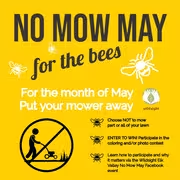
Images & videos from our back yard, either our Kiwibit camera or my own.
1 teacher. 1 world. Eco-friendly. EdTech-friendly. Classroom-friendly.Teacher-friendly. Kid-friendly. Parent-friendly. Planet-friendly. Sustainability. Innovation. What can we do to increase the likelihood that this one li'l world will be here eons from now? Whether you are a teacher, a parent, or just someone who firmly believes that every tiny bit helps, let's all be part of the solution rather than adding to the problem, knowing that innovation along the way is the way to make that happen!

March is known as Women's History Month, but who says you only have to pay tribute to women one month of the year? I certainly do NOT subscribe to that! Especially during the month of Earth Day!
This article from BBC Wildlife showcases these 10 amazing women: "10 Women Who Changed the World: The Pioneering Female Conservationists, From Jane Goodall to Sylvia Earle, who redefined Our Bond with Nature by Amy May Holt (10-2-2025). I love the videos that are included on many of these phenomenal environmental leaders.
Image created using www.Perplexity.AI with this prompt: Make a photo montage/collage of these environmental leading women: Jane Goodall, Sylvia Earle, Dian Fossey, Saengduean Chailert, Lily Venizelos, Margaret Murie, Wangari Maathai, Marina Silva, Leela Hazzah, Florence Merriam Bailey.
Here's the breakdown:
Given all of the above, here's this math:
Agrivoltaics = symbiosis = win + win
This image is a great example of the win, win of the symbiotic relationship between humans, land, and livestock:
Check out how the land is being used in a multitude of ways: grazing grass, growing crops, housing solar panels for generating energy which, in turn, have the panels creating shade for the animals.
Additionally...
Playing around with my new best friend, Canva Code, I created this upper elementary/middle school level interactive which can further help the concepts of agrivoltaics sink in. To go directly to the site to see it screen-sized or to link to it in your own classroom, click here.
Eager to learn more about agrivoltaics? Here are some excellent resources:
University of Illinois' ‘My Agrivoltaic Farm’ Game: Learning, Fun, and Sustainability — All in One or download My Agrivoltaic Farm from either the Google Play Store or the Apple Store to play a simulation game foccused on "the interaction between crops and solar panels, supporeted by the scientific research" from the U of I to "discover how sustainable agriculture and renewable energy can work together to create a greener future."
Summer is here! Longer days of sun, pool-beach-boat plans abound.... and life starts slowing down as June, July, and August heatwaves head our way. Sounds like reading season to me!
I read all kinds of books: mysteries, romance, coming of age tales, non-fiction, work-related reads, chick-lit, biographies, young adults/kids books, and more. This past year, I've become a big fan of audio books, especially when driving about the world or doing laundry. It makes for the perfect escape and travel mate!
If you are a bibliophile like me, you might be looking for a few good books for your lazy, hazy days of summer ahead.Here are 8 booklists where you can find over 120 books to inspire your eco-reading this season:
But also this week ahead--both on February15th this year--we have two eco holidays celebrating some sizable species that need our love too. Celebrate these conservation commemoration days.
World Hippo Day is annually February 15th. Hippos are at a high level of vulnerability on the International Union for Conservation of Nature Red List of endangered species. As the 3rd largest land animal (after elephants and rhinos), they weigh in at over 7,000 pounds. Found mainly in Africa, these huge land mammals have had dwindling numbers because of habitat loss to urbanization and farming (as well as loss of access to the fresh water they need). Likewise, poaching puts hippos at great danger.
World Whale Day, held the 3rd Saturday of February (which this year is February 15th). Since 1980, the Pacific Wildlife Foundation & Greg Kauffman have led the way in honoring and protecting these marine giants. Not only important to ocean ecosystems, whales hold an important place in many cultures as revered creatures and symbols. Their threats come from getting trapped in fishing gear, being illegally hunted, and warming ocean waters from climate change.
To honor both of these animals and share love with them along with your loved ones this weekend, you can ...
Just like being found in the vast fairgrounds for us, Elmo is always full of surprises. Elmo's latest is an environmental partnership between Sesame Street and Cut Media's HiHo Kids YouTube Channel. This collaboration pairs Elmo with HiHo Kids and their "Kids Meet" Series to create a two-part video series to help build environmental stewardship and curiosity of our natural world through eyes of kids and Elmo! As a follow up to my Watching Wildlife post earlier this summer, it seems only natural to share a little Canva creation I made from our family's Cape Cod adventure last month where we did just that: watched some wildlife. Whales, in fact. We booked a whale watching excursion through Dolphin Fleet of Provincetown, Massachusetts. Leaving from the very tip of Cape Cod, we traveled further north where we witnessed a show of nature.
Cape Cod map from https://www.tripsavvy.com/cape-cod-marthas-vineyard-nantucket-maps-3265660, Video created in Canva using my photos/videos from our whale watching trip.
Never forget--you are out in their natural habitat--THEIR zone... so leave them alone!
The birds always catch both my eyes and ears, as do the flutter-by butterflies that come this way. For years, we've had a little patch of milkweed that my husband tends--some years more fruitful in their crop of hatching monarchs than others.
I ran across this video, from Atlas Obscurer, which is amazing... and probably does not do the beauty of the monarch's justice in a way a camera can never compare to real life. The video, from 2019, highlights Phil Torres at the El Rosario Butterfly Sancutuary in Mexico, one of the places where monarch's overwinter.
As a companion piece, there is a video by Joe Hanson for his series, "It's Okay to Be Smart" which goes a bit more into the science of why monarchs do what they do. It's seriously fascinating!
If these 2 videos had you hankering for more and you are feeling the need to read up on morehere's a list of top 10 "must read monarch" books from SaveOurMonarchs.org.
Here's hoping our milkweed patch this summer has a good monarch harvest and can be part of this whole migratory cycle!
Video from https://youtu.be/mXc1ZeRlOe0?si=SuBrhyYi_EsxLeaj and https://youtu.be/fBakLuH6kDY?si=1J9VlLN-4CPJXmoL, Image created at canva.com
Lately, with life events, I've been living the Meg Ryan Lines in the 1991 movie "When Harry Met Sally" and I've been "trapped under something heavy."
Given that, I've not been running as "on time" as I'd like. But there's a lot going on in the world eco-wise these days. Please bear with me as I play a little important catch up...starting with Jane Goodall's birthday about 2 weeks ago on April 3rd. 90 years are definitely worth celebrating!
Born in 1934, Jane Goodall is certainly an environmental champion and cheerleader. A primatologist, an ethologist (person who studies animal behavior), an anthropologist, a conservationist, a UN Messenger of Peace, an activist, a trailblazer, and the founder of The Jane Goodall Institute. Not letting 9 decades slow her down, she's currently on a worldwide tour to hit 6 continents this year. Her primary message: "hope through action." She's a phenomenal lady who could be slowing down, but would rather spend her time, energy, and effort fighting the good fight on behalf of our planet. In the days leading up to Earth Day, she certainly is one to celebrate!And here are some additional tributes to this amazing environmental champion with some of my previous posts--happy belated birthday, Dr. Jane Goodall!
Images: Portrait from her Jane Goodall Press kit (OTH0163-02-CREDIT: JGI/Bill Wallauer.jpeg) https://archive.janegoodall.org/portals/presskit?_gl=1*ouonf9*_ga*MTg2NTE2NzMzMy4xNzEyOTMyOTY3*_ga_TJ66KYN8TV*MTcxMjkzMjk2Ny4xLjEuMTcxMjkzMzYzMC42MC4wLjA.*_gcl_au*MTQ1MTYwODEyNi4xNzEyOTMyOTY3&_ga=2.129113676.157562142.1712932967-1865167333.1712932967, group photo taken by me on a school visit just a day after her 74th birthday https://www.greenteamgazette.com/2014/04/happy-80th-bday-jane-goodall.html, videos from https://youtu.be/7ZFgtsRpsUM?si=XmTU3ivgKBGd087L and https://youtu.be/wBZEVOuvqi8?si=Ds0t5CAJdnNpnkGF
As the perfect follow up from my last post about the history of environmental education...
In this TED Talk from May 2023, Arvolyn Hill speaks out about her experiences as a black woman tying together environmental awareness with racial justice. She also talks about her nature programs at the New York Botanical Gardens and how these programs can help black and brown kids see themselves out in nature....because representation matters!
But 50th birthdays/anniversaries are meant to be celebrated. And truly, since 1973, there's a lot to celebrate regarding our planet, biodiversity, animal conservation, and the protection of endangered species!
Five Fast High Fives:
1. Species Recovery: Thanks to the Endangered Species Act (the ESA), many species have come been fortunate enough to become success stories, bouncing back from the edge of extinction. Some notable ones include the bald eagle, gray wolf, California condor, and the Peregrine falcon.4. Global Influence: Successes these past 50 years due to the ESA has served as inspiration to other countries, leading them to create their own laws for safeguarding species on the edge of endangerment and extinction. Japan, Australia, and India are just a few countries that have put protection laws in place.
5. Economic Benefits: Conservation efforts under the ESA have been known to boost local economies by way of eco-tourism. While not a product of the ESA, eco-tourism has been on the rise in the last 50 years in places like Yellowstone National Park, the Galápogos, and other nature-centric parks, sanctuaries, and wildlife refuges.To go deeper into the celebration, you can check out these websites:
I ran across the website Switchzoo while looking for some elementary STEM activities for my Tech/Maker Lab classes. This website ended up being a Mecca of all sorts of free online activities and teacher resources, all related to Animals. While not a new website (it's been around in different degrees since 1999), it was new to me and has some valuable resources and some striking reviews.
Some of the great finds you will find there:
Logo from https://www.switchzoo.com/
The Maui fires are coming on the heels of the March-Summer 2023 Canadian wildfires which were impacting the air quality with their particulate matter in much of the Eastern US and at times the upper Midwest as well.
Just as the Australian wildfires of 2019-2020 caught global headlines, here we are again. Before that in 2018, the Carr & Mendocino fires of California were ripping through headlines. Wildfires and drought conditions are becoming more and more prevalent.
This isn't just a freak of nature--there is a cause. That cause is climate change and the effects of extreme weather. Especially in a year that is proving to be the hottest on record. After 8 of the last 10 years of maintaining this same record-"winning"-title, we keep heating up--landing with the same "Hottest Year Yet" headline. The cause itself isn't climate change, but rather with raised temperatures and an overabundance of heat, everything dries out, intensifying the fire, and ultimately the devastation.
This information from climate scientist Katherine Hayhoe helps shed some light on just how climate change and massive wildfires are related:
The devastation to communities, landmarks, wildlife, and individuals is immense, horrific, and heartbreaking. To learn more about how to help the people of Maui, learn more at this PBS News Hour article about ways to donate.
One can only hope that out of this tragedy, there can come the tiniest sliver of a silver lining. As more global natural events like wildfires, droughts, or hurricanes happen, mainstream media is FINALLY starting to focus more news time on climate news and our human impact. As more and more people get educated about what is happening in the world, human change hopefully will follow. Through more open dialogue and detailed, science-based information, perhaps legislation and policy will also take place--leading to a global community committed to takinge care of our planet and ultimately each other.
Video from https://youtu.be/00qL_jupv0o, image from https://www.theguardian.com/us-news/2023/aug/11/hawaii-fires-made-more-dangerous-by-climate-crisis
Tech Integration Teacher @ Severn School.