Showing posts with label reducing. Show all posts

Saturday, March 7, 2026

A Lesser-Plastic Lifestyle

I landed on these infographics on Plastic Pollution Coalition's February 28, 2026 Facebook Post. These make for great reminders and helpful hints if you are trying to cut down on your own plastic consumption.


For more ways to work on reducing your plastic use, check out these websites:

Images from https://www.facebook.com/PlasticPollution/posts/pfbid02rALGPo6wGa91AN2QwUnD5U76GeRxQp3D72hZLyj5oXRHgThsT2WmVnUHCaoTtYzbl

Saturday, February 21, 2026

Story of Stuff & Their Endless Pursuit on Sustainability

I've been a long time fan of The Story of Stuff Project and their many documentaries. Their very first one came out in 2007, and I've been writing about them for awhile.

They have a few new features out in their Movies page of their website. "Reuse Revolution" is fairly new, and their first movie details Okapi Coffee and it's circular economy solution to keep waste out of landfills by encouraging patrons to use reusable cups:


Go to Okapi's website to learn more about where to find participating cafes that are in their network.

I'm eager to see what else Story of Stuff comes up with for their Reuse Revolution series!

In the mean time, here are more of their educational movies you can check out.
  • Their 13 video set of their "Story of ..." Movies.
  • Their 6 video collection of their plastic pollution documentaries.
  • Their 3 video series "Exposed" about Coca-Cola Company's attempts & advertising campaigns, all of which essentially shut down recycling their glass bottles. 
  • "Burning Injustice" about incinerators in California and the toxic air pollution they create.
  • Their 10 video set on plastic solutions in "Solving Plastics."
  • Their set of 5 videos entitled "The World We Need" showcasing activists standing up to make a difference.
  • Their 15 video collection "The Good Stuff" where they look at some pollution problems and some potential sustainable solutions that would benefit us all.
  • Their 3 video set of "Water Documentaries" about clean water and bottle water sources.
  • Their 11 episode series "The Shift" on the coronavirus epidemic of 2020.
With 67 video shorts (as of this writing) over the last 19 years, this is a powerhouse collection of environmental and sustability resources... all just a click away! What a bounty!

Saturday, December 6, 2025

Redefining Holiday Gifting: Making It Merry & Light

This is a piggyback post to my last one. While thinking about ways to be more smart and sustainable in our shopping approach, maybe it's time to consider what it is we are shopping for. 

I believe it's an important distinction to realize we are shopping for our loved ones, not "shopping for Christmas," "shopping to get done with shopping," "shopping to get the best gifts ever," or "shopping to keep up with Aunt Sue or Uncle Joe." 

We are shopping for our loved ones: to bring them joy, to show we care, to make them smile with delight because we know them. We know what makes them tick and makes their heart sing.

Unless we are a bazillionaires, our wallets need some consideration. So do our homes. The sentiment should be the sweetness and love of the season, not just of buying the shiniest, fanciest, most expensive thing on the list. Money ≠ love. There's no point if a week after gift giving season, the gift lays there collecting dust, in our house over-stuffed with stuff, while our wallets-credit cards-banks are over-strapped without cash.

Maybe making it a season centered around meaning and connection is just what you need this year--a year for some that's been hard economically. Here are some "merry & light" gifts to consider:

  • Focus on Experiences Over Stuff: Create gifts of adventure by gifting classes (local or online), museum memberships, nature hikes, streamed concerts, or shared outings that create memories rather than clutter. Get creative by crafting an at-home “movie marathon” day, a kitchen cooking crazy day or gourmet event, an at home craft day make-a-thon, self-created scavenger hunts, or and indoor camping adventure. Creative coupons, countdown calendars, and mystery envelopes to reveal these future extravaganzas can even inspire kids to grab the magic and excitement in the novelty and togetherness of a planned day ahead. Think of all the ways you can creatively spark excitement and spread the magic in these gifts. 

  • DIY and Upcycled Gifts: Encourage handmade presents by way of baked goods, knitted scarves, crafted ornaments, or scrapbooks of memorable moments. This is a great way to get creative using reclaimed or natural materials.

  • Zero-Waste Products: Use some of the links from the last post to search out beauty, wellness, or kitchen goods with packaging made from compostable or recycled items. A gift that can keep giving could come from an eco-conscious brands that offers refillable or package-free options.

  • Digital Gifts: We live in a digital world. Opt for e-books, audio books, or digital subscriptions. These gifts require no shipping and work with what your loved ones already have.

  • Swap or Secondhand Celebrations: Organize a “give what you have” exchanges or a regifting party. I'm sure you have some great barely-used items in your closet, drawers, or basements that someone else would love. Lighten your load and makes someone's day. You can also take advantage of online tools like Bunz, Freecycle, or Facebook "Buy Nothing" groups to share-forward your items in search of something else.

  • Donation Gifts & Gifts That Give Back: Give a charitable donation in your recipient's name. Make it a gift that pays it forward. These companies include a small gift for the recipient that accompanies the larger gift of the donation.
💠 World Vision 
💠 Because International (with the mission to alleviate poverty)

The benefits of going "merry & light" are many:

💝 The environmental payoff is significant through less packaging, landfill waste, and shipping costs and emissions. You can support local artisans and green businesses.

💝 Emotionally, you can land on a deeper sense of gratitude and meaning in the season. Likewise, it can lead to less stress and stronger bonds--things that last longer than the momentary excitement of the latest, greatest, bright & shiny, pricy gizmo.​

💝 Perhaps it builds new traditions in your family, having you craft "Santa Workshop" weekends, candlelight storytime, treasure hunts, baking for neighbors and loved ones, making pinecone bird feeders for your backyard friends. Think of the memories made by these! Plus, think of the warmth that comes from giving sustainable gifts of stewardship and family togetherness...and the gift on no over-spending anxiety when it comes to January's bills!

💝 Showcase the magic in less by wrapped gifts with extra flair, written clues, or puns and poetry. Make the presentation part of the surprise to make your gift unforgettable.

Downsizing doesn't have to be a downer. Lightening the load might also lighten our spirits. The magic isn't lost, but it is what you make it. It's a shift in perspective and discovering your own ways to make the season shine. THAT is the true gift for your people.

Images created using canva.com

Saturday, November 8, 2025

Floating Farms: A New Green Frontier


More and more, climate change and population growth are impacting everything. Including traditional agriculture.

What if the future of farming isn't on land? What if our blue planet could help us out by maximizing our waterways to help create "floating farms?" 

It's a revolutionary concept that the Netherlands have used, along with a growing number of other communities. It is helping to "turn the tide" on how we grow food. 

Floating farms are a type of agricutural system built on a floating platform designed to operate on rivers, lakes, harbors, and coastal zones. Think of it as a large scale garden on a raft. These farms often build in eco-friendly systems like hydroponics, solar energy, and use recycled water. This makes them for a closed-loop system. Additionally, it makes them well-suited for urban environments with limited space. It's a way to maximize resources and sustainability when space is at a premium. 

Floating farms help adapt to the negative effects of climate change by contending against future flooding from rising sea levels (because a floating farm would rise as the water rises). It also positions food closer to urban areas, which helps not only bring fresher food to cities but also reduces the need for transport. The alternative energy sources they use also reduce the reliance on fossil fuels, which ultimately conserves resources. This, in turn, also can aid in drought-proofing the farm due to the water reserves floating farms factor in.

Netherland's Rotterdam’s Floating Farm is a pioneer in floating farms. There they have a three-level platform complete with solar panels, rainwater collection, and robotic milking systems for their cows. As they would say, it's a mindset-shift: a "transfarmation." Check out this video (or visit their website) to learn more. (I love how they refer to the UN Sustainable Development Goals on their website. As they say on their website: "At Floating Farm we have an eye on the future, for everyone.")

Floating farms offer a wealth of eco-advantages: 
  • Minimizing land use: They free up valuable land for conservation or urban development.
  • Maximizing flooding resilience: This plays out especially in coastal cities where sea levels are rising. 
  • Integrating renewable energy resources: Wind turbines and solar panels can efficiently power this farming grid.
  • Employing circular systems: Waste is composted and put back to use.
  • Serving as educational opportunities: They are learning labs of sustainability, science, and engineering in action.
Of course, as with anything (including innovative problem solving), challenges exist:
  • The initial cost can be quite high.
  • They can impact the aquatic ecosystem on which they are built.
  • Over time, degradation happens, which can create new problems to solve.
Innovation has always depended on forging new frontiers. This could be a new foray into future thinking, serving as a way that combats the issues that traditional farming is experiencing. With luck, science, skill, and design, perhaps these floating farming platforms bobbing on the water take us one step closer to a morre sustainable and adaptable world.

For some good resources, check out these sites:
Additionally, click through this interactive I created using Canva Code to learn more about the many parts of these floating food systems. Click here for a larger version.

Video from https://youtu.be/eIBu3sQa8j8?si=6QRLOVoT5P2E4gVA, Image created using Canva.com, interactive created using Canva Code: https://floaating-farm-interactive.my.canva.site/

Saturday, July 26, 2025

Easy Actions You Can Do To Tend Our Planet

"What can one person do?"

An environmental question for the ages. If you find yourself asking these same questions, here's a compilation I created from the visuals I found on 1 Million Women's Facebook page. Just as titled, they are "10 easy actions you can do to look after the planet this week." Click through to see all the slides.

Easy to do, and necessary to share. 

As you are going into the week ahead, which of the 10 can you do? 

  1. Be a flexitarian 
  2. Rethink your modes of transportation
  3. Chill out your laundry
  4. Go LED
  5. Take action with your local/national leaders
  6. Shop & use less
  7. Eat why you buy--fridge-wise
  8. Push away plastic
  9. Eco-invest when it comes to your banking
  10. Come up with your own solutions and share!

10 Easy Actions You Can Do to Look After the Planet this Week by Vicki Dabrowka--Slideshow created on Canva.com using the visual slides created using the social media visuals from the“1 Million Women” Facebook Page: https://www.facebook.com/1MillionWomen/posts/pfbid01T91VUhM715k5WQswHhVHJ7XawfKgSoUdeUZCiJiSXVjEuokxD1G2MEZwApiBfu1l

Saturday, July 12, 2025

Plastic Free July

Stop. 🛑 
Set a timer for 60 seconds. 
Watch that minute count down. 
In that minute (not to mention every other minute), the equivalent of one garbage truck full of plastic finds its way into the ocean. With 525,600 minutes in a year, that amounts to over 8 million TONS of plastic pollution created each year. 

But that's just what ends up in our waterways. Compare that to the approximately 400 million metric tons of plastic humans globally produce each year. And of that, 91% is often still not recycled--hard to believe when recycling has been "a thing" for decades. 

Not to mention, a majority of this is single use plastic--used once, then tossed. 

We need to be "once bitten, twice shy" instead! And July is a great time to flip this script. Plastic Free July is the perfect time to ditch disposables, rethink packaging, and demonstrate that "plastic is not fantastic." 

Small behavior shifts can make a a difference in our consumption, our landfills, & our values. 


Grab your stainless steel straw, your reusable tumbler, your tote bag of tote bags to make moves to step away from plastic.

Here's an oldie but goodie--It's not me, it's you:


Places to check out:


Sunday, April 13, 2025

Reduce, Reuse, & Recycle: 3 Decades of Teaching Materials Go In the Bin

temp-Imagef-Uk-Hq-OIt's Earth Month, so what better time to get your declutter on and go knee-deep-in reducing, reusing, and recycling!

I recently spent about 11 hours over the course of a weeekend doing just that--tho maybe more like neck-high-in! 

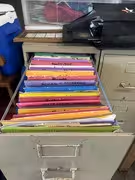
My mission: to purge two 4-drawer file cabinets and a dozen tubs and boxes in my garage. Lighten up and make space. 

The contents: 30+ years of teaching materials. 

Having been a teacher since the fall of 1991 (with the exception of one year between schools where I was moving, pregnant, and having my first child), I've accumulated and created a lot of materials over the years. The majority of my career has been in homeroom classrooms in about 6 different elementary schools. Ten of the last 11 years, the majority of these teacher materials have been living in my garage--untouched as I moved from teaching 3rd grade (or 2nd... or Kindergarten... or 5th grade) to teaching Technology. 

In this day and age, files are definitely more digital than anything, and it was time to "let go." No, not retiring yet, but my garage certainly was getting out of hand--just ask my husband! Plus I was settling on the answer of "no" to these questions: "Would I want to go back to a regular homeroom classroom? Would I ever use all of this again, even if I did?"

11 hours of purging about 33 years of materials gives you a lot of time to trip down memory lane. Upon pulling open the first file drawer, I had a pang. Did I really want to do this? I was thinking about the blood, sweat, toil, tears, and lamination/creation time I was about to get rid of. Yes, I'm doing this. It's time to reduce, reuse (via donation), and recycle!

7 garbage bags, 2 filled large yard lidded-recycle bins, at least a dozen bags and boxes of paper stacks of files to recycle, 20 or more dead binders that housed teaching units, and a half a dozen boxes of books to donate, I was in a lighter place. 

Yes--I got to see windows into each and every school I have taught. 

Yes--there's a lot of money that I have put into my teaching career. 
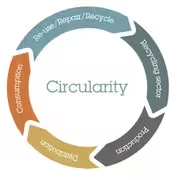
temp-Image40q-Il-QThe biggest yes--there's a lot of irony in recycling binders of environment and green school lesson plans a couple weeks before Earth Day. The "circularity" was striking, though maybe not picture perfect when describing the circular economy of true sustainability. But I did mentally hear the "Circle of Life" song from the Lion King going through my mind.

But, also yes--all of this served me at its time. It was there when I needed it. It all helped mold me into the teacher I am today. 

And yes--some of the items (ditto copied resources and even transparency overlays from my early days in mid-1990s teaching) should have already been long gone. Maybe, just maybe, I've been an organized hoarder--or at least compiler of teaching materials. I was "curating" long before Pinterest even thought of it. Mine was just the file cabinet version.
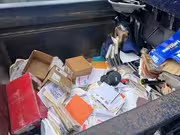
temp-Image-VYWIKdThe true moment of circularity for me came when my mission was completed and I realized there were far too many materials to put all out at the curb. Boxes of paper won't weather well when setting them out the night before an early trash/recycling pick up the next day. Given that, I loaded my dozen boxes into the back of the car and trekked to the local recycling center. Up and over the ledge into their bin all the boxes went.

A neat field trip we once took at the Maryland Green School I used to work at was to the local landfill and recycling center. I definitely flashed back as my files when floating in the bin. 

Yes, full circle. 

Graphic from https://www.pactcollective.org/pactresources/circularity, other images from my camera.

Saturday, November 9, 2024

"Are Bioplastics Really Better?" Quiz & America Recycles Day: November 15th

Time to test your knowledge friends? What do you know about bioplastics....and are they really better? Take the quiz from the Story of Stuff Project. Even if you are a tad test-averse, these 6 questions aren't too frightening...though you might be surprised by some of the answers. Once you get your results, you can watch a 2 minute video and learn even more about bioplastics: what they are and how they impact our world. Likewise, you can check your answers and learn from your mistakes.

All of this gears you up and gets you ready for America Recycles Day -- annually on November 15th. To learn more:


    Saturday, July 20, 2024

    Long Live Les Éco-Olympiades

    The 2024 Summer Olympics in Paris are a week away, beginning on July 26 and running until August 11th. Excitement is building across many sectors for this global, quadrennial event of celebrated humanity and athleticism.

    As with events like this, each successive one wants to be bigger and better in as many ways as possible. Paris' Olympics this year is no different:

    As mentioned in the video above, one of the ways Paris' Olympics plan to lead are through its green initiatives.  Interesting Engineering's Sujita Sinha's 7-15-2024 post and Forbes' Claire Poole's 7-19-2024 article detail some pretty cool eco-initiatives in place here for this summer's olympics:

    • When planning the events, emphasis was put on minimal new construction while also improving existing ones to house the events. Examples include adding a retractable roof to the Georges Vallerey pool and restoration of the Grand Palais.
    • When new buildings were built (such as the new aquatics center), sustainable elements were put into place including specialty roof design and solar energy farms. Likewise, seats constructed of recycled plastic were installed where needed. (11,000 to be exact!)  Additionally, these structures were purposely built for reuse.
    • The Olympic Village incorporated seashell pavements and air purifiers near the roads.Additionally, the Village is outfitted with furniture specifically created from reused or recycled materials such as badminton shuttlecock-created tables and bottle cap-created chairs, parachute fiber covered bean bags, and couches constructed from metal sidewalk barriers at their base.
    • After the games, furnishings in the Olympic Village are planned to reused, donated, or repurposed, giving thousands of items second life rather than have them be a part of the throw-away mentality.
    • Using famous landmarks such as the Eiffel Tower, the Seine River, and the Palace of Versailles as backdrop settings for a number of sporting events.
    • The opening ceremony will be help in the streets of Paris as well as on a Seine River in a flotilla-stryle boat parade. 
    • Food options for the athletes have emphasis on plant-based menu items as well as being locally sourced.
    • In an effort to protect seagrasses near Calanques National Park in Marseille where some of the sailing competitions are planned to occur, organizers are preparing to use drone-like buoys. In doing so, this is more protective to the carbon-soaking grasses because there will be less disruption to them due to not being dredged by anchors.

    To do a deep dive on the 2024 Paris Olympic's commitment to sustainability and see their nods to the 2015 Paris Agreement (with goal date of 2030),  check out their website and their multitude of reference points, remarks, and reports. Then also watch this video from Interesting Engineering to see how their plan for fewer building projects for these games is both a sustainable AND money-saving move.


    Videos from https://youtu.be/IMLMJVX4NsU?si=9Mxpz3x42iSjeMJJ and https://youtu.be/WBiPdEcyAlM?si=Voaq7QhXzKhys-Dk, Logo from https://www.latimes.com/sports/story/2019-10-24/paris-olympics-2024-logo and https://olympics.com/ioc/sustainability