Saturday, August 30, 2025
Rick Steves Classroom
Sunday, May 5, 2024
Happy Teacher Appreciation Week 2024
Video from https://youtu.be/vrU6YJle6Q4?si=sFFTa2Lxcw9ShpwG; Images from https://i.pinimg.com/originals/31/2a/b3/312ab319fce92b9f74531b5af6e38145.jpg and https://twitter.com/QuoteILoveU/status/880985804545372160/photo/1 and https://tsd401.org/we-appreciate-our-teachers/snip-of-happy-teacher-appreciation-week/
Wednesday, November 16, 2022
Reaching 8 Billion
Ever since yesterday when I heard the news of it being 8 Billion Day, I've periodically checked in on WorldOMeter's website. It shows the current population numbers in live time, with numbers changing by the second. It's amazing to see the incredible jump from this time today versus the same time yesterday!
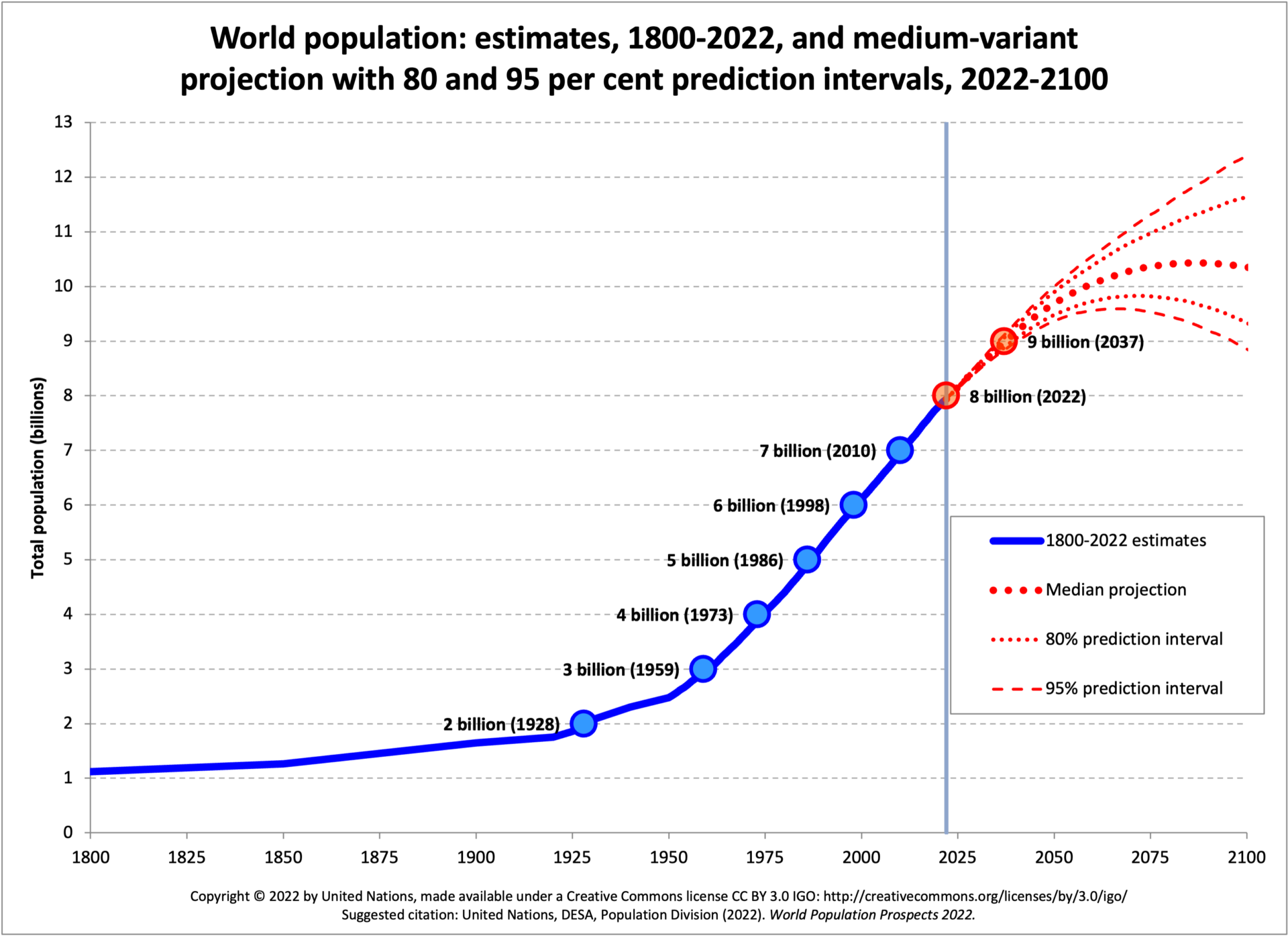
Watching the trajectory historically as we gain each additional billion is fascinating. The graph below--as well as the data in the chart I made--were from Population Education's website and their post by Marian Starkey [July 6, 2022] entitled "8 Billion and Growing: World Population Milestones Throughout History." Both data visualizations are eye-opening and jaw-dropping when you think of how that rate has increased over time. The startling point too is how flat the line on the graph was for population growth from year 0 to 1800 (which you can see on the graph shown here).
While it's looking like United Nation projections don't have us hitting 9 million until 2037 (15 years, a bit of a bigger jump than what we just saw between 7 and 8 billion), there clearly are ramifications across almost every field of study and interest. Of course, there are the environmental impacts of an ever-crowding planet. Technology and medicine have made it possible to have fuller, richer, healthier, and longer lives. Growing population means we need to have the resources available for us to live here on our planet as well as to provide us with food for all of these growing people.
To learn more about the Day of 8 Billion and how 8 billion people impact our planet, check out these sites:
- "How Big Is a Billion" benchmarks from Population Education so you can begin to wrap your head around just how big IS 8 billion??!
- Click this GTG archived link from back in February of 2015 (way back when there were only 7.3 billion people) to see Population Education's 7 minute map-animated video of population over time from 0 to current day and projected to 2050
- Also from February 2015 and my "Framing Education Around Population" post about Population Education, find the map of what countries would look like if their land mass matched their population.
- Population education's "Day of 8 Billion – 9 Interesting Population Questions and Answers"
- Pam Wasserman's August 2022 Population Education blog post entitled "8 Billion People on the Planet by November… and 13 Other Takeaways from the 2022 UN World Population Prospects"
- Population Education's "Teaching in a World of 8 Billion" for class simulations, lesson plans, and other resources.
- Population Riddles you can use in class with to get your students math minds bending around these really big numbers.
- Counting Populations: Millions & Billions, a population unit for K-5 students.
Intro image from https://thelatch.com.au/current-world-population/, Population graph from https://populationconnection.org/wp-content/uploads/2022/07/1800-2100.png; chart created from data on https://populationconnection.org/blog/world-population-milestones-throughout-history/, video from https://www.youtube.com/watch?v=6vL1_kCX6qg
Saturday, October 8, 2022
Humble Media Genius with Ruff Ruffman
Here's his short on Green Technology--click here to find 3 more Green Tech shorts:
Other topics in the Humble Media Genius suite include the following, with videos, games, information, and more:
They have also united with the Youth and Media team at Harvard's Berkman Klein Center to compile classroom curricular resources for teachers for grades 1-3.Ruff Ruffman has the right mix of humor, quirkiness, and information to engage kids and stress the importance of being safe, being respectful, being responsible, and making good decisions both online and off!
Video from https://youtu.be/l6zp8lI2KJE, image from https://pbskids.org/fetch/ruff/about.html
Saturday, October 1, 2022
Building Leaders Through Outdoor Education
I ran into this quote the other day and it really spoke to me.
Saturday, September 10, 2022
NatGeog Explorer Mindset Framework
I think I have NatGeo on the brain lately, because all roads keep pointing back to here. I recently shared some excellent learning resources from there (link) and a bit earlier in the summer I shared this infographic which highlights the Explorer Mindset.
What I should have realize was the graphic organizer was built from a pretty solid and empowering framework. I love that it "is a guide to developing the Explorer Mindset in the next generation of planetary stewards."
In this video from National Geographics' Explorer Mindset Framework page, marine ecologist/geospacial analyst Whitney Goodell discusses the importance of her work to our planet...which also details an explorer mindset in action.
The Explorer Mindset Framework is built from the Attitudes, Skills, and Knowledge [ = ASK] that is at the heart of an explorer. Here is slide 1 of their 8 slides details the qualities that make up the framework. You will want to download it all as it is an excellent resource!!
Additionally, be sure to check out this downloadable resrouce: The Explorers Mindset Toolkit. It is dated from last year's school year, however it is a valuable resource for elementary school teachers.
Here is a shorter video showing the Attitudes, Skills, and Knowledge in action:
As I watch these videos, and look at the framework, my wheels in my brain start to spin about ways to employ these skills in the classroom. We definitely want our students to be risk takers, full of curiosity, working together, being empowered, solving problems based on our observations.
These are all the skills that lead to innovation. As teachers, we have an enormous task to inspire our students to become lifelong learners. As I've said before, it is through all of these skills, attitudes, and knowledge that we will start to conquer some of the difficult problems we face in this world.
May we all be the next generation of planetary stewards!
Images from https://media.nationalgeographic.org/assets/file/Explorer_Mindset_Framework_June_2022.pdf?_gl=1*kalpt*_ga*NjA2MjYyMjEuMTY2MDkyNjIyMA..*_ga_JRRKGYJRKE*MTY2MDkyNjIyMC4xLjEuMTY2MDkyNzEzOS4wLjAuMA.. and https://blog.education.nationalgeographic.org/2021/09/21/dear-educators-no-one-explores-alone/
Videos from https://youtu.be/9BM11wtxtnk and https://youtu.be/9KPtcbXZtkQ and can also be found on https://www.nationalgeographic.org/education/about/explorer-mindset/
Wednesday, August 31, 2022
National Geography Education Resources
- Mapmaker Collection -- In their Mapmaker Collection Library, there are at least 40 lessons and activities using Mapmaker, their Geographic Informations Systems tool. Geared for grades 5-12, students can go in-depth and study a multitude of geography, anthropology, sociology, history subjects using this tool.
- Blackline Maps -- With the national boundaries changing, sometimes those maps in our archaic file cabinet swiftly become out of date. Who better to know maps than NatGeo? You can fine-tune it to get the map you want, with the layers you want, both with and without labeled nations.
- Resource Library -- Nearing 3000 different resources, there is definitely something here for everyone. Search by topic or check out the filters to find just about anything. Filtering by content type is one of my favorite ways to approach it. (I love a good infographic, and their's are spectacular!!)
- Online Courses for Educators -- If you are the kind of person who just can't get enough, checking out these free, self-paced online courses might be just what you are looking for. The range of topics varies, and each one details fully the time-table required to take these course. Some are on demand, while others are time-specific paced cohorts. The 90 minute self-paced "Applying Geographic Thinking Skills With Your Learners" class has an amazing infographic you can download about the different geographic perspectives that I love that is open until January 1, 2023.
- Explorer Classroom also has a wealth of past online events you can watch as well as interactives for your and your students.
- National Geographics Facebook Page -- If you like to curate your Facebook feed with inspirational resources, following this page is great. They often share many of their resources and you can learn new online curricular tools every day while scrolling through your FB feed. I love it!
Saturday, August 29, 2020
World's Largest Lesson: Global Goals For Sustainable Development
While researching the late Sir Ken Robinson, I ran across this video series about the World's Largest Lesson. Created a few years ago, this ties in the with United Nations Global Goals for Sustainable Development, with their target date of making "our planet fair, healthy, and sustainable by 2030." Both were written by Sir Ken Robinson. And... with the second one narrated by Emma Watson, and the first narrated by Malala Yousafzai, how can it be anything but amazing?!
On The World's Largest Lesson website, there are a wealth of free resources (including lesson plans) and ideas for taking action as students. 2030 is a mere ten years away.
With every year, it becomes more daunting, but we can certainly do the important work, if we put our minds to it! These videos certainly serve as inspiration!
The World's Largest Lesson pt 2 - with thanks to Sir Ken Robinson and Emma Watson from World's Largest Lesson on Vimeo.Videos from https://vimeo.com/worldslargestlesson/english-malala and Part 2: https://vimeo.com/178464378, Part 3: https://vimeo.com/266852848
Wednesday, August 26, 2020
Honoring Sir Ken Robinson

For a more decade, Sir Ken Robinson has been known as a rock star--at least with teachers and when it comes to his viral social media. His infamous 2006 TED talk "Do Schools Kill Creativity?" still is one of the most-viewed TED Talks of all times. For that reason combined with his push for innovation, imagination, & creativity in education, it is with great sadness too learn of his passing at the age of 70 last Friday (August 21st, 2020).
- His official website
- Sir Ken Robinson's YouTube Channel
- Sir Ken Robinson's Speaker page on TED.com where it features
- "Do Schools Kill Creativity" (June 2006)
- "Bring on the Learning Revolution (May 2010)
- "Changing Education Paradigms" (Dec. 2010)
- "How to Escape Education's Death Valley" (May 2013)
Saturday, August 1, 2020
Bandwidth
There's irony in the fact that "bandwidth" relates to both technology and mental capacity.... which means it is also ultimately tied to nature and the outdoors (for we all know that the latter is the cure for the former).
In this world that's already highly tech-i-fied, after a season of remote learning and multiple Zooms a day, computers make the world go 'round. Especially as coronavirus cases continue to rise in the United States. Social media, news, the TV, and more tell us that now as August arrives, we in the United States did a rather abysmal job of curtailing the Covid as our curve continues to crawl the wrong way.
From a teacher's perspective, summer is always my season to regroup, relax, and rejuvenate. It's that time we teachers soak up, tackling those home tasks we maybe haven't gotten to over the past several months. (Mine right now is overhauling the basement!) Likewise it's time to read books (for business and pleasure), search out new ideas, percolate over our classrooms and curriculum, and even have a few adventures so that we can be ready to dive into the fall school year.
School is not now, nor has it ever been, a 9 to 5 job.
Summer 2020 ... much like the rest of 2020 ... is an beast unto itself, and the normal "summer things" just aren't the same. For me, I've noticed a direct hit on my bandwidth. Literally (technologically by way of my wifi) and physically/mentally/emotionally/spiritually.
It's summer, and yet I've spent approximately 12-15 hours both this week and last doing school work. Teaching professional development (PD) classes, taking other PD classes, reading, researching, wrestling with wifi, orchestrating, and organizing some real needs for my school, my teachers, and myself. Will we be in school, out of school, or somewhere in between with a hybrid model--and will it be safe? I know teachers who love their jobs who have resigned rather than go back into a classroom they do not deem safe due to their local Covid numbers. Likewise, I know others that are making sure their affairs are in order by making sure their wills are written. Just in case.
As my zoom meetings have moved from spring teaching to summer learning, it all heightens awareness. Perhaps only if we can prepare for everything! Typically, summer is a time to relax the reliance on calendars... yet this year I am religiously keeping a calendar so I can make sure to show up at the proper Zoom times. My calendar is peppered with white sticky labels as events get rescheduled or canceled due to quarantine restrictions. I've got layers and layers of labels covering up canceled commitments.
My brain feels much like that layered calendar, trying to keep track of what is and is not happening. I can't shake the feeling that the ground beneath seems to be constantly shifting. We're trying to be flexible, but there is so much uncertainty in the unknown. It makes it difficult to plan. (Teachers are big planners by the way!) Case & point: we're working on the 4th iteration of move-in days for my daughter's college. The lacrosse tournament we went to (masked) last weekend for my son was on it's 2nd or 3rd calendar date, having shifted a month or two later month than originally intended. In our house, my family is putting forth dedicated effort to follow the restrictive orders of "safer at home;"yet, after months of this it leaves us wondering why we are trying so hard to stay healthy when it's clear that others are not. Meanwhile, numbers of Covid cases and deaths grow exponentially. (Yes, there is increased testing, but the positivity rate in some states is downright scary.)It all leaves a layer of frustration under the surface--much like my calendar sticky labels. It all piles on top, dismantling motivation along the way. Plus, social media and nightly news show us continued signs of racial injustice, peaceful protesting, reports of rioting, and stories of military-style secret police in major metropolitan areas. All the while, we carry our own concern for our own children, our own parents (some of whom we haven't seen in awhile due to all the regional restrictions), our own wallets and how the economy is affecting it....also on top of conundrums of "what's for dinner," "do we have clean laundry to wear," and a myriad of other mental calisthenics that keep us awake at night.
There's an overload in my brain.... all related to a lack of bandwidth!The oft-used quote "what doesn't kill you makes you stronger" comes to mind. But, the pile-on sometimes does more than just build character. The overload can weaken your immunity because there just are way too many things to think about. In the age of coronavirus, a weakened immune system is the last thing we need!
Now more than ever, as we enter August, teachers and students need to make sure to take the time to relax our brain. Parents and kids and the community as a whole does too. We need to schedule in more than zooms and work and planning. We need to take time breathe. To unwind. To unplug. To get outside. To get some sleep. To focus on healthy approaches like sleep and exercise. To slow down if have yet to do so. We need time to watch campy TV shows just to laugh! We need time in or near water to decompress and to soak up #bluemind to counter the non-stop, active, anxious, "red mind."
Without doing a combination of all of the above, we certainly aren't going to have the bandwidth as teachers (and parents) to make it through the upcoming school year. By all means, no matter whether we are remote, in class, or in the in-between, I sense that this will be the most memorable school year of our lives. It'll take grit and work to reconfigure the art of teaching school. Teachers are some of the hardest working people I know, and I have no doubt we will accomplish that goal. My hope is that it doesn't come at an incredible expense or loss--of our spirit, of our creativity, of our clarity, of our health, or even our lives. We love our students and give them our all... but we want everyone in our midst to be safe and stay healthy.
A wish I have for all of you!
Definition from dictionary.com; Images from https://www.lifewire.com/what-is-bandwidth-2625809, https://www.mentalfloss.com/article/570709/yes-you-have-too-many-tabs-open-your-computer-and-your-brain-probably-blame, and https://psmag.com/magazine/this-is-your-brain-on-poverty
Wednesday, July 8, 2020
MAEOE's Cavalcade of Collected Resources
An atlas of maps.A cache of jewels.
A quiver of arrows.
A blush of robins.
A charm of hummingbirds.
A wonder of stars.
A kaleidoscope of butterflies.
When it comes to a knowledge base, I like to think of it a a "cavalcade of collected resources." If you are looking for a wealth of nature-based info, Maryland Association of Environmental & Outdoor Education [MAEOE] is the place to go. Given their dedication to environmental education & green schools, it's no surprise!
This summer, they are creating weekly newsletters entitled: "Engaging With Nature: Weekly Ideas for Parents & Caregivers Newsletter." Here they have a collection of outdoor, nature-centric ideas to connect you with nature in a variety of no tech, low tech, and high tech activities, camps for kids, and adult inspiration. At this writing they have Summer Edition 1 (June 19) & Edition 2 (June 26).
In addition to their Resource Library, they have another page of a multitude of resources dedicated to providing parents & educators loads of links. Their Home-Based Environmental Education Resources (Teachers, Parents and Guardians) page has links to resources on all of these:
- 50th Anniversary of Earth Day resources
- Bay Backpack Resouces
- National Wildlife Federation Resources
- Project Learning Tree
- Green Center Partners
- Virtual Field Trips & Tours
- Spanish Reosurces
- Climate Education Tools
- Community Science Tools
- MAEOE Video lunches
- Professional Development & Webinars
- Activities
- Videos
- Wednesday Lunch and Shares--A google drive folder filled with all of their weekly lunch recorded events since April 1st
- April 1, 2020: Taking a Purposeful Pause
- April 8, 2020: Share ideas for connecting families with nature nearby or inside
- April 15, 2020: Climate Change and COVID-19
- April 22, 2020: Earth Day and Citizen Science
- April 29, 2020: Climate Education and Art Online
- May 6, 2020: Online Portals and Virtual Learning
- May 13, 2020: Engaging With Volunteers During COVID-19
- May 20, 2020: What's the Buzz: All About Native Bees
- May 27, 2020: Conservation and Agriculture
- June 3, 2020: Environmental Forums and Virtual Green Team Meetings
- June 10, 2020: Virtual Encounters with Live Animals
- June 17, 2020: Agricultural and Virtual Education Resources
- Environmental Educators Collaboration Meetings:
- March 30, 2020: Working Collaboratively Together
- April 14, 2020: Equity and Inclusion
- April 27, 2020: Place-Based Learning
- May 11, 2020: Aligning Virtual Resources to Standards
- May 26, 2020: Engaging in Nature this Summer & Communication Strategies
- June 8, 2020: Continuation of May 26, 2020 Meeting (Engaging in Nature this Summer & Communication Strategies)
Wednesday, June 24, 2020
Summertime & Remote Learning Reflections
It's officially summer, and boy oh boy does it feel good. For teachers, 'tis the season for decompression and reflection.
That all piggy backs on the reflection piece we were asked to write for our school's virtual time capsule. Our very own primary documents in a historic time period of unprecedented quarantine and remote learning. After rereading what I wrote, it really serves not only as my story, but a tribute to all of the hard-working teachers who had to turn on a dime from in-school teaching to remote learning. Some, over the course of a weekend! Although all our stories and situations and remote learning settings were different due to platforms, school wide device availability, community internet capability, synchronous versus asynchronous teaching, and more, teachers have shown such an ability to do what they can for the best of their students. That is what teachers do.There's the dichotomy of both the good and the bad to the coronavirus quarantine hitting right at the cusp of our Spring Break. Foreseeing the potential need to go into remote learning, a team of people on campus spent first 2 weeks in March furiously making a game plan. Being in Lower School Tech, I was pulled into all school planning meetings with IT, Division Heads, and the School Head, along with Lower School specific meetings as well. We scurried furiously to make a systemic plan using Seesaw as our main mode of student/parent communication since our younger students have far less learning management pieces in place than our Middle and Upper School students do. Luckily, we had all 8 grade levels PS-5th using Seesaw as a digital portfolio to share in-school student work with parents, with 100% family participation.) We managed to get some in-house Lower School training on both our plan and on Zoom right under the wire of Governor Hogan declaration to shut down school right before our Spring Break. That was certainly the "good" part--that and the fact that the sheltering in place would coincide with our Spring Break.
However, a 2 week Spring Break also gets zapped when you are still working out all of the details, especially if you are in Technology. My 2nd week was a very full and busy work week! [And yes, there's a lot of gratitude in being at a school that has the rare benefit of a 2 week spring break to begin with!!]
Before we knew it, we were "back to school" (yet of course, still at home) after break. Monday and Tuesday were days of giving and receiving last minute tech training. We were jumping in with both feet on Wednesday, April 1st. (The irony was quite apparent!)
Remote Learning settled into a daily version of the movie "Groundhog's Day." Lather, rinse, repeat. Zoom, tech help, repeat. I was so thankful that my own children were old enough to be on autopilot. It certainly made our houseful of 4 Zooming-homeworkers workable. My heart goes out to my colleagues who have "little littles." For our elementary students, we had homeroom teachers doing 2 zooms daily with their students, and then the students had 1-3 specials a day as well. Given the time on screens, we did not hold additional Technology classes--everything was Tech these days! But we did give weekly assignments--mostly short keyboarding assignments and maker activities using the design process. Most of those Specials asynchronous assignments shifted to optional over time due to Zoom fatigue being a real thing. Given all of that, my role shifted away from teaching students and was split between tech support and teaching teachers. Helping them with the Zoom tools and a variety of websites, restructuring our report cards to best accommodate this term, or creating online materials for our teachers--things that are certainly not central to our style of PS-5th grade classrooms. Remote Learning was a brand new animal in the elementary school setting--especially for our youngest Preschool and Prekindergarten students. As I wrap up this writing on our last official day of school for our students, it seems hard to believe this "new normal" is how we spent the last 2.5 months of this school year. I miss seeing my colleagues in the hall and chatting with them at lunch. Yes, we can get together by Zoom, but it is so not the same thing. Likewise, I am not accustomed to full days of sitting as my role as technology specialist typically has me "zooming" around school in a far different way: on my feet, not my computer camera! Most of all though, I miss my students. Having been more "tech help" than "tech teacher," I only get to occasionally pop in on classes to solve problems, rather than doing what I have been trained to do--teach children. I did not get the end of the year closure with students, nor did I get to see their smiling faces as they bound out the door to summer. I know they have grown so much over these last few months, especially with their tech savviness, but I miss that human connection.
As we enter into summer, we have no idea what the fall holds when it comes to school. Will it be full in session in the classrooms, back to learning and teaching remotely from home, or some hybrid combination? Time will tell. We all have resilience and will do the best with the situation, but it certainly makes you appreciate things in a new way. As teachers, we have grown in our flexibility, our creativity, and our ability to learn to teach in new ways. As a result, we are stronger and better off for it... but we are tired! Summer will feel so good in order to have time to step away, decompress, reflect, and then rebound.
Wednesday, May 27, 2020
Virtual Field Day
Typically around this time of year we always have Field Day at school. It's always a perennial favorite in elementary schools. It's a grand opportunity to take advantage of a beautiful day, leaving the books, paper & pencils indoors.This year, with most schools diving into some degree of remote learning, it's one of those annual traditions that just can't happen in the same way.
But, necessity is the mother of invention, and in the world where so much is going virtual, who is to say that Field Day can't either. I ran across this great resource that allows for you to have your very own Virtual Field Day! May it inspire you to get outside and move and groove!
Field Day logo from https://clipartlook.com/look/1787-field-day-clipart.html, Screenshot from https://docs.google.com/presentation/d/1b_5dunjX5JZvBvKCHUA3gM_UOtyxRxhdlA-v_-9ZqGI/mobilepresent?slide=id.g7181f696e8_0_0
Wednesday, May 13, 2020
Virtual Classrooms
Being a Bitmoji fan, I decided maybe it was time to check it out, and add some of this flavor to my Technology classes by creating a few of these interactive boards.
Despite the fact that there's no one "app for that," there is luckily a great Wakelet board for it, created by Lindsay Toub. I've seen her "Create A Virtual Classroom" Wakelet board referenced on several sites, so if she's not a viral internet sensation yet, she soon will be. The resources on her board walk you through every step of combining the Bitmoji app with Google Slides or PowerPoint to create your own. Add a lot of your own personal touches plus resources for the lesson or activity you want, and you can do a lot to create a fun clickable for your class.
Here are screenshots of two I created for upcoming lessons:


