Showing posts with label population. Show all posts

Saturday, January 20, 2024

Population Education's: A Quick Trip to 8 Billion


Population Education is an amazing website that brings together a lot of globally important factors: numbers, demographics, and human impact on each other, economics, and our planet. In the many. years of Maryland Association of Environmental and Outdoor Education conferences I've attended, I always try to catch any workshops presented by Population Education. They have a wealth of lesson plans and teaching resources, and they are top notch in anything they do.

One of my favorites is their World Population "Dot" video, which I first wrote about in 2015 and I watch at least once a year with students. Another version of it is their World Population History data visualization accompanying website.

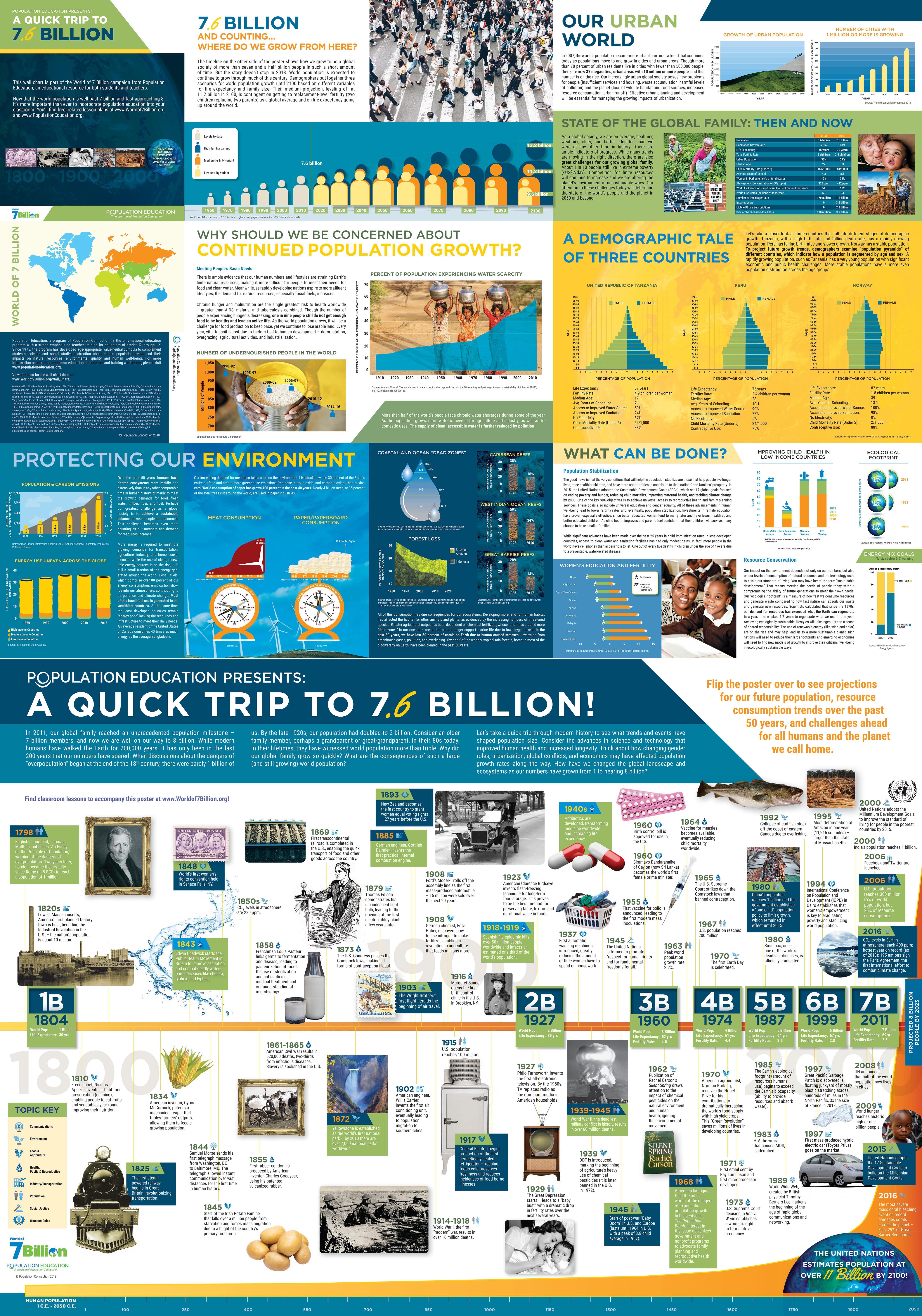
Now, as our numbers keep growing, they have a new poster out: "A Quick Trip to 8 Billion." This two-sided wall chart gives a timeline of historical events and inventions over the past 200 years to show how the population has impacted all of this. The flip side shows a multitude of infographics detailing the challenges that come from increased population growth. Along with the poster, 3 lesson plans are included: 1). a guided exploration of the timeline; 2). a scavenger hunt to see how numbers and resources have changed over time; 3). an activity where students create a planetary report card to measure the human and environmental health of the planet over the past 200 years.


I'm looking forward to ordering a couple for my school. (Posters are $5, but $4 if you buy in larger quantities. Click here for details.) Additionally, you can also get a high resolution version of the e-poster.

Other Resources on their site include:

Population Education is tied to the following education websites to check out for even more resources:

Images from https://www.worldof8billion.org/wp-content/uploads/2022/11/wall-chart-high-resolution.jpg and logo from https://populationconnection.org/population-education/k-12-students/

Disclosure: I am not profiting at all if you purchase anything from their store--I just love their resources!

Wednesday, November 16, 2022

Reaching 8 Billion

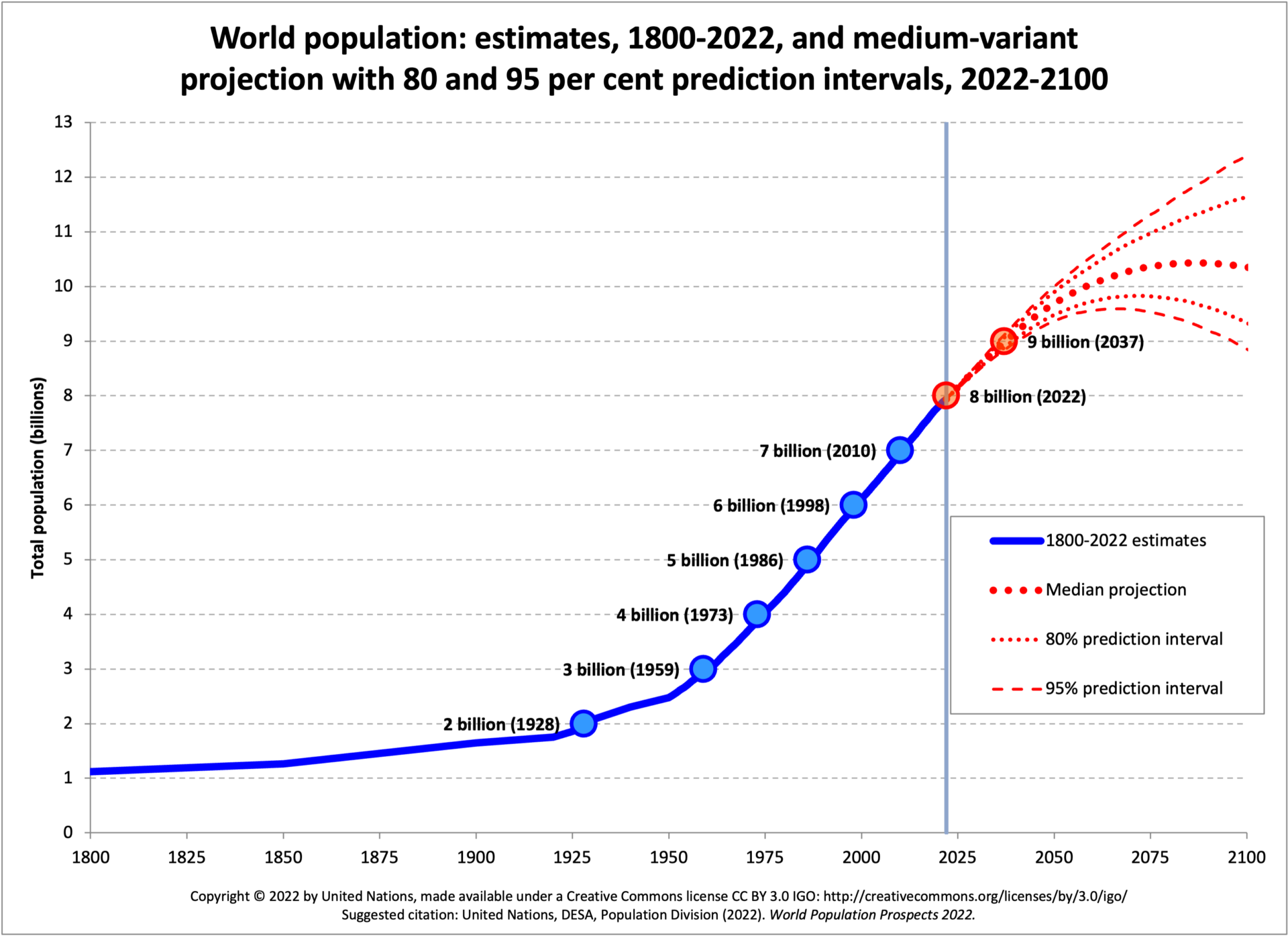
Yesterday (Tuesday, November 15th, 2022) was the Day of 8 Billion. It was the day we, as a planet, reached the global milestone of 8 billion (with a "B") people. This feat took only 12 years to go from 7 billion (in 2010) to 8 billion.

Ever since yesterday when I heard the news of it being 8 Billion Day, I've periodically checked in on WorldOMeter's website. It shows the current population numbers in live time, with numbers changing by the second. It's amazing to see the incredible jump from this time today versus the same time yesterday!

Watching the trajectory historically as we gain each additional billion is fascinating. The graph below--as well as the data in the chart I made--were from Population Education's website and their post by Marian Starkey [July 6, 2022] entitled "8 Billion and Growing: World Population Milestones Throughout History." Both data visualizations are eye-opening and jaw-dropping when you think of how that rate has increased over time. The startling point too is how flat the line on the graph was for population growth from year 0 to 1800 (which you can see on the graph shown here).


While it's looking like United Nation projections don't have us hitting 9 million until 2037 (15 years, a bit of a bigger jump than what we just saw between 7 and 8 billion), there clearly are ramifications across almost every field of study and interest. Of course, there are the environmental impacts of an ever-crowding planet. Technology and medicine have made it possible to have fuller, richer, healthier, and longer lives. Growing population means we need to have the resources available for us to live here on our planet as well as to provide us with food for all of these growing people. 

To learn more about the Day of 8 Billion and how 8 billion people impact our planet, check out these sites:

  • "How Big Is a Billion" benchmarks from Population Education so you can begin to wrap your head around just how big IS 8 billion??!
  • Click this GTG archived link from back in February of 2015 (way back when there were only 7.3 billion people) to see Population Education's 7 minute map-animated video of population over time from 0 to current day and projected to 2050
  • Also from February 2015 and my "Framing Education Around Population" post about Population Education, find the map of what countries would look like if their land mass matched their population.
  • Population Riddles you can use in class with to get your students math minds bending around these really big numbers.

Intro image from https://thelatch.com.au/current-world-population/Population graph from https://populationconnection.org/wp-content/uploads/2022/07/1800-2100.png; chart created from data on https://populationconnection.org/blog/world-population-milestones-throughout-history/, video from https://www.youtube.com/watch?v=6vL1_kCX6qg


Wednesday, June 16, 2021

Mount Recyclemore At G-7


20,000 pieces of electronic waste all in one place is sizable to begin with. 

Put those pieces together in an artistic installation--it causes people to take notice. 

Put them into the faces of 7 world leaders AND put them on the beach across the Carbis Bay Hotel in St. Ives, Cornwall, United Kingdom where the G7 Summit is taking place--it makes national news.

Welcome to Mount Recyclemore!

Reminds me a bit about Mount Trashmore!

Mount Recyclemore was created by artist Joe Rush & musicMagpie (a second hand electronics store) with the help of 15 artists over the course of 6 weeks. It was first created in Rush's south London studio scrapyard then shipped to Cornwall to be erected in time for last week's G7 Summit. The G7 is the "Group of Seven" organization of leaders from Canada, France, Germany, Italy, Japan, the United Kingdom, and the United States, and the Summit was held during the 3 days of June 11-13, 2021. 

The reason behind this creation: to spotlight electronic waste, its harm to the environment, and the need for it to be more easily recyclable and reusable. It is especially true given that some of the worst e-waste heavy hitters being developed nations. E-waste leaches chemicals into the soil or water if sent to landfills, or becomes hazardous air pollution if burned. Both of these are major contributors to environmental destruction and climate change. Additionally, materials in phones, laptops, monitors, and other tech waste include precious materials from limited resources where the extraction process adds major impact to our planet. Especially when e-waste is the fastest growing waste stream right now.

Taking the lead from South Dakota's Mount Rushmore's 4 presidential faces, this structure highlights the following seven leader's faces (in order from left to right):
  • British Prime Minister Boris Johnson
  • Japanese Prime Minister Yoshihide Suga
  • French President Emmanuel Macron
  • Italian Prime Minister Mario Draghi
  • Canadian Prime Minister Justin Trudeau
  • German Chancellor Angela Merkel
  • U.S. President Joe Biden
With climate change and Covid-19 being two of the top issues of the Summit, Mount Trashmore as a creation of discarded tech becomes an important symbol for the environment. 

After the Summit's end on Sunday, June 13th, the plan is to move Mount Recyclemore to musicMagpie’s headquarters in Stockport, Greater Manchester.


Wednesday, September 16, 2020

Wildfires & Hurricanes: Two Devastating Side Effects of A Warming Planet

Wildfires are burning everywhere it seems right now--especially everywhere west of the Rockies. At least that's how it feels when you go to the U.S. Wildfire Map or the Global Forest Watch Map. Glowing orange skies in California and reports for friends in Colorado and Oregon are not comforting. I'd imagine their air quality isn't comforting to them either! As if we don't have enough reasons to wear masks with Covid 19!

The wildfires in the West Coast with overly-dry land is about as comforting as hitting the peak of hurricane season on September 10th when there were there were 7 active systems in the Atlantic Ocean. Only 2 were named at the time, though the other 5 had potential of moving beyond "tropical disturbances." Thus far for the 2020 Hurricane system, at this writing we had hit 17 named storms. Annual average is 11-12 storms. There's even a potential (if we keep going this year) of hitting Hurricane or Tropical Storm Vicky (yours truly, though spelled differently). Of course, if we judge 2020 by memes, we're of course destined to get lucky and land there! There's some other speculation that we will use up the 21 storm-slated names, causing us to have to use the Greek alphabet. The only other time we had to do that was in 2005.

Hurricanes & wildfires are two of the major effects of climate change and warming global temperatures. 

For fires, the problem is visible in this visual (from the Union of Concerned Scientist "Infographic: Wilfires & Climate Change: Visualizing the Connection in 5 Sets of Photos & Charts"):

The Union of Concerned Scientists also have some thoughts on hurricanes in their "Hurricanes & Climate Change" report published July 16, 2008 and updated June 25, 2019. Factors that have intensified hurricanes with time include:
  • rising ocean temperatures
  • rising sea levels
  • increased melting of ice-coverage over land
All of which create greater coastal storm surges, causing water to go further inland. Greater population density over time in coastal areas doesn't help.... especially with approx. 40% of the U.S. population living in these coastal areas. 

When you look at the United States map under the layer of impact of both wildfires and hurricanes, we're at a great environmental impact. With our bandwidth not only stretched but maxed right now in 2020 with the pandemic, environmental issues seem to slip to the bottom of the list. One could argue that is really doing us a large disservice--especially as Covid 19, wildfires, and hurricanes may potentially all be vying for FEMA money (Federal Emergency Management Agency) down the line.

If 2020 has shown us anything, it's that you never know what lies ahead. Here's hoping that we have already seen the worst!

Saturday, August 29, 2020

World's Largest Lesson: Global Goals For Sustainable Development

While researching the late Sir Ken Robinson, I ran across this video series about the World's Largest Lesson. Created a few years ago, this ties in the with United Nations Global Goals for Sustainable Development, with their target date of making "our planet fair, healthy, and sustainable by 2030." Both were written by Sir Ken Robinson. And... with the second one narrated by Emma Watson, and the first narrated by Malala Yousafzai, how can it be anything but amazing?!

On The World's Largest Lesson website, there are a wealth of free resources (including lesson plans) and ideas for taking action as students. 2030 is a mere ten years away. 

With every year, it becomes more daunting, but we can certainly do the important work, if we put our minds to it! These videos certainly serve as inspiration!

The World's Largest Lesson pt 2 - with thanks to Sir Ken Robinson and Emma Watson from World's Largest Lesson on Vimeo.Videos from https://vimeo.com/worldslargestlesson/english-malala and Part 2:  https://vimeo.com/178464378, Part 3: https://vimeo.com/266852848

Tuesday, November 5, 2019

Wednesday, January 23, 2019

Recycling Conundrums: The Dark Part

Over Christmas when I was home (as in, "my childhood home") visiting my family, we got into a quandary conversation about "where does 'this' go?" The 'this' in question was one of many things--a bottle, the pizza box, foil...you name it. The "where" in question was either "trash" or "recycling." We've all been recycling for years, but it seems as if the rules are always fluid, always shifting as to what "can" and "cannot" be recycled.

Is it a municipality thing?
Is it a real thing?
Is it a "we feel vindicated because we're recycling" thing, but really a "we're being snowed" thing?
Are we making our recycling unrecyclable because we're not putting enough effort into the act (and perhaps "art") of recycling?

At one point years ago, our local recycling was pitching the motto: "when in doubt, recycle it out." (Well, give or take--I added the rhyme.) They wanted to encourage over-recycling, saying they'd sort it out. Having just gone online and checked out their website, they've since come to change their view.

Recycling just doesn't seem easy nor intuitive anymore!

As part of my quest to re-figure out this recycling thing, I checked out a few articles.

538.com's 1/10/2019 article "The Era Of Easy Recycling May Be Coming To An End" reiterated the point that recycling has changed. Single-stream recycling (where we put them all into one bin and let the recycling center sift & sort it out) has made recycling efforts grow from 29% to 80% in the 9 years between 2005 and 2014. However, single-stream is not as cost-effective as it once was. Add in the fact that the mixed mess we are throwing out in that recycling bin can cross contaminate other recyclables, making our recycled items UNrecyclable! We're essentially shooting ourselves in the foot (about 25% of the time), BUT feeling good while we do it, because we wrongly think we are doing something for our planet!

Put plainer: we ultimately have higher rates of recycling happening when it's single-stream, but higher contamination rates too. Which means higher rates of recycling landing in the landfill.

This line struck me;
"There are also electronics and batteries, plastic grocery bags and Christmas lights — all of which can be recycled, but only through specialty drop-off programs, not the curbside bin. There are perfectly recyclable cans and paper coated in food, grease or cleaning fluids that render them unrecyclable. There are plastic bottles full of glass syringe needles that break open at the sorting facilities like a piñata from hell."
Additionally, glass bottles break, water bottles flatten, tin cans get smushed and misread by the machines. Shards of glass wind up enmeshed in cardboard boxes. Even some of the glues, inks and or packing tape wind up fouling up the machines. All of these cause problems, making single-stream more expensive and lowering recycling rates. It's not surprise that communities are starting to move away from one-stop-shopping recycling.
"Even the seven most common types of plastic used in consumer manufacturing–stamped on the bottom with a number inside a triangle–are replete with inconsistent resin composition, color, transparency, weight, shape, and size that complicate and often rule out recycling. For example, a #1 soda bottle has different melt properties than a #1 lettuce container, making the lettuce container a contaminant for the soda bottle. Colored soda bottles cannot mix with clear soda bottles. Yogurt containers cannot mix with milk jugs, even though both are white. Filmy cling wrap can be recycled in theory, but is too often contaminated by food. The limitations are too many to count."
If that didn't make your heads spin right there... just wait. There's more. National Geographic's article China's Ban on Trash Imports Shifts Waste Crisis to Southeast Asia details how China's trash import ban has been a game changer for all of us. For a year now, China (previously the largest importer of plastic waste) stopped buying the majority of what's out there. Their pursuit was for the 99.5% pure plastic trash. That upset a $200 Billion plastic scrap/plastic crap global industry... uprooting a 25 year roll!

But the trash has to go somewhere--and most Americans buy into the "NIMBY" philosophy--"Not In My Backyard! So where has all this recyclable waste gone? Indonesia, Thailand, Vietnam,, & Malaysia. And, being "newbies" versus 25 year veterans, the learning curve led straight to overwhelm due to quantity alone!

From the article:
“I hate seeing my country as the dumpsite for the developed world,” said Yeo Bee Yin, whose full title is Minister for Energy, Technology, Science, Climate Change, and Environment. She declared that 'no developing nation should be the dumping site for the developed world.' "
Malaysia may now be considered the world's largest importer of plastic trash--and potentially the largest trash heap. Who wants that for their country?! But, perhaps it's the wake up call we all need in terms of thinking about our use of resources in order to help minimize the idea, especially with a potential of 10 billion people on our planet by 2050. The rate of waste is only growing. More people could get us to an increase of 70% over the next 30 years, meaning the garbage problem is only going to get worse!

Economy always rules the game. Especially when it is often exponentially cheaper to ship from the American West Coast to China by boat versus land-transport across our own country. The uncertainty in the recycling markets doesn't help. Additionally, there's now become a market for illegal importation of plastic trash. If there's a potential economy for anything, I suppose there's the potential for an illegal market of "that thing" as well. Sad but true.

So what ARE you supposed to do? Curl up in the fetal position? Bury your head in the sand? Drink ourselves silly? Those strategies, while temporarily comforting, aren't going to help.

Given this feels like the doom & gloom, mind-numbing portion of the program, I hate to stop here. But as you can tell, there IS a lot here. Given that, I'm going to share the silver linings in a secondary post. The good news is there ARE still ways we can take action and rein in the recycling.

For other eye opening articles for your own deeper dive, be sure to check out: 

Wednesday, September 12, 2018

Hometown Hot, Over The Years

It's no surprise to anyone that great content comes from the New York Times. This September, they created an interesting interactive entitled "How Much Hotter Is Your Hometown Than When You Were Born?" It's premise: to showcase how "human-induced climate change" (their words!) has caused a rise over time in the number of above-90°F days.

It's amazing how much factual data and science can tell you.

I did it for my hometown of Decatur, Illinois (along with a half dozen other cities including where I now live in Maryland) and found it somewhat shocking to see the data and trends. (It was especially noticeable here on a 90°F day as I sit and type this in the shade of my patio umbrella.) More information and projection is revealed as you continue to scroll down. Every city I did showed the same basic upwards trend, though the numbers differed significantly the closer to the equator the city fell.

This interactive would also be an excellent teaching tool for students, giving them a variety of cities to investigate.

You need to go to the New York Times interactive (click here) and plug in some of your favorite cities, hometown and otherwise. To see the data is remarkable. To see the projected numbers for when you are 80 years old might startle you. No matter what, it will cause you to take pause.

Images are screenshots from my data placed within this interactive: https://www.nytimes.com/interactive/2018/08/30/climate/how-much-hotter-is-your-hometown.html

Wednesday, August 8, 2018

Meatless Mondays, Part Deux

Continuing our conversation....

Whether you call it Meatless Mondays, Weekday Vegetarianism, or Flexitarianism, switching up how you eat in order to try to reduce your meat intake is a trend these days. In some circles, it's seen a trend among millennial for 2018--especially when it comes to "plant-based meat alternatives."

It's not a new concept, and in fact, there are resources galore on the subject on the web.  Some fingers (like Peggy Neu, in the TEDxManhattan video below) point back to the rationing Americans (and Europeans) did during World War II. Items like meat, cheese, butter, cooking oil, processed food, and more were rationed, making it necessary to get a little more creative in the kitchen.


Here's a multitude of resources to "make Monday the day all health breaks loose:"

  • Meatless Mondays, from the non-profit Monday Campaigns and the Center for a Livable Future (CLF) at the Johns Hopkins Bloomberg School of Public Health. Here you will find resources for a variety of perspectives: restaurants, K-12 schools, hospitals, food service, campus, community, and corporate dining. Included here are implementation guides, free resources, and recipes.
  • The Greenpeace Less Is More Movement. FoodTank details the specifics of Greenpeace's report here, including a recommendation for a 50% reduction in meat dairy by 2050. The Less Is More website does a nice job of detailing the planetary effects of eating less meat to climate change, forests, water, health, animal welfare, and fair food... as well as ways to take action.
  • The Humane Society has toolkits for K-12 schools, parents, universities/colleges, and hospitals on ways to implement meatless game plans into each of these locations. (This is also where the "What Is Meatless Monday" video came from that I posted in "Flexitarians, Unite.")
  • Earth Day Network made Meatless Mondays one of their 2018 "Taking Action" points for Earth Day 2018. There, you can get some key points as well as a pledge to help you deepen your commitment.

For anyone looking to lighten your meat intake, here's a list of places to find all sorts of recipes:

At the very least, it gets us in the mode of thinking about eating a little lighter, in healthy ways, in ways that help our our planet.

Images from https://www.geneseo.edu/cas/meatless-mondays, http://www.familycounselling.com/wanting-eat-healthier-try-meatless-mondays; Video from https://www.youtube.com/watch?v=XPkV1bDZDl4

Wednesday, July 25, 2018

Bounty of Food Related Books

This summer I've been eating up books. Of course, not literally, but one of the best parts of summer
time for teachers.

When I was writing about Food Tank, I happened on their wealth of resources, including reading lists. If you are looking for a little literal "food for thought," here's a bounty of food related books: 100+ books from these 6 lists alone. Click the + hot spot icon to go to the webpages.


After looking at all of these lists, I think these are the ones that are initially "whetting my appetite," making me eager "take a bite out of" them!
Additionally, I'm going to check out the monthly podcast "Real Food Reads" hosted by Anna Lappé as a virtual book club, discussing many of the books listed in the links above!

We already knew it, but clearly there's too many books, too little time!


Interactive infographic created at canva.com and https://www.thinglink.com/scene/1072538160245768194
Book list links if the graphic doesn't work:
https://foodtank.com/news/2017/05/food-tank-summer-reading-list-2017/
https://foodtank.com/news/2017/08/fall-reading-list/
http://realfoodmedia.org/programs/real-food-reads/
https://foodtank.com/news/2017/12/childrens-books-growing-minds/
https://foodtank.com/news/2018/01/food-tank-2018-winter-reading-list/
https://foodtank.com/news/2018/04/2018-food-tank-spring-reading-list/

Saturday, July 14, 2018

Food Think With Food Tank

As a teacher, life is pretty hectic 3/4 of the year. But summer rolls around and opens up time a little bit, which also means it opens up life to a little more down time, thought time, and relaxation time.

For years now, summer is also my time to focus a little more on my health, my food intake, my level of exercise and movement, my time outdoors, and my brain space. I read more books, listen to a few more podcasts, lose a few pounds, up the steps on my pedometer, and have more time to do all those things I never had a chance to get to during the school year.

Recently I was listening to the Chalene Show Podcast (her June 4th episode with my favorite Shawn Stevenson from the Model Health Show, which focused on "6 Morning Habtis for Weight Loss"). Chalene Johnson was talking about her dad feeling under the weather and headed to the doctor. She summed it up to an insulin crash where he had a very carb-heavy traditional breakfast of cereal, toast, orange juice (after the last thing he ate the nnight before was ice cream). She was convinced it was low blood sugar due to his food--his doctor didn't even ask about his nutritional intake. She was discussing how food is medicine, and unfortunately many in our doctors in our culture don't even look at this important element.

Insert Food Tank here. This is a good portal (both online and on Facebook) where food-related health topics are addressed. It's especially important as we look at the statistics of diabetes, heart disease, obesity and more that are on the rise and causing major risks to people. From their Facebook page:
"Food Tank is a non-profit organization focused on building a global community for safe, healthy, nourished eaters. We spotlight environmentally, socially, and economically sustainable ways of alleviating hunger, obesity, and poverty and create networks of people, organizations, and content to push for food system change." 
Danielle Nierenberg, co-founder of Food Tank in 2013 and current president of Food Tank, is impassioned about fixing our broken food system, feeding the hungry, and helping our environment... especially since we are all eaters. Here is her TEDx Talk from March 2015.


On Food Tank's website, you can find news on the following topics, each with articles pertaining to the health and food issues. It's a vast learning library and way to start thinking like food activists, advocates, and innovators
Video from https://youtu.be/zqSrobaD5sA; All images from Food Tank's Facebook page: https://www.facebook.com/TheFoodTank/

Wednesday, May 23, 2018

Nat Geo's Planet Or Plastic Campaign

Just last week, National Geographics launched their latest magazine and newest multi-year campaign with a striking cover. Planet or Plastic?

When you put it that way, clearly we have to choose.
Which I think is their point! And, if we must choose, my hope would be for the former versus the
latter.

When roughly 9 million TONS of plastic end up in the ocean annually that's significant. Don't forget, plastics, especially single use plastics, are pretty light in weight!

Just like their paper version of the magazine, their online portal is ripe with information... including a pledge you can take to cut down on your plastic consumption and usage!

Articles:
  • Plastics Explained, From A-Z by Elizabeth Atalay, Laura Parker, & Heidi Schulz
    • This has a lot of important environmental vocabulary, and lots of resources available through clickable links or embedded videos.


Interactives:

Their videos:
  • Plastics 101
  • A Brief History of How Plastic Has Changed Our World
  • How to Cleanse Your Beauty Regime of Microplastic
  • Students' Ice Pops Bring Plastic Pollution to (Unappetizing) Life
  • Manta Ray Swims in Trash
All images from National Geographics Planet or Plastic https://www.nationalgeographic.com/environment/planetorplastic/?beta=true

Wednesday, April 18, 2018

Drawdown's Top 10 To Drop Down Greenhouse Gases

I've recently been reading the book "Drawdown: The Most Comprehensive Plan Ever Proposed to Reverse Global Warming," edited by Paul Hawken. The book details Project Drawdown and it's ambitious plan to bring together 200+ scientists and researchers around the globe to analyze and rank 100 solutions to reverse the effects of climate change and global warming. Additionally, with the efforts to do this by 2050. In the book they detail what each option would look like by ranking based on the number of gigatons reduces of carbon dioxide, the economic net cost, and the economic net savings.

The term "drawdown" (as stated in the book & their website) "is that point in time at which greenhouse gases peak and begin to decline on a year-to-year basis"(page x in the Forward). They have broken their solutions into the following categories: Energy, Food, Women and Girls, Buildings & Cities, Land Use, Transport, and Materials... and they also share 20 "Coming Attractions" of innovative ideas on the horizon that have environmental potential.

The top 10 alone are fascinating, and speak once again to the fact that innovation is the key to solving our environmental issues:
  1. Refrigeration Management (HFC's & previous ozone depleters)
  2. Wind Turbines (Onshore)
  3. Reduced Food Waste
  4. Plant Rich Diet
  5. Tropical Forest Restoration & Recovery
  6. Educating Girls
  7. Family Planning
  8. Solar Farms
  9. Silvopasture (cattle in treed, not cleared, pastures)
  10. Rooftop Solar
Here's a video of Paul Hawken discussing Project Drawdown with Bill Maher. (It is Bill Maher, so this is mostly PG-13, except for about 6:30 and 7:50 in. Therefore, the information here is more for the adults in the room.)


To learn more about Project Drawdown, check out their website, especially their Frequently Asked Questions page. Also online (or in the book), you can see the entire listing by rank.


Video from https://www.youtube.com/watch?v=k1wXHx2DsSU; book cover from https://www.amazon.com/Drawdown-Comprehensive-Proposed-Reverse-Warming/dp/0143130447/ref=sr_1_1?ie=UTF8&qid=1521212923&sr=8-1&keywords=drawdown; graph from Drawdown's Facebook page: https://www.amazon.com/Drawdown-Comprehensive-Proposed-Reverse-Warming/dp/0143130447/ref=sr_1_1?ie=UTF8&qid=1521212923&sr=8-1&keywords=drawdown

Saturday, March 3, 2018

Following Up On "Day Zero"

Water, water, water makes the world go round.

My life is sponsored by water these days, between reading Jeff Goodell's "The Water Will Come" and previous writing about Charity:Water and the water situation in Cape Town, South Africa.

Since my original post, luckily, "Day Zero" (aka: the day the water shuts off in Cape Town) has shifted a few months. Instead of the originally-projected date of May 11th, 2018, it has now shifted forward to September 7th, 2018. This shift is based on the area's local conservation efforts, which of course is certainly a positive thing. In some aspects, a 4-month shift is phenomenal. Take having babies, for instance. That 4 extra months would be significant. While still positive, in a global timeline scheme, 4 months is still saddening. We're talking about fresh water here, so we essentially are talking about life. But at least it is shifting the right direction!

To see a live-time website of the water levels for CapeTownians, check this out. Sadly, you can watch daily as the numbers diminish.

As an extra eye-full, this 4 minute video is striking.  Derek Van Dam, CNN Meteorologist, and his wife (and infant) do a 24 hour water simulation, attempting to use the required amount of Cape Town Water to see where they get. Having once lived in Cape Town, this challenge is personal to Derek Van Dam and his wife.  Could you do it? For me, I found it to be an eye-opener. This Green Team Girl questions her family o'4 and the ability to pull it off to this degree!!

It certainly made me reconsider little things like tooth-brushing and bath-taking!


As you watch Derek and his wife in action on this challenge, I challenge you.  What can you do to live more sustainably? If Cape Town is enduring this now, it's only a matter of time before more communities will be enduring it as well. Climate change is not debatable. Science is science. Drought conditions will lead to more water availability issues. What are you going to do to help... before it's a matter of being too late in your area?


Images from: https://www.youtube.com/watch?v=NbQ4GxUAivk and https://www.news24.com/SouthAfrica/News/new-day-zero-date-announced-as-cape-town-fights-back-20180130Facebook post and video from https://www.facebook.com/derekvandamfanpage/posts/10155038160906249

Wednesday, February 28, 2018

Jeff Goodell's "The Water Will Come"

Back in January I mentioned that I got a trio of eco-reads for Christmas.

I saved Jeff Goodell's "The Water Will Come: Rising Seas, Sinking Cities, and the Remaking of the Civilized World." I think I saved it for last because the title is a tad daunting, and too close to Christmas didn't quite feel right for what I knew would be a hard-hitting book.

I read the bulk of it over a three-day period. every chance I got.

On the cover, Elizabeth Kolbert, author of The Sixth Extinction and Pulitzer Prize winner, is quoted as saying "Deeply persuasive and deeply unsettling." Yes, both sentiments are true.

Goodell is an excellent documentarian, a riveting storyteller, and writer with a no-nonsense approach and the facts to back it. I wouldn't say it's a feel-good tale, but I would say it was an excellent read. A necessary read. A mandatory read for all. I know some climate deniers, and I still can't seem to wrap my head around that. He quoted one of my favorite Neil deGrasse Tyson quotes: "The good thing about science is that it's true whether or not you believe in it."

It's coming folks.

I marked up many-a-passage while reading the book, and it does indeed haunt me. Especially in the wake of the current political climate and administration of the United States, the disappearance of climate science on the governmental websites, and the apparent allergy many politicians have with the words (and science of) "Climate Change."  Goodell addresses this, as the book is quite current--having been published in November 2017.


His topics are many: walled cities (by seawalls), raising cities, floating cities, canaled-cities like Venice, climate refugees, Arctic ice melting, Climate Apartheid (the separation between the wealthy and the poor), temperatures rising alongside with oceans, greater susceptibility to hurricanes and wildfires, leaving for higher and/or safer ground, pollution issues from rising water and sewage situations, the climate leading to security risks, Northern geoengineering, and more.

One of my biggest takeaways is that it's not a matter of "if" climate change is to happen (along with those rising seas)... but more a matter of when and how quickly.

My other big takeaway is that Miami, with it's proximity to the coast and reliance on pricy real estate, may very well be screwed in the next 50-100 years. And Miami is not alone in this.

There are a lot of parallels here with the details Goodell brings up with the ability of many to not access clean water (and some of the water issues I've written about recently). One of my former colleagues (from my teaching days at my uber-green environmental school) said that she thought Water was one of the two main issues we shall face as a global society over the next few decades. (She felt Artificial Intelligence would be the other.)

I will admit: I found myself writing "yikes!" in the margins more than a few times!!

Again, I say it again. Innovation is the answer to our environmental problems. We just might want to start getting a move on it to be able to manage this water crisis in a timely manner.

Add this to your "What to Read Next" list. We all need to be educated. This would be a good book for everyone--especially our public officials!

Book cover from https://www.amazon.com/Water-Will-Come-Remaking-Civilized/dp/031626024X/ref=asap_bc?ie=UTF8, "Book Snap" photos of my notes in Goodell's book, pages 52 and 170.

Wednesday, January 10, 2018

A Trio of Eco Reads for the New Year


My environmental library is pretty sizable for your "Average Joe." I think it's an occupational hazard for being an environmental educator for 7 years, and an eco-blogger for 9 years!

This Christmas my library has grown by 3 more books.  At this point, I've only read one and am currently mesmerized by another, but they all have been on the top of my bed stand stack.

In case you are looking for some eco-reads, here's my trio, and I'd say a great place to start!

Unstoppable: Harnessing Science to Change the World by Bill Nye (2015, 2016)

Bill Nye for the win, as per always. Fact-finding (and sharing) scientist, myth-buster, and engineer with a tinkering, designing, and curious mind, he lays out several issues and the creative innovation that it's going to take visionaries AND the citizen activism that it will take all of us to make small changes at home and big changes with our voting power. A voice of the ages indeed. I love the empowering aspect of his writing, taking us out of the fear factor and resignation that the climate conversation can sometimes bring.

Peter Kalmus is a climate scientist and a dad living in suburbia. This book is a bit about him slicing his own personal carbon footprint, living a simpler life and achieving greater happiness along the way. He and his family of 4 live on 1/10 the fossil fuels of the average American--giving inspiration to us all that it is indeed possible to live with and on less. Some of his approaches are definitely outside the box! Kalmus outwardly mentions his approach in combining science, spirituality, and taking action. Again, more optimism versus "doom and gloom," and a message that will get many thinking!
The Water Will Come: Rising Seas, Sinking Cities, & the Remaking of the Civilized World by Jeff Goodell (2017)
More weighty than the other two, as a harsh dose of reality splashed literally in your face. The sea-levels are rising--undeniable scientific data. Our shorelines and major cities will indeed be changing by century's-end. His writing comes from his experiences as he travels the world and reports from the front lines--detailing how the climate deniers are out of touch, merely ostriches with heads in the sand.  This book also was acclaimed as A New York Times Critics' Top Book of 2017, one of Washington Post's 50 Notable works of Nonfiction for 2017, and one of Booklist's Top 10 Science Books for the year.

The more I read, the more I'm convinced that the current administration is leading us the wrong way. In many wrong ways, but environmentally I'm for certain. As Peter Kalmus said in his title...we must "be the change." Scientifically, spiritually, and by taking action. May we all lead this 2018!

Book Images from each one's Amazon.com page, Eco Reads banner created by me on Canva.com.